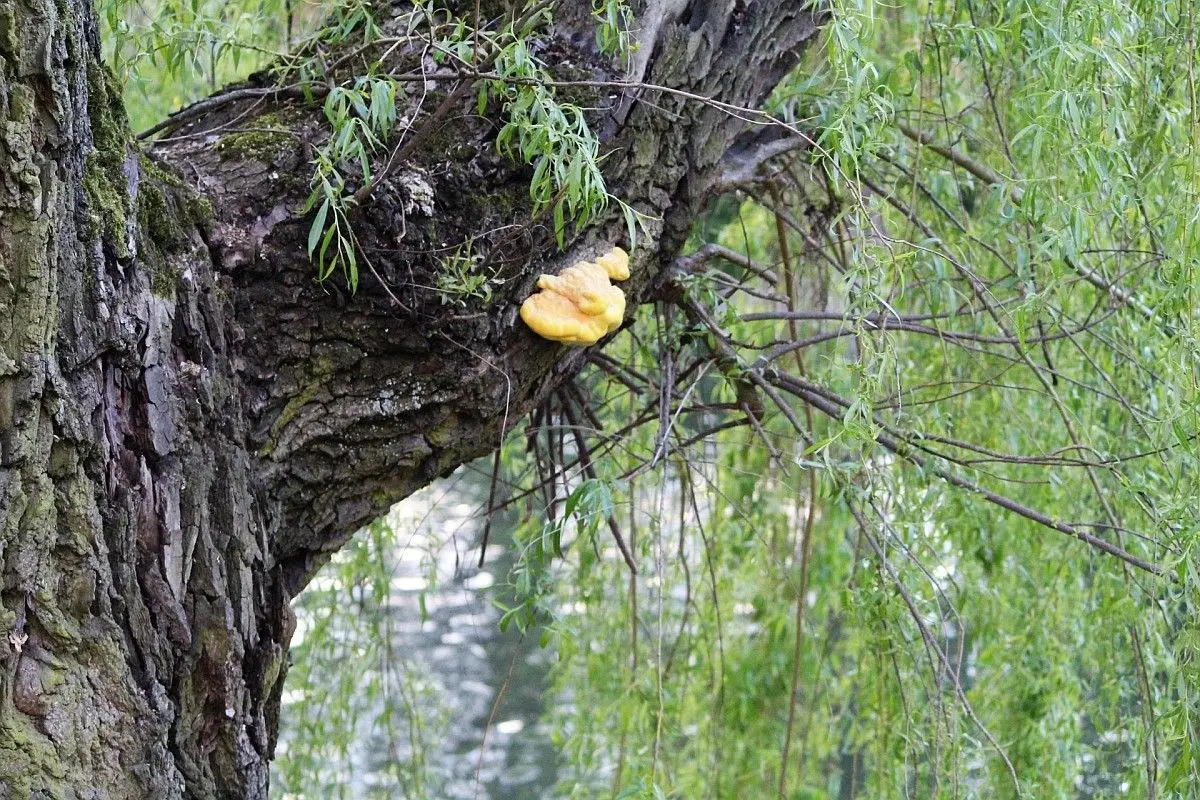
Although it poses a deadly threat to trees, causing a disease known as brown wood rot and eventually killing the tree, it is an edible and tasty mushroom for humans. However, before eating it, it must first be heat-treated (boiled for 15–20 minutes, then the water in which it was boiled must be discarded). Only then can you start preparing sulphur polypore. You can make a cutlet or tripe-style soup from the mushroom, or pickle it.

It should be emphasized, however, that only young specimens are suitable for eating—those that are soft to the touch and intensely colored (like the ones in the photographs). When the mushroom is older, it becomes paler, hard and stringy, which makes it unpalatable.
Where and when to look for sulphur polypores?
The mushrooms appear mainly on trunks, snags and logs of deciduous trees (e.g. oak and willow) in May and June. They can be found in parks (in city centers) and along busy roads. We do not recommend collecting sulphur polypores growing on yews and black locusts, as these trees are poisonous.
Sulphur polypores owe their name to their color and smell. The smell of sulfur is particularly noticeable when the mushroom is parboiled. The mushroom’s flesh resembles poultry meat, which is why it is called “chicken of the woods.”
When sulphur polypores are young, they have an intense yellow or orange color, and that is when they are best collected for consumption. Naturally, we also do not recommend collecting these mushrooms in places where they may be contaminated (e.g. along busy roads).