
Bulbous honey fungus can surprise you with where it appears. Instead of forest undergrowth, it sometimes chooses parks, gardens or squares. It can be found near old, mainly deciduous trees, on whose roots or the remains of branches buried in the ground its mycelium develops.
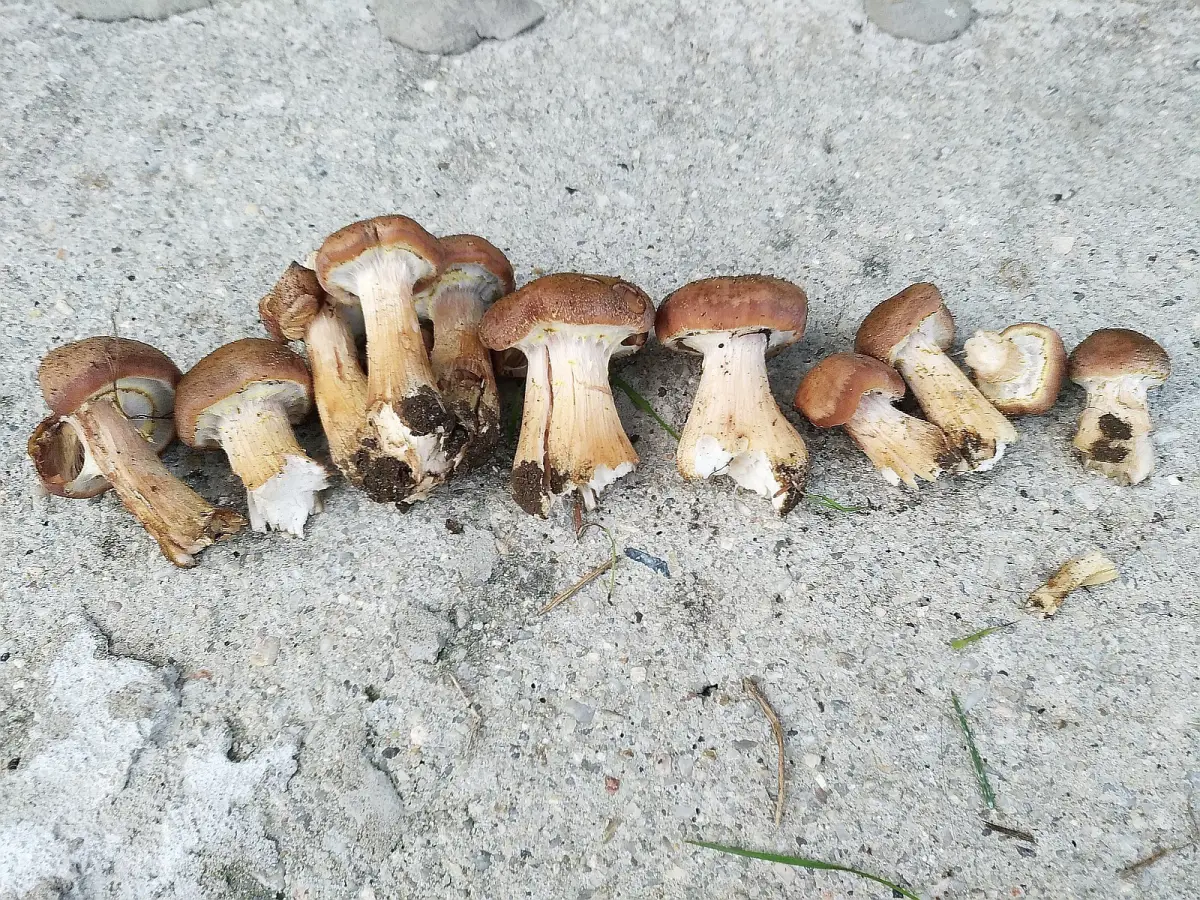
The mushroom does not appear in clusters as large as those of dark honey fungus or honey fungus. It most often grows in groups of a few specimens or singly. It has a distinctive cap in honey, yellow-brown or brownish shades.
Small scales may be visible on its surface. Light gills are found beneath the cap. The stem is also distinctive: its base is clearly swollen, resembling a bulb (hence the name bulbous honey fungus). There is a ring on the stem.
It is precisely its habitat that may surprise the finder. Honey fungus does not have to grow directly from a visible stump. Its fruiting bodies may appear above roots or fragments of wood located underground. That is why an entire “bouquet” of honey fungi clustered around one spot can sometimes be found in a park or garden.
Tasty, but not raw
Bulbous honey fungus is edible after proper preparation. Like other honey fungi, it is not suitable for eating raw. Before consumption, it should be thoroughly boiled for about 15–20 minutes, and the water should then be discarded. Only after this preparation can it be fried, stewed, marinated or used in other dishes.
After appropriate heat treatment, honey fungus is valued for its distinctive mushroom flavor. For mushroom lovers, it can be an interesting addition to autumn cuisine and, in culinary terms, is no inferior to other edible honey fungi.
What does honey fungus contain?
Like other edible mushrooms, honey fungus provides, among other things, protein, fiber and minerals, while being a relatively low-calorie food. It also contains bioactive compounds that laboratory studies associate, among other things, with antioxidant properties (helping protect cells from the effects of free radicals).
However, honey fungus should not be treated as medicine. Its potential biological properties are still being studied, and in the everyday diet it is primarily a valuable ingredient in dishes.
When it comes to mushrooms, correct species identification remains the most important thing. If we are not one hundred percent certain what we have found, we should neither collect nor eat such a mushroom.
It turns out, then, that you do not always have to travel outside the city to go mushroom picking. Sometimes it is enough to take a closer look at what is growing in a park, garden or urban square. An old root may be hidden underground, with an entire cluster of distinctive honey fungi growing above it.