
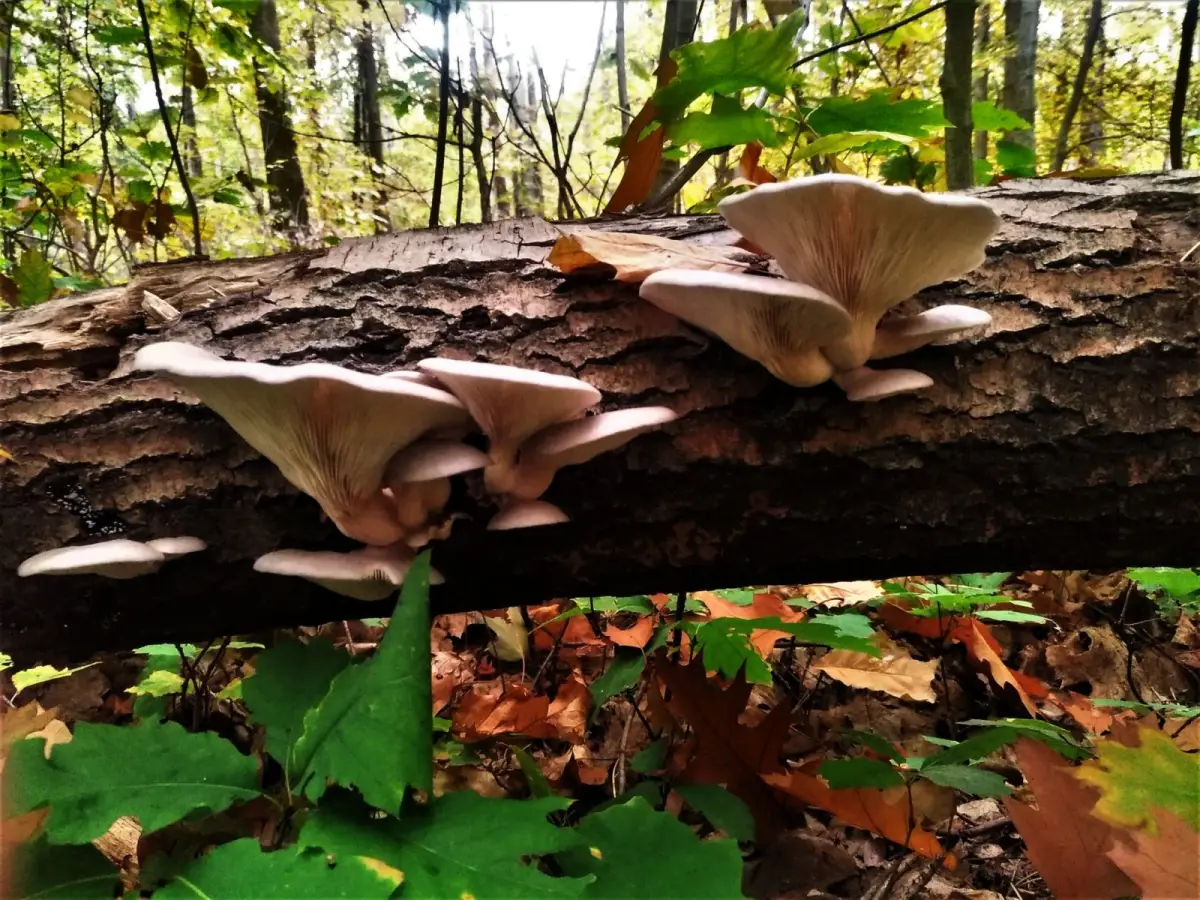
What edible mushrooms can be found in forests in late autumn and winter? For experienced mushroom pickers, the winter classics are: velvet shank, oyster mushroom and Judas's ear. All these species are wood-growing mushrooms and can be found in forests, parks and green areas around Bolesławiec. In addition to their taste, winter mushrooms also have health-promoting properties. This particularly applies to velvet shank and oyster mushrooms. In the photographs, we present specimens found in the forests near Bolesławiec. Beneath the short descriptions of the mushrooms are links to video materials in which you can see where to find these mushrooms and how to identify them.
As we read in Wikipedia:
Velvet shank grows from October to December, and during a mild winter even until March, on the branches and trunks of deciduous trees, almost always in clusters, most abundantly on poplars and willows. The mushroom is unaffected by frost and does not rot. It grows on dead trees, but also on living ones, even several metres above the ground. It grows in deciduous and mixed forests, as well as in parks and even gardens. (...) Velvet shank is a tasty mushroom, suitable for soups and pickling. It is particularly valuable because it fruits in winter. It is also cultivated. In Asian cuisine it is known as enoki. It does not grow during frosts, but continues growing after the frosts have passed.

Oyster mushroom is a wood-growing mushroom found on the dead wood of deciduous tree species such as hornbeam, beech, willow, poplar, black locust, birch and walnut. It usually grows in dense groups. These consist of many larger and smaller specimens, often fused into clusters resembling oyster beds, which is where the species gets its name. The fruiting bodies appear only in late autumn, from the end of October through winter, and when the winter is mild, also during winter. (...) Oyster mushroom fruiting bodies provide easily digestible protein, folic acid, amino acids, B vitamins and mineral salts; they have also been found to contain lovastatin, which lowers blood cholesterol levels.
Judas's ear grows on weakened or dead wood in forests, thickets, parks, gardens and along roads. It is most commonly found on black elder, but also on many other deciduous tree species, particularly maples and alders; it is only rarely found on conifers. It grows throughout the year, and during a mild winter it can even be found in late spring on stumps and trunks. During prolonged wet weather, it often forms entire clusters of fruiting bodies. (...) In Europe, it is rarely collected, while it is highly valued in Chinese and Japanese cuisine. It is an ingredient in many dishes. It is almost tasteless and is eaten for its cartilaginous texture. Judas's ear also has medicinal properties. It benefits the body by activating the immune system and also has anti-inflammatory, anticoagulant, antitumour, antibacterial and antiviral effects. It is a valuable addition to the winter diet.
