
The following are available at the e-Tax Office:
- certificates of the amount of revenue, income, tax due and insurance contributions reported in PIT (ZAS-DFU)
- certificates of the taxpayer’s income in personal income tax (ZAS-DF)
- certificates confirming that there are no tax arrears or stating the amount of arrears (ZAS-W).

Certificate issuance process
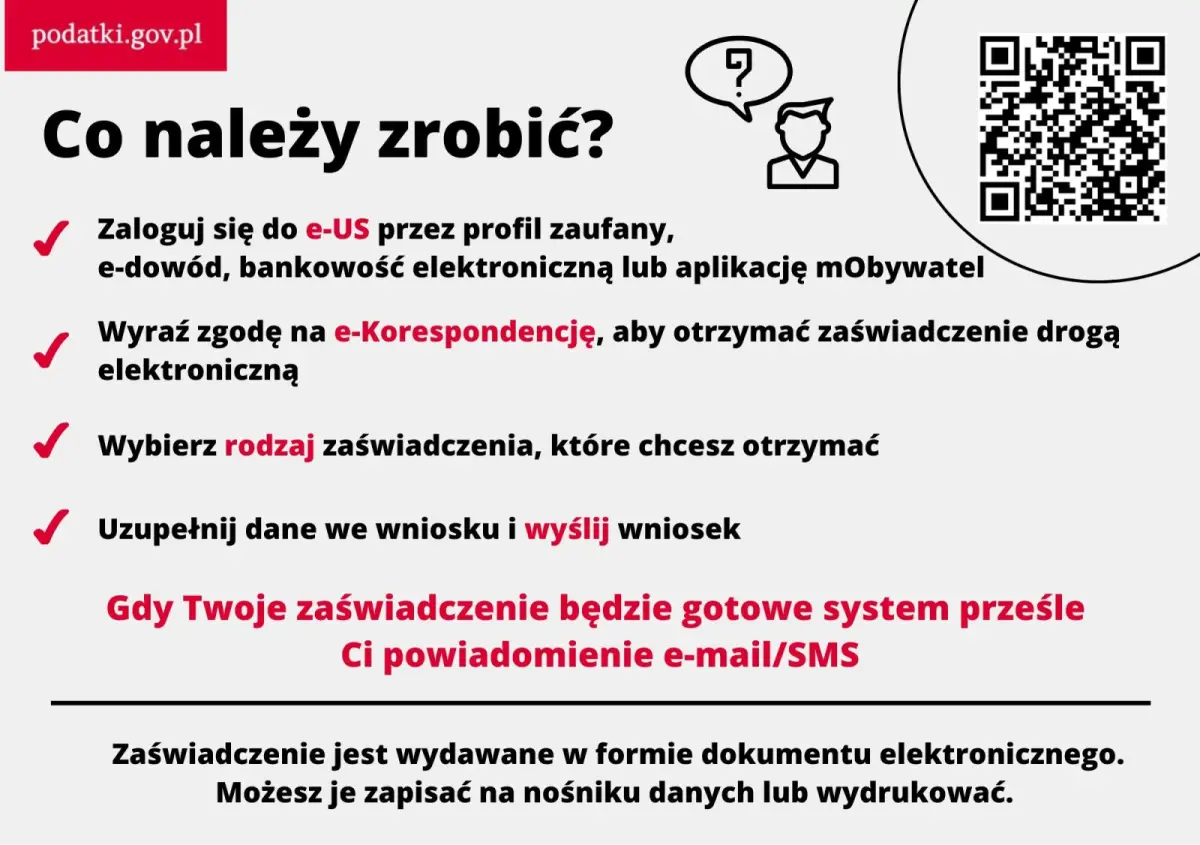
An application for a certificate can be submitted through the e-Tax Office. Consent is required for the certificate to be delivered electronically to the account in the e-Tax Office. People using the e-Tax Office do not incur the stamp duty for certificates issued to them.
Automatic issuance of a certificate takes place without the involvement of the tax office; the taxpayer can download it as an electronic document. The certificate is automatically stamped with the seal of the head of the National Revenue Administration.
If the certificate is issued manually by the tax office and delivered to the account in the e-Tax Office, it is signed with an electronic signature by an authorized person.
Certificate as an electronic document
A certificate issued through the e-Tax Office is an electronic document (file) that, in unchanged form, confirms and certifies information concerning the taxpayer’s tax settlements.
An electronic document issued through the e-Tax Office has the same legal force as a traditional paper document. Tools used to verify electronic signatures are used to authenticate such a document.
Only the electronic file delivered to the taxpayer through the e-Tax Office constitutes the document. A printout of such a certificate will not be treated as a document and will not additionally be signed by a tax office employee.
Certificates issued in electronic form and presented when handling various matters, for example at banks or universities, should be accepted.
Local government social assistance units, meanwhile, can automatically verify information about their clients’ income through an electronic data-exchange service made available to them by the National Revenue Administration.