
On Wednesday, 16 December, a conference was held in the council chamber of the Bolesławiec County Office, where the implementation status of the county educational project “SOS – Schools of Opportunity” was presented. The project aims to equalise the educational opportunities of students at four general secondary schools and a Special Lower Secondary School—schools run by Bolesławiec County. The entire project was to last for two school years (from September 2009 to July 2011). During this time, more than 900 students would take part in approximately 10,000 hours of remedial and supplementary classes. The total value of the project amounts to PLN 2,082,925.62 and, most importantly, the entire sum was obtained by the county from European Union funds.
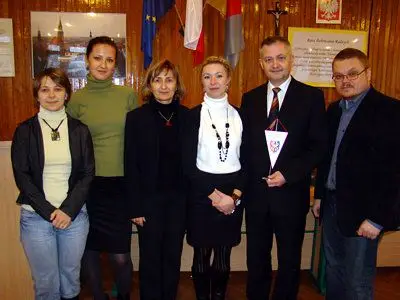
Among the meeting’s participants were several dozen teachers who conduct classes at their schools on a daily basis, as well as members of the so-called project team. It consists of six county office employees, including the project coordinator (Alicja Krzyszczak), two people responsible for finances (Monika Weselak and Dagmara Jaworska), a lawyer and public procurement specialist (Radosław Palczewski), the project secretary (Emilia Zarzycka), and the IT specialist (Leszek Jędrzejczyk), as well as four leaders supervising the teachers’ work at the schools: Cezary Czernatowicz at I LO, Beata Sulska at II LO, Laura Słocka-Przydróżna at III LO, and Jolanta Baniecka at IV LO. The work of the teachers conducting classes at the special lower secondary school is overseen by the director of the special school, Zdzisława Woźniak. The conference was also attended, among others, by county representatives—County Head Cezary Przybylski and Deputy County Head Stanisław Chwojnicki—as well as county councillors: County Council Chair Karol Stasik, Deputy Chair Jarosław Molenda, and Józef Król and Jan Stasiak.
The project continues—and helps
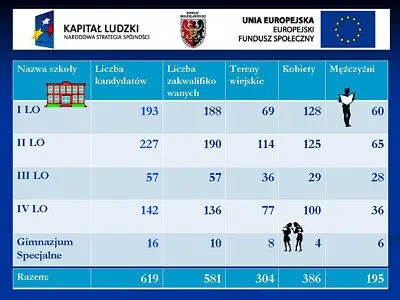
Classes have been conducted for more than two months by 70 teachers from county schools. In October and November alone, 1,298 (!) hours of various classes in 12 subjects covered by the matura examination were held. A total of 581 students took part, including 296 living in rural areas. During this time, 121 hours of psychological and educational support were also provided to 81 students. It is worth adding that students of the special lower secondary school at the County Complex of Special Schools and Institutions in Bolesławiec—in addition to remedial classes—also take part in recreational activities at the municipal swimming pool, which traditionally enjoy great popularity.
What do the beneficiaries think about the project?
The main topic of the conference was an analysis of the evaluation survey conducted among class participants. “The project is ongoing, and we are pleased that recruitment went smoothly, but what do the students themselves think about the classes? Does the programme suit them? How do they assess their quality? Are they satisfied with the teachers conducting them? How has the project’s implementation affected the issue of taking private, and therefore paid, tutoring?” asked Dariusz Kwaśniewski, a member of the county board, who led this part of the conference.
He answered these questions with satisfaction, presenting the results of the anonymous survey—results proving that the project’s most important objectives are being achieved.
Here are the most important information and conclusions:
- Among the students currently attending the classes, 70% are third-year students and 30% are second-year students.
- 38% of the students live in Bolesławiec, 5% in Nowogrodziec, 3% in another town (outside the county), and 54% in rural localities, including 6% outside our county.
- Before the project began, 29% of the students took private paid tutoring in one subject, 13% in two or more subjects, while as many as 58% did not take tutoring.
- As a result of participating in the project classes, 10% of the students stopped attending paid tutoring, 9% attend fewer such classes, while 25% attend both private tutoring and “eSOeS” classes.
- Attention: 93% of respondents said they were satisfied with the project classes!
- When assessing how the classes were conducted, 57% of the students gave them a very good rating, 34% a good rating, while only 2% of respondents rated the classes “1” or “2”.
- When asked how the additional classes help them prepare to pass the matura examination more successfully, a total of 92% of students answered “very well” or “well” (54% + 38%).
The surveyed students also stated that:
“The project helped them understand and learn things they had struggled with”—48% of responses; “They would like to participate in more classes”—11% (they may attend classes in a maximum of three subjects); “The number of class hours in the subjects they chose is appropriate (sufficient)”—27%; “There should be more hours in a given subject”—11%. It is good news that only 1% of students said they “would like the classes they attend to be taught by a different teacher.”
(information: County Office / ii)