
From January 2021, travellers arriving in Poland from the United Kingdom are subject to the same rules as travellers from third countries, that is, countries that are not members of the European Union (EU).
The changes to the rules on bringing in goods and transporting animals do not apply to travellers from Northern Ireland, as, in this respect, it will be treated as an EU Member State.
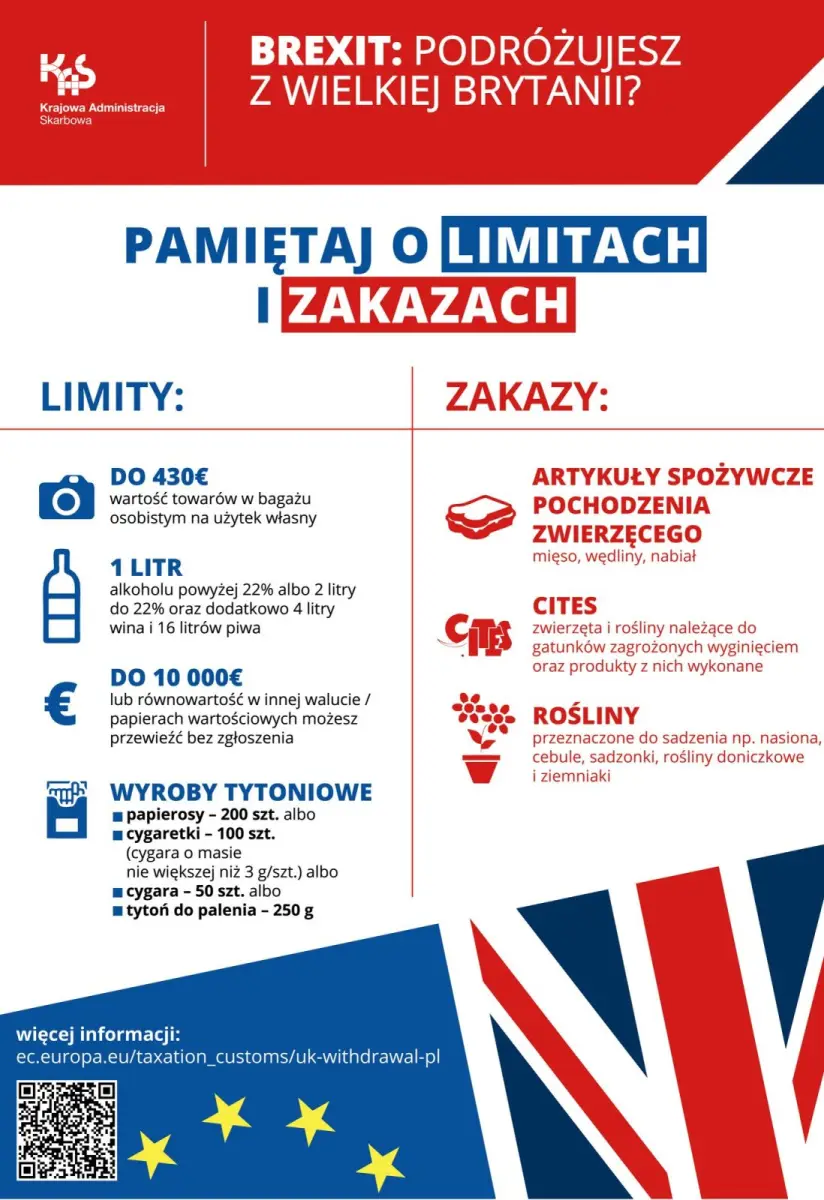
Goods in the personal luggage of travellers arriving in Poland from third countries are exempt from customs and tax duties up to the following values:
- by air or sea – up to the equivalent of EUR 430,
- by transport other than air or sea (road or rail) – up to the equivalent of EUR 300.
The following are not included in these values:
- personal luggage imported temporarily or imported after its temporary export
- medicinal products necessary for the traveller’s needs
- in the case of motor vehicles – the value of fuel in the standard tank and fuel in a portable container, not exceeding 10 litres (this fuel also constitutes the traveller’s luggage)
- tobacco and tobacco products, as well as alcoholic beverages, brought in by travellers aged 17 or over.
Duty-free limits for excise goods
The following are exempt from customs and tax duties:
- Tobacco and tobacco products, if brought in by air or sea, in the following quantities:
- cigarettes – 200 units or
- cigarillos (cigars weighing no more than 3 g each) – 100 units, or
- cigars – 50 units, or
- smoking tobacco – 250 grams.
- Tobacco and tobacco products, if brought in by road or rail, in the following quantities:
- cigarettes – 40 units or
- cigarillos (cigars weighing no more than 3 g each) – 20 units, or
- cigars – 10 units, or
- smoking tobacco – 50 grams.
The exemption under these limits may be applied to any combination of tobacco products, provided that the sum of the percentages used from the individual exemptions does not exceed 100%.
- Alcohol and alcoholic beverages:
- ethyl alcohol with an alcoholic strength by volume exceeding 22% (e.g. vodka) – 1 litre, or
- ethyl alcohol and fermented beverages, sparkling wines and intermediate products with an alcoholic strength by volume not exceeding 22% (e.g. liqueurs) – 2 litres in total, and
- still wines – 4 litres in total, and
- beer – 16 litres.
The exemption under these limits may be applied to any combination of the different types of alcohol and alcoholic beverages listed in points a) and b), provided that the sum of the percentages used from the individual exemptions does not exceed 100%.
- E-liquid for electronic cigarettes
- 50 millilitres – for travellers by air or sea
- 10 millilitres – for travellers using transport other than air or sea.
- Novel tobacco products
- 0.04 kilograms – for travellers by air or sea
- 0.008 kilograms – for travellers using transport other than air or sea.
The exemption under these limits may be applied to any combination of the e-liquid for electronic cigarettes referred to in point a) and the novel tobacco products referred to in point a), provided that the sum of the percentages used from the individual exemptions does not exceed 100%.
The exemption under these limits may be applied to any combination of the e-liquid for electronic cigarettes referred to in point b) and the novel tobacco products referred to in point b), provided that the sum of the percentages used from the individual exemptions does not exceed 100%.
Movement of pet animals
People travelling with animals should pay attention to the rules on moving pet animals from the United Kingdom to the EU, which will come into force after the end of the transition period (from 1 January 2021).
For non-commercial movement, the following will be required:
- proper identification of the animal
- a valid rabies vaccination
- a health certificate each time the animal enters the EU (a passport issued in the United Kingdom will no longer be a document permitting entry into the EU).
In addition, pets brought into the EU will have to be presented for inspection at a designated travellers’ point of entry.
For the movement of pet animals brought from the EU to the United Kingdom, it is required that they:
- are properly identified
- have a valid rabies vaccination
- have an EU passport.
Products of animal origin in travellers’ luggage
Meat, milk or products containing them may not be brought from the United Kingdom into the EU. The United Kingdom will be treated as a third country with regard to procedures for bringing food in travellers’ luggage.
Plants and plant products
EU law prohibits the introduction from the United Kingdom into the EU of certain plants, plant products and other objects because of the associated phytosanitary risks. Under EU plant health regulations, people travelling to the EU may not bring any plants or plant materials from the United Kingdom unless they are accompanied by an official certificate issued by the plant health authority in their country of origin. The only exceptions to this rule are bananas, coconuts, dates, pineapples and durians, as these fruits pose no risk.
Antiquities and cultural goods
People exporting works of art from Poland are required to obtain permission from the minister responsible for culture and national heritage protection for monuments meeting the relevant criteria of category, age and value.
From 28 December 2020, the introduction into the EU of certain cultural goods is prohibited if they were illegally removed from the territory of the country in which they were created or discovered.
CITES – specimens of endangered species
The import into and export from the EU of specimens of endangered species may take place only on the basis of appropriate CITES documentation, which must be presented for a border inspection conducted by a customs authority. CITES specimens include live animals and plants, as well as products made from them or derivatives contained, for example, in cosmetics. The illegal import of CITES specimens across the EU border in Poland is a crime punishable by imprisonment from 3 months to 5 years.
More information on the rules for moving pets, plants and plant products, products of animal origin, CITES specimens and cultural goods can be found in the European Commission document: “Notice on travelling between the EU and the United Kingdom after the end of the transition period” (PDF file; 904 KB).
Exporting goods in personal luggage under the TAX FREE procedure, purchased within the European Union
From 1 January 2021, travellers who purchased goods within the EU under the TAX FREE procedure and have their permanent residence in the United Kingdom will be treated as citizens of third countries. Consequently, they will be entitled to a refund of the tax paid when purchasing goods within the EU, provided that the goods are exported outside the EU in an unchanged condition in their personal luggage.
To apply for a refund of tax paid when purchasing goods within the EU, travellers will be required to have confirmation of the export of the goods in the form specified by the legislation of the Member State from whose territory the goods were actually exported.
Travellers with permanent residence in Northern Ireland, which under the provisions of the Protocol on Ireland and Northern Ireland will be treated as an EU Member State, will not be able to use the TAX FREE procedure.
Detailed information on the rules for using the TAX FREE procedure in Poland is available on the granica.gov.pl website.