
In the 1990s, the guns belonging to soldiers of the 7th Guards Tank Corps and the 31st Infantry Division of the 1st Ukrainian Front, located on II Armii Wojska Polskiego Street (commonly called “Kutuzov Cemetery” by the people of Bolesławiec), became targets for scrap-metal collectors. Fortunately, thanks to the efforts of the police and Bolesławiec residents, the guns were saved and placed on land belonging to a company involved in maintaining greenery. In 2013, the guns were transferred to the collection of the Bolesławiec museum. Although they require conservation, they are already attracting considerable interest among residents and tourists.
A Soviet gun with German origins
Guns of this type are very rarely displayed in museums. The examples on display are 1943-pattern 76 mm regimental guns (Object 25). The Russian designation for this model is: 76-мм полковая пушка «ОБ-25» 1943 . Such guns were designed at Factory No. 172 in Leningrad. In fact, this can be described as the continuous modification of an existing 1942-pattern gun (M-42) with a calibre of 45 mm.
An interesting fact is that this design was derived directly from the German PAK 36 gun, produced from the late 1920s and sent to the USSR under a trade agreement in exchange for raw materials: rolled steel, non-ferrous scrap and rubber.
Thus, we are dealing with a Russian gun whose original design was produced by the German Rheinmetall factory. The gun carriage and armour plates remained common to both versions. However, various modifications were made to other components of the gun; for example, the first models used spoked wheels, while the German examples had rims made of light metal alloys.
The “farewell, motherland” gun
The 1943-pattern regimental guns were used by the gun batteries of infantry and cavalry regiments. The gun had a bad reputation, and soldiers called it “farewell, motherland”. The German PAK 36 equivalent was nicknamed the “door knocker”.
The main problem with the 1943-pattern gun was its insufficient firepower. To remedy this, a new shaped-charge projectile was introduced, which, at a sufficiently short distance, could penetrate the armour plate of a medium tank. The Germans initially used over-calibre projectiles, resembling mortar shells in appearance. However, German designers were also forced to develop a gun with an increased calibre of 75 mm (Infantriegeschütz 37), whose projectiles could penetrate 90 mm of armour from a distance of 500 metres.
Guns of this type performed well in urban combat; their low weight and large calibre allowed them to effectively destroy machine-gun nests, barricades and lighter tanks. The relatively low weight (approximately 600 kg) and the gun’s size made it possible to fire, for example, from an upper floor of a building, which could effectively surprise the enemy.
The final modification of the 1943-pattern gun introduced into service was the lengthening of its barrel, which increased the projectile’s muzzle velocity and consequently its penetration capabilities. This design change was borrowed from the 1927-pattern Russian regimental gun. The final version of the gun, produced until 1945, was called the M3-2.

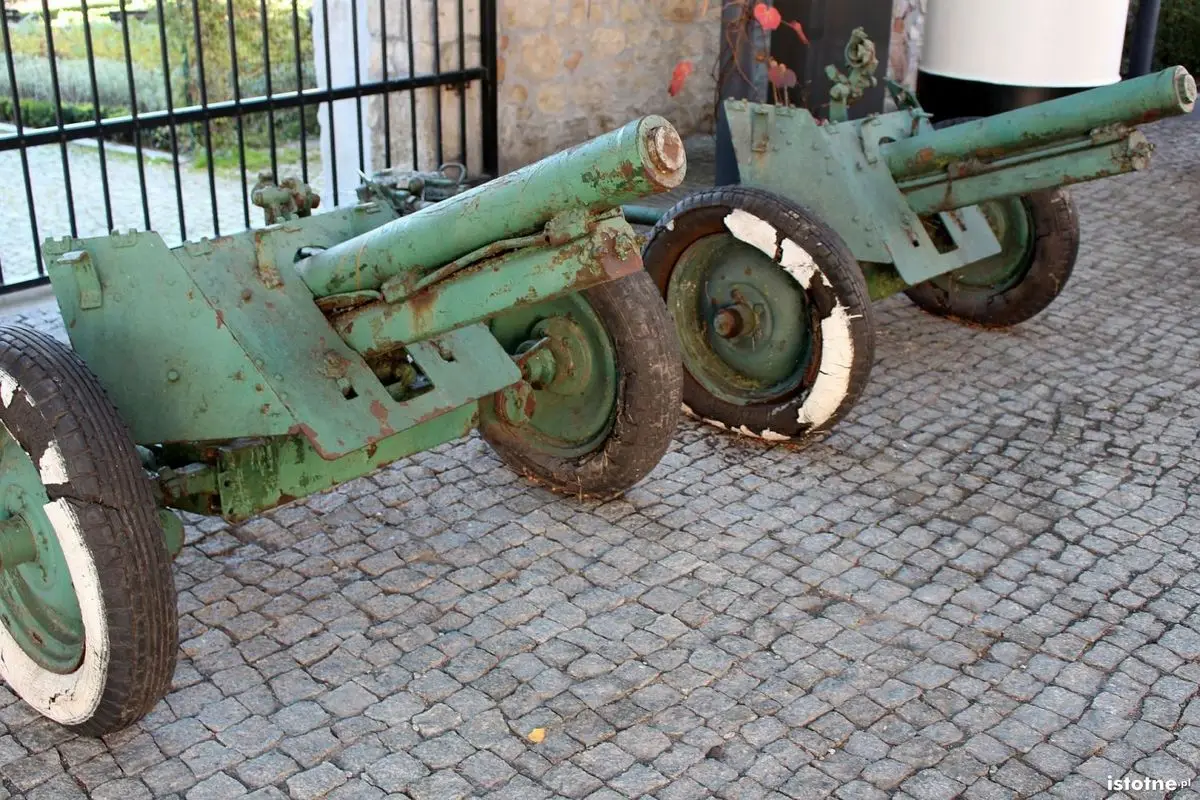


Weapons of this type were designed from the outset so that they could be moved, together with their ammunition limber, by four horses or one motor vehicle. Instead of air, the wheels were filled with an elastic material resistant to penetration by bullets or shrapnel, so that towing could take place without the need to replace the wheels.
One of the guns standing in the museum courtyard bears traces of shelling. A fragmentation projectile damaged the recoil mechanism housing and the sights, causing the example to be withdrawn from the battlefield. In the 1950s, the guns were placed beside a cemetery obelisk in Bolesławiec. In Lower Silesia, a similar fate befell worn-out T-34 tanks, which were widely erected as monuments glorifying the liberating Russian army. An interesting example is the group of tanks located beside the Soviet army cemetery in Wrocław.
Author: Museum of Ceramics / “Objects and Anecdotes” series