
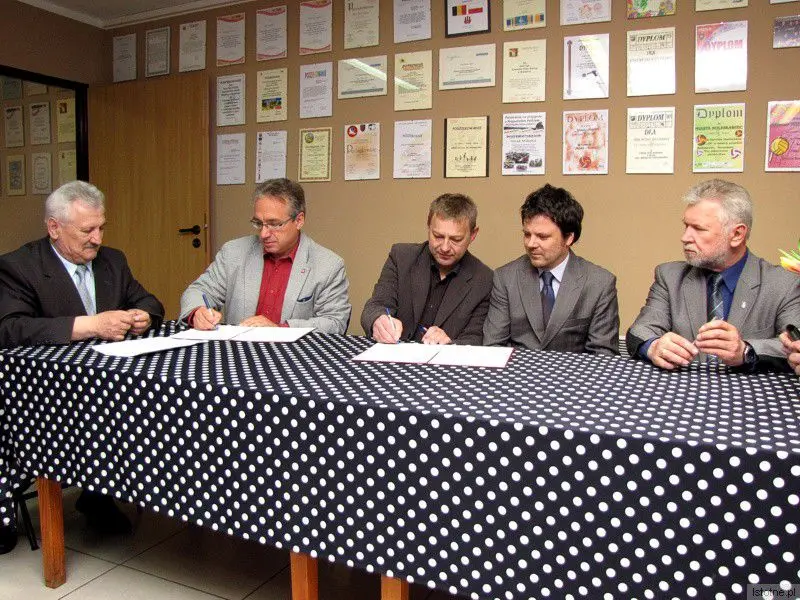
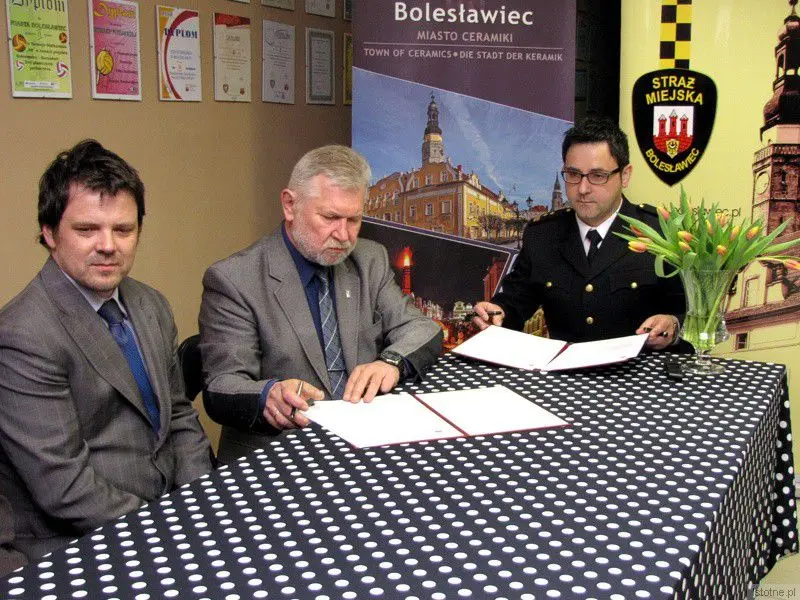
A new municipal video surveillance system has been put into operation in Bolesławiec. The investment cost PLN 1.4 million; the city received funding amounting to 69.99% of this sum, or approximately PLN 1 million. On April 17, the acceptance protocol was signed at the Municipal Police headquarters.
The ceremony was attended, among others, by Bolesławiec mayor Piotr Roman, secretary Jerzy Zieliński, City Council chairman Józef Pokładek, head of the Forum councillors’ group Jarosław Kowalski, head of the Public Procurement and Municipal Investments Department Andrzej Kuriata, head of the Civil Affairs Department Krystyna Hodowana, representative of the Gliwice-based company Specialised Projects Polska Przemysław Pierzchała and commander of the Bolesławiec Municipal Police Emil Zając.


As part of the investment, 16 existing camera points were modernized and the system was expanded with 15 additional points, bringing the total to 31. A mobile surveillance unit was also purchased—a vehicle equipped with a camera that can be sent anywhere in the city. This solution will help ensure safety during the organization of various mass events held regularly in Bolesławiec.
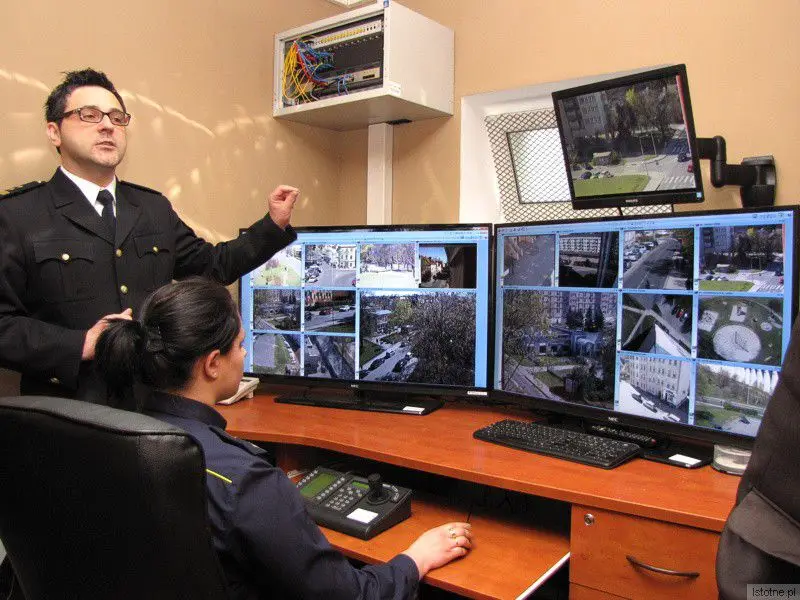
The work also included modernization of the Main Monitoring Center in the Municipal Police building at 14 Mikołaja Brody Street in Bolesławiec, including the creation of a center for image management and archiving. An important element of the system was the construction of a modern radio data-transmission network. The new cameras cover a substantial part of the city, including Bankowa Street, Bielska Street, the Millennium Cross, Dolne Młyny, Gdańska Street, and the intersection of Jeleniogórska, Podgórna and Garncarska streets. Images are transmitted exclusively from public spaces. The locations of the cameras were agreed in detail with the police, councillors and municipal police officers.
“Ensuring safety is a responsibility of local governments, and this system is a very good tool for providing that safety to Bolesławiec residents,” emphasizes Przemysław Pierzchała. “Now we will be even more effective in ensuring that laws and public order are not violated in our city,” says commander Emil Zając. “And if that happens, we will respond more effectively.”
“The preventive role of surveillance should be remembered,” Emil Zając continues. “In places where the first cameras appeared, the number of prohibited acts fell radically. The difference between that system and the current one is like the difference between an analog record and a compact disc. The possibilities for working with images are incomparably better. Previously, we could only watch what had been recorded; now we can enlarge and zoom in on the image and use it analytically.”


“The surveillance system we introduced in 2003 was among the most modern in Poland, but it became worn out,” says mayor Piotr Roman. He explains that the expansion of surveillance in the city was influenced by a visit to Nogent-sur-Marne in France (every year, at the invitation of the mayor, residents of Bolesławiec take part in the Nogent Baltard event, a 10-kilometer race). There, the mayor and commander had an opportunity to visit the municipal police’s new surveillance center. “The change that has taken place in Bolesławiec in this respect can be compared to moving from the era of radio into the age of television,” Piotr Roman adds.

The project was co-financed by the European Union under the Regional Operational Programme for the Lower Silesian Voivodeship for 2007–2013, No. RPDS.06.05.00-02-025/12, entitled Monitoring of Tourist Areas of the City of Bolesławiec, Priority 6, “Use and promotion of the tourism and cultural potential of Lower Silesia (tourism and culture),” Measure 6.5, “Actions supporting tourism and cultural infrastructure.”
The contractor was Specialised Projects Polska sp. z o.o. of Gliwice.
(information: Bolesławiec Municipal Office/ii)