
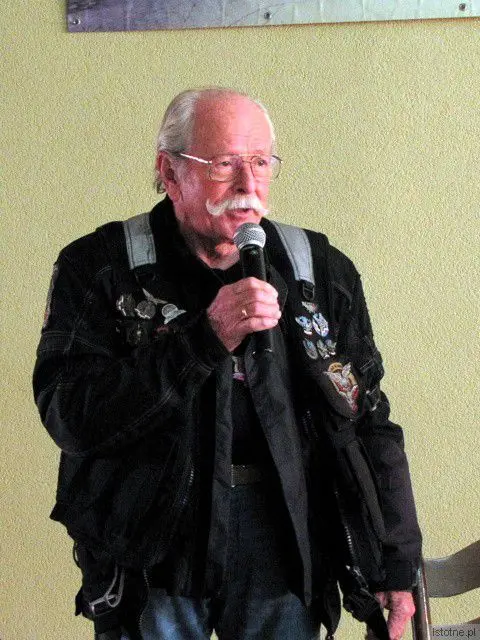
The meeting with Bogumił Kubiak, a motorcyclist and the son of a uhlan who fought in World War I, and with Michał Szeliga, the organizer of the motorcycle rally held as part of the “Save your great-grandfather’s grave from oblivion” campaign, took place on Tuesday, November 19, at the Janusz Korczak II General Secondary School in Bolesławiec.
Both motorcyclists have participated in the Katyn Rally for years. “It is a wonderful initiative,” Michał Szeliga said during the meeting. “Every year, one hundred motorcyclists set off along the trails of the eastern borderlands, Polish history and Poles scattered across six countries. Everyone takes part: from teachers and students, through lawyers and doctors, to Boeing pilots.”

The idea for the rally was born twelve years ago. “Wiktor Węgrzyn came to Poland, noticed that Poles’ historical awareness was very limited, and decided that he would organize such a rally together with his brother, who had miraculously survived Katyn,” Michał Szeliga explained.
He added that before he took part in the Katyn Rally for the first time, his parents had encouraged him to spend his holidays abroad. They suggested Egypt, among other destinations. “But I wanted my holiday trip to be a challenge,” the motorcyclist recalled. “I went to the eastern borderlands, even though I did not know anyone there at the time. I had many stereotypes in my head. I thought they would kill me. I was very wrong. For example, many Poles live in Vilnius, and in Smolensk there is a Polish House where my peers study Polish.”
“Thanks to these rallies, I learned about many historical events that are not discussed at school,” emphasized Bogumił Kubiak, who bought his motorcycle in 2005 and has travelled... 57,000 kilometres on it since then.


Bogumił Kubiak and Michał Szeliga visited the “second school” at the initiative of Barbara Sykulska, a history teacher and coordinator of the “Save your great-grandfather’s grave from oblivion” campaign, which aims to preserve Polish cemeteries in the eastern borderlands. Barbara Sykulska, II LO student Aleksandra Siembida and a group of volunteers from the Complex of General and Vocational Schools in Bolesławiec, led by teacher Barbara Smoleńska, cleaned up a cemetery in Sieniawa near Zbarazh.
The campaign participants also visited many places connected with Polish history, including Zbarazh, Kremenets, where one of Poland’s national bards, Juliusz Słowacki, was born, and Vyshnivets, where the magnate Wiśniowiecki family had its residence. “I am interested in history,” Aleksandra said. “I stayed with a Ukrainian family that welcomed me very warmly and kindly. I became friends with the daughters of the couple who hosted me. This year they will come to Poland.”
Both II LO volunteers emphasized that the spirit of Polishness can still be felt in the eastern borderlands. “Older people would stop us and ask us to speak Polish with them,” the secondary-school student recalled. “It is very moving. The people of Ukraine learn from us how to care for their own history,” Barbara Sykulska added. “We encourage all Poles to visit the eastern borderlands.”


More about the holiday trip taken by volunteers from Bolesławiec can be found in the feature Active holidays with ZSOiZ.
(information: ii)