
Many building managers in Poland decided to eliminate old, often dangerous gas water heaters and installed central domestic hot water systems in their buildings.
Concerned about customer comfort and safety, managers use heat from the network. This is what estate managers decided in Łódź (in 2006), Tarnów (in 2007), where 10,000 residents use district heating, and Szczecin (in 2008).
The system is very safe and requires no additional activities, such as inspections, repairs or maintenance of chimney flues. Uninterrupted supplies are guaranteed by the year-round, continuous operation of the heat source, supervised by the round-the-clock District Heating Emergency Service.
The water-heating process takes place away from apartments, while heaters disappear from bathrooms, along with the risk of carbon monoxide poisoning, explosions or electric shock.
What is heat from the network?
District heating, in other words heat from the municipal heating network, is hot water flowing through the installations, available at any time of day or night, in the required quantity and at a constant temperature.
Homes most often have two separate water-heating systems. Domestic hot water flowing from taps is usually heated with electricity or gas (water heaters). Water for central heating, in radiators, is supplied from the municipal heating network. In this way, three bills are paid: for water, gas or electricity, and heating the home.
The best solution would be to simplify this system and use only district heating. In this way, one supplier would heat the water in radiators as well as the water flowing from taps. Hot tap water (mains water heated to the required domestic temperature in a heat substation) would have the same temperature as water heated by a gas or electric boiler installed in the home.
Lower hot-water bills
Water-heating prices are more stable and competitive. This is influenced by the cost of coal used to produce the heat. Coal prices are more stable compared with increases in liquid-fuel and electricity prices.
Starting a service for heating water with district heating eliminates the need to finance servicing and periodic inspections of gas installations and chimney flues (smoke, exhaust and ventilation flues).
District heat used for domestic hot water is billed according to actual consumption. Data from district-heating companies indicate that the average monthly cost of heating and hot water in a typical apartment (Central Statistical Office, 2009 – a three-person family in an apartment of approximately 60 m²) is about PLN 120 (PLN 2 per m²), or PLN 40 per person.
A safer and more durable solution
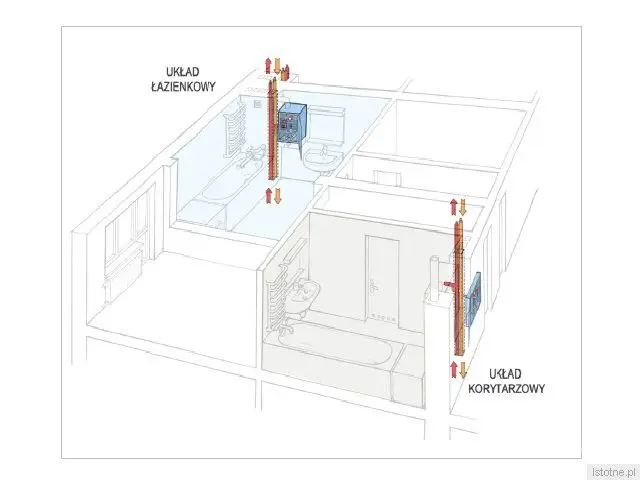
The standard scope of work involved in installing an internal hot-water distribution system in a building will mainly include work in the basements of a residential block:
- expanding the heat substation with a domestic hot water module
- bringing a cold-water installation of the required diameter to the substation room
- distributing hot-water and circulation installations to the individual risers
- and one-day work (from 4 to 8 hours) in the apartment (in installation ducts and unused flue ducts)
- constructing a hot-water and circulation installation riser
- dismantling the gas water heater and the gas installation connected to it
- connecting the existing installation to the newly constructed riser
- installing a hot-water meter in an accessible location
The duration of installation work in an apartment depends primarily on the good organization of the contractor selected through the tender. A contractor that has already completed work in several tens of thousands of apartments estimates this time at 4 to 8 hours. Once the installers leave the apartment, hot water is available in full.
Installation free of charge for the first three buildings
To encourage residents to use the offer and see for themselves that “it is not as frightening as it is made out to be,” the Management Board of ZEC decided to carry out the investment at its own expense, with no contribution from residents. The promotional offer covers only three buildings located on Gałczyńskiego, Jana Pawła II and Staroszkolna streets. The offers are valid until the end of 2014.
Zakład Energetyki Cieplnej will also co-finance investments in other estates. The co-financing will amount to 35% of the investment costs, but no more than PLN 567 gross (PLN 525 + 8% VAT) per apartment.
The investment will involve installing a complete internal hot-water distribution system in the building and supplying it to every apartment.
(commissioned information from ZEC)