
Update
The councillors adopted this resolution unanimously: 15 voted in favour.
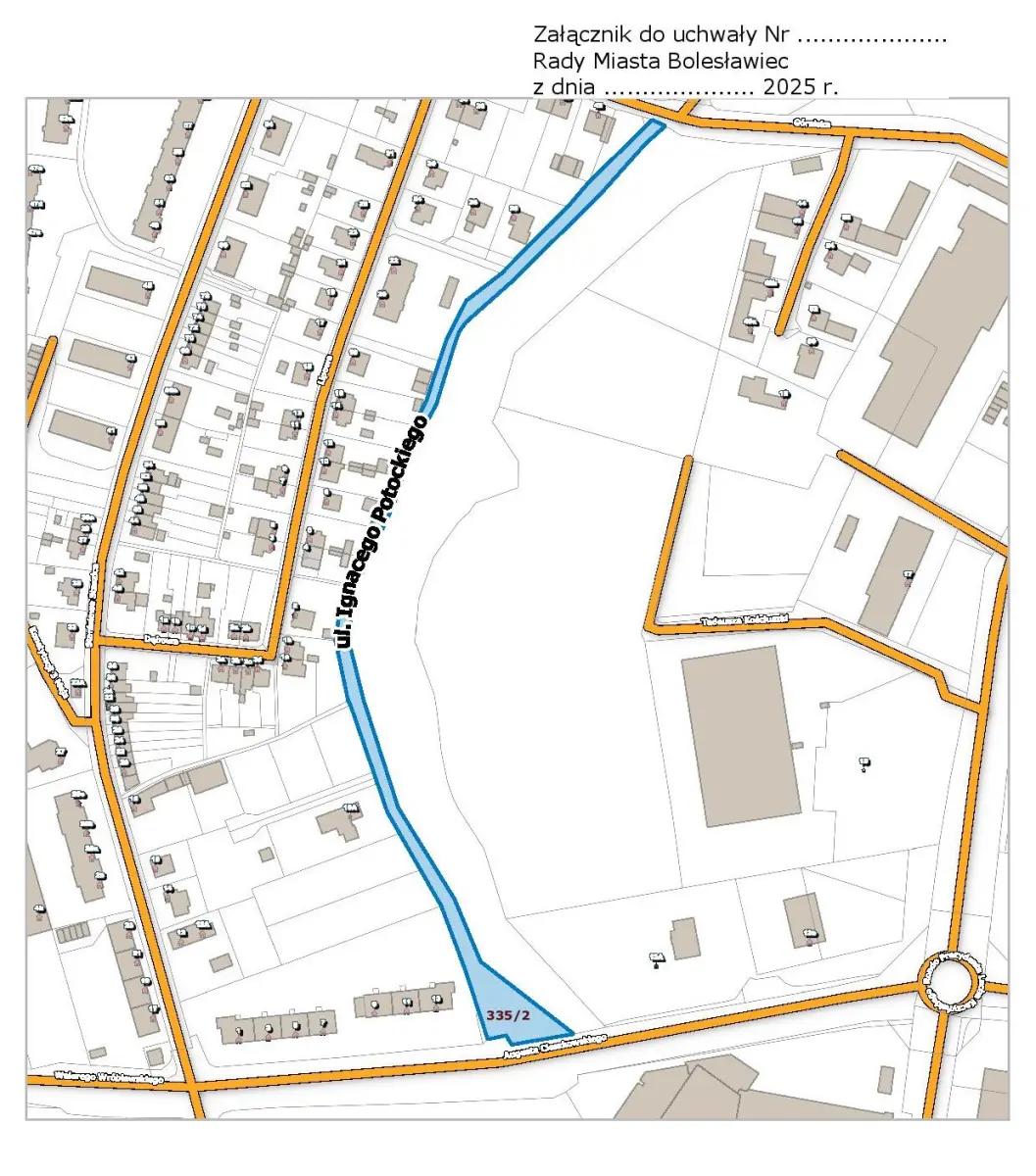
During the June session of the Bolesławiec City Council, councillors will consider, among other things, a draft resolution on naming an internal road. The justification reads:
(…) Factual justification: Establishing a new name for the street covered by this resolution is connected with the need to ensure correct and clear sequential numbering of the properties intended for development located in its vicinity, in accordance with the rules set out in the Regulation of the Minister of Development, Labour and Technology of 21 July 2021 on the register of localities, streets and addresses (Journal of Laws of 2021, item 1368). In addition, naming the road will make it easier to identify it in the field. In view of the above, it is justified to submit the draft resolution to the Bolesławiec City Council for a decision.
If the councillors adopt this resolution, the road will be named Ignacego Potockiego. The remainder of the justification states:
The newly created “Ignacego Potockiego” street is located in the northern part of Bolesławiec. The area includes a street commemorating one of the most important dates in Polish history—the adoption of the Constitution of 3 May—as well as streets named after leading reformers and scholars of the Polish Enlightenment and the era of the Four-Year Sejm, namely Hugo Kołłątaj, Stanisław Staszic, Tadeusz Kościuszko and Franciszek Salezy Jezierski.
Where?
More about Ignacy Potocki
Ignacy Potocki (1750–1809) was a Polish politician and patriotic activist, journalist, playwright, poet, educator, historian and translator. He was one of the most important Polish political activists, playing a key role in the history of the Polish–Lithuanian Commonwealth, as well as a member of the confederation of the Four-Year Sejm and one of the principal authors of the Constitution of 3 May, together with Hugo Kołłątaj and King Stanisław August Poniatowski. As a member of the Commission of National Education—the first ministry of education in Europe—Ignacy Potocki supported the development of a modern education system. In 1778, he was awarded the Order of the White Eagle. Among other positions, he served as marshal of the Permanent Council (1778–1780), and later was its member until 1784. He was one of the founders of the Assembly of Friends of the Government Constitution, also known as the Friends of the Constitution Club, considered the first modern Polish political party. Ignacy Potocki supported literary and scientific work, promoted the development of the Polish language, and wrote numerous political and journalistic treatises in which he advocated the need for systemic reforms. Some of his writings were published in print. Ignacy Potocki wrote occasional poems, including works recording family experiences and impressions from his travels. He translated Horace. He left behind scholarly texts, including the work of uncertain authorship “Memoir on Establishing Order in the Study of Civil Law and Founding an Assembly of Legal Men” (1772), as well as writings connected with the reform of education and government, especially “Thoughts on the Education and Instruction to Be Established in Poland” (1774) and “Principles for Improving the Forms of Government” (1789). In 1793, he published the political pamphlet “On the Establishment and Fall of the Polish Constitution of 3 May” (1791).