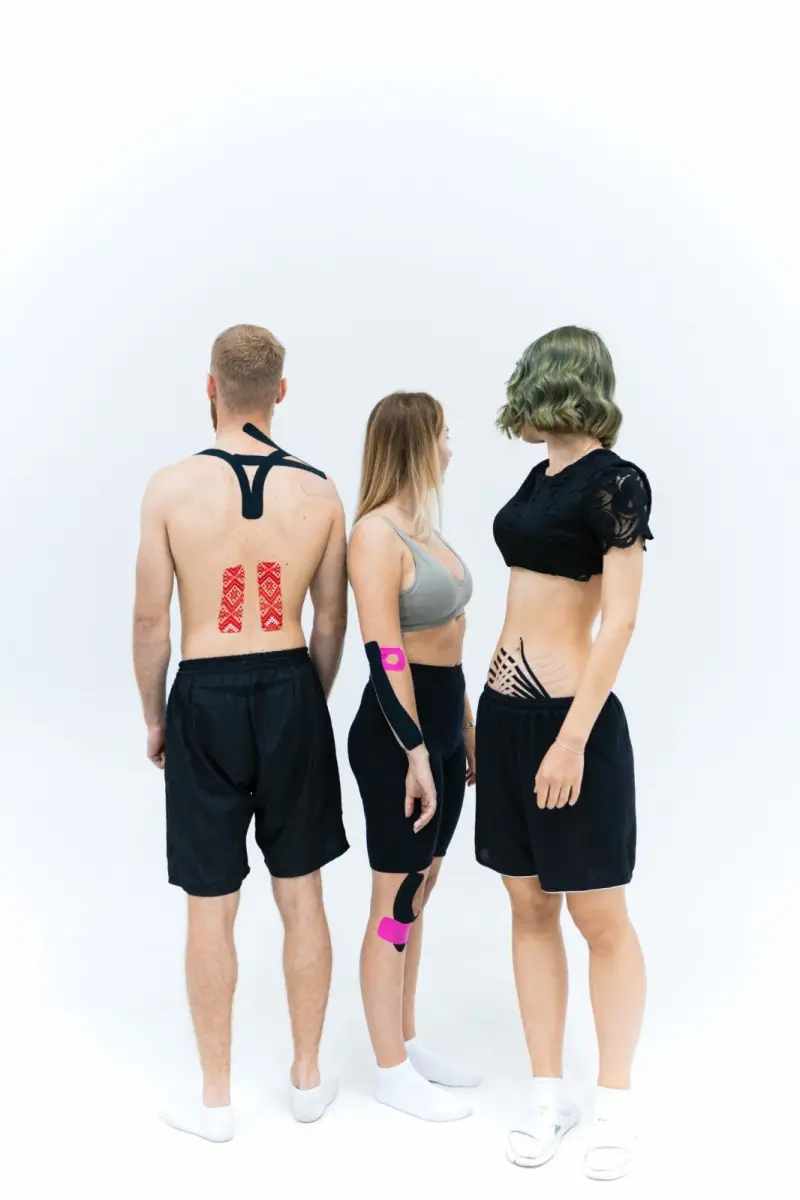
Why? What are they, and when is it worth using them? You will find out below. We encourage you to read on!
What is kinesiotaping tape?
When watching a football match or an athletics competition, you have surely noticed colourful tapes on athletes’ bodies more than once. What are they? These are specialist kinesiotaping tapes, which are increasingly used in medicine and, in particular, sports.
Kinesiotaping tape is a specialist self-adhesive tape created to improve the quality of life of people dealing with various musculoskeletal conditions. This type of tape is made of an elastic material that allows the skin, muscles and joints to move freely, so the person using it does not experience discomfort. It is coated with a special hypoallergenic, waterproof adhesive that allows the application to remain in place for a longer period—even for several days.
When are kinesiology tapes used?
Taping tapes are used in many situations. They are used mainly in physiotherapy and sports medicine, but increasingly also in cosmetology. Thanks to their properties, these tapes can help improve muscle and joint function, reduce pain and swelling, and increase range of motion. They are also used to prevent injuries and during rehabilitation after injuries.
Kinesiology tapes are also increasingly appearing in beauty salons. They are used as an additional treatment element, for example after facial lifting massages, but are also applied to pregnant women as a way of supporting the abdomen, and after childbirth to help mobilise stretch marks and scars.
Taping tapes: types
Kinesiotaping tapes may differ in their properties. The most common types include:
- universal tapes: with 130–140% elasticity, made up of more than 90% cotton with a small addition of elastane, and most often featuring strong hypoallergenic adhesive. They can be used for any condition after being cut to the required size;
- rigid tapes: with zero elasticity, made entirely of cotton, with a dense weave and hypoallergenic adhesive. They are often used as substitutes for orthoses or even casts after injuries;
- cross tapes (cross tape): featuring a characteristic crossed-strip design and made from double mixed fibres. They are recommended for addressing trigger points and postoperative pain, as well as joint inflammation and back pain;
- tapes in the form of elastic self-adhesive bandages: made from stretchable material and hypoallergenic adhesive, they are lightweight, waterproof and breathable. They are excellent for protecting wounds and cuts.
Tapes are also available in various colours and sizes, allowing them to be adapted to the individual needs of a given patient. A standard roll is 5 cm wide and 5 m long, but narrower versions are also readily available, such as those 2.5 cm wide.
There are many colours of taping tapes available. It is worth remembering that colour does not affect their effectiveness in any way, so it can be chosen freely. You can find classic versions in beige or black shades, which are easy to hide under clothing, as well as more unusual ones: yellow, red, blue or even designs featuring interesting prints, such as leopard print.
Taping tapes are a way to relieve and relax muscles and improve blood circulation in the treated area. They can provide excellent support during recovery after injuries, as well as help prevent them. They are also often used to correct posture defects or for cosmetic purposes. Do you feel this is a good solution for you? Don’t wait—choose your kinesiology tapes and benefit from the support they provide!