
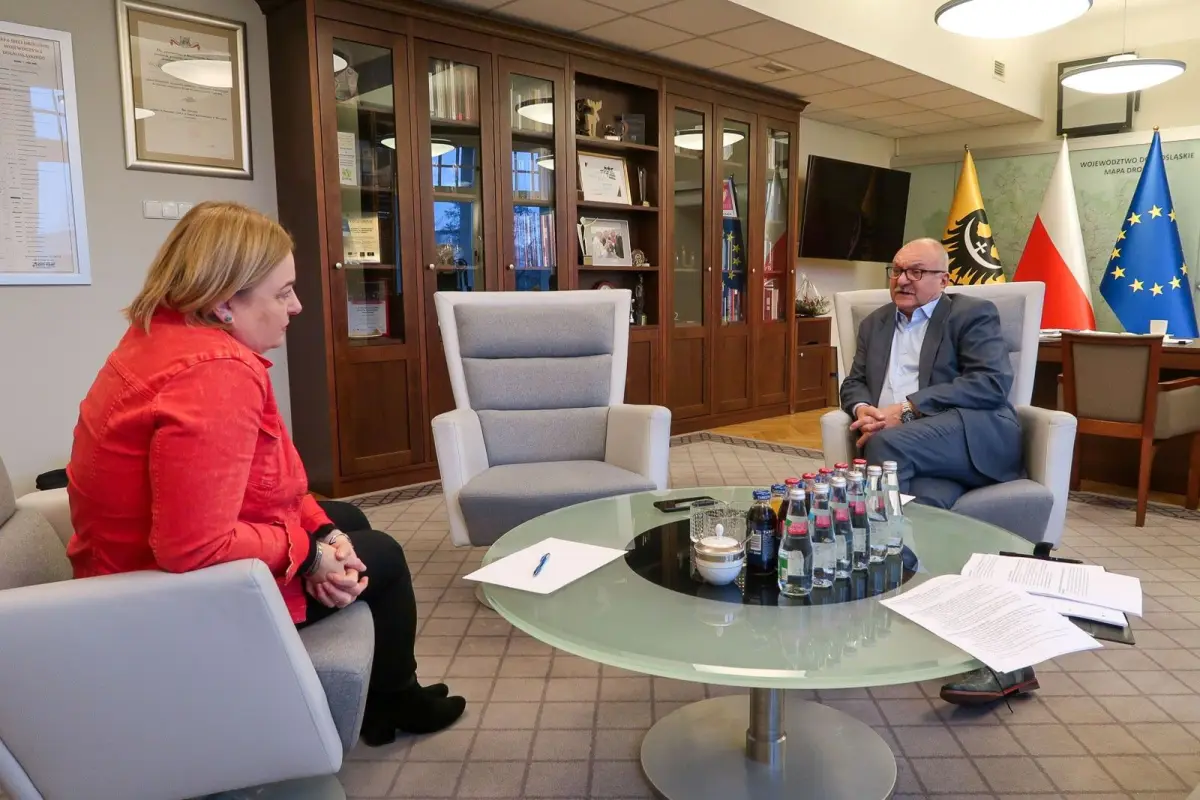
Grażyna Hanaf: – Did the Lower Silesian Voivodeship emerge from the pandemic with its shield or on it?
Marshal Cezary Przybylski: – As the voivodeship’s local government, we faced the pandemic head-on and effectively took the necessary measures to protect healthcare and the regional economy. We tried to mitigate the effects of the pandemic by allocating approximately one billion złoty to micro, small and medium-sized enterprises. The tourism industry, which experienced this period most severely, received substantial support. We are a tourism hub, and many people work in this sector. The modular hospital established in Bolesławiec as part of the County Hospital was financed entirely by the Lower Silesian Voivodeship local government, using EU funds amounting to PLN 8.2 million. I should add that the idea for this hospital originated in Bolesławiec, and the County Hospital played a very important role throughout the voivodeship in treating COVID-19 patients. The modular hospital increased treatment capacity. It solved many problems for the voivode during the pandemic. To sum up, we emerged from the pandemic with our shield.
The Marshal’s budget for Lower Silesia amounts to more than two billion złoty. What slice of this pie will go to Bolesławiec County?
Yes, the budget for Lower Silesia for 2023 amounts to almost PLN 2.3 billion, and there has never been such a large budget before. It is a development-oriented and investment-focused budget. As far as Bolesławiec is concerned, the second stage of the city bypass is currently being built. We will construct this important route, which will receive funding from the Government Roads Development Fund, for a total of approximately PLN 65 million. To date, more than 100 investments worth almost PLN 220 million have been completed in Bolesławiec County, of which nearly PLN 150 million was provided from EU funds. Many investments will certainly receive funding from the European Funds for Lower Silesia in the coming years. On 5 December 2022, the European Commission approved our programme after difficult negotiations, and many projects will be carried out under it. This is an opportunity for municipalities and micro, small and medium-sized enterprises to obtain funding for their own projects, benefiting residents of all municipalities in Bolesławiec County – Bolesławiec, Gromadka, Warta Bolesławiecka, Osiecznica and Nowogrodziec. I encourage people to visit the Marshal’s Office website, where we publish information about calls for proposals. We will also organise meetings to explain to potential beneficiaries how they can obtain funding from the programme. This amounts to more than two billion euros, or eleven billion złoty, available for use. We are preparing to implement the European funds and announce the first calls for proposals.
What emotions accompany the adoption of such an impressive budget?
Generally, emotions are always involved, because the voivodeship’s new budget for 2023 represents a great deal of money. There were essentially no disputes over allocating funds to the larger infrastructure investments. The dispute concerned social projects, such as funding for in vitro fertilization.
Was the Marshal in favour of funding in vitro fertilization?
In my opinion, it is an absolutely necessary initiative, but the state should find funds in its budget to support projects of this kind. I know that several large municipal governments have adopted the relevant resolutions and allocated funds for in vitro fertilization.
It does not look as though the PiS government will support the funding of in vitro fertilization.
That is true, but the state should represent the interests of all citizens, not just one group that voted for a particular political party.
Is the Marshal closer to Warsaw or Wrocław? To the President of Poland or the president of the capital of the Lower Silesian Voivodeship?
I think that is the wrong question. The task of the voivodeship’s local government is to realise the ambitions and dreams of the people of Lower Silesia. If we look at the coalition agreement and the tasks that have been completed, are being completed and will be completed, this is thanks precisely to this coalition, which is not easy but is pragmatic. One example is the construction of the New Oncology Hospital in Wrocław, for which the government has pledged PLN 550 million. No local government has carried out such an investment before. We will be the first. There is also the unprecedented nationwide project to revitalise railway lines, which we are carrying out as the Non-Party Local Government Officials. We have already taken over 20 railway-line sections from the state for revitalisation; under previous governments, taking over even one was a huge problem. We now own many lines that we will systematically revitalise and restore rail services on. Three routes have already been completely revitalised, and passenger services have been restored on them. These are the Bielawa–Dzierżoniów, Chojnów–Rokitki and Chocianów–Duninów lines. This year, we plan to put the Gryfów Śląski–Mirsk and Mirsk–Świeradów routes into service and also restore the railway to Karpacz. We have launched rail services on routes to Jelcz-Laskowice, Sobótka and Świdnica, and to Lubin. It is very important to us that residents of smaller towns have transport connections to clinics, schools and workplaces. It is also important to remember that a passenger who buys a regular railway ticket already has half of its cost paid by the local government, which purchases services from Koleje Dolnośląskie and POLREGIO.
Returning to the subject: I cannot imagine a situation in which a large local government does not cooperate with the government. This does not mean that it has to be a uniform coalition. It means cooperation. In the regional assembly, we voted in favour of PiS projects and voted with the opposition against PiS. For example, on supporting the Women’s Strike.
Bolesławiec was one of the smaller cities that took a very active part in the Women’s Strike. Is the Marshal in favour of women’s freedom of choice regarding abortion?
Abortion is every woman’s right; she must be the one to make this decision above all. For me, the law of 7 January 1993 was a good solution.
Does the Marshal realise that the Women’s Strike would not agree with him? That law tightened abortion regulations.
I know, but it is about compromise.
So definitely no legal abortion on request?
Yes.
The elections are approaching. Citizens will be pleased with all the investments, but they will vote emotionally. And the emotions currently being stirred concern the right to abortion on request, in vitro fertilization, and human rights, including the violation of LGBTQ+ rights in Poland.
I do not like it, but yes, emotions govern elections. And, in truth, both sides are interested in inflaming them. Society is left with this “duopoly”—a choice between good and evil, between PiS and everyone else. This vicious cycle must be broken. It is not good for Poles. At present, we are as divided as we have probably not been for a long time. I think the vast majority of Poles support building, not dividing. And all of this is transferred to local governments. After all, neither a hospital, nor a road, nor public transport, nor education has political colours.
Is this where the strength of the Non-Party Local Government Officials lies?
The strength lies in the fact that there is no other decision-making body above us. We decide on the development of Lower Silesia here, in Lower Silesia. I do not start the week with “meetings at the party office”, where they arrange my schedule of meetings. No one gives me orders from above telling me that I have to do something. We are independent Non-Party Local Government Officials, and we are entering the elections with precisely this message and a specific programme that serves the residents of the entire region. We do not forget about problems; we solve them effectively. The well-being of the residents of Lower Silesia is most important to us.
Thank you for the interview.
Thank you.