
On Friday, May 7, a ceremony was held at the Town Hall in Wrocław to present the “Righteous Among the Nations” medals and honorary citizenships of Israel to Poles who risked their lives to save their Jewish fellow citizens during World War II.
Nine residents of Lower Silesia were honored during the ceremony. One of the Righteous whom Ambassador Zvi Rav-Ner granted honorary citizenship of Israel is Alfred Kwarciak, a resident of Bolesławiec who, together with his parents and siblings, helped 15 escapees from the ghetto in Dubno in Volhynia. In February 1989, the titles of Righteous Among the Nations were awarded to Piotr and Maria Kwarciak and their three sons: Anatoliusz, Alfred and Feliks.

The “Book of the Righteous Among the Nations. Rescuers of Jews during the Holocaust. Poland” states:
Before the liquidation operation, a Jew named Fiszer, who worked outside the ghetto, met his former friend Piotr Kwarciak. He offered to hide the entire family in his suburban home if their lives were threatened. During the liquidation of the ghetto, eight members of the Fiszer family escaped, together with relatives from the Szenker, Półtorak and Sznajder families.
When they arrived in the Kwarciaks’ yard, they found a well-camouflaged shelter built of bricks beneath the barn, with separate spaces for each family. Despite the risks they were taking and having little money, five members of the Kwarciak family cared for the escapees, supplying them with food and clothing. They had to keep everything secret because of the hostile attitude of their Ukrainian neighbors toward both Jews and Poles.
At first, the Jews paid for their food, but when they ran out of money, the Kwarciaks did not stop hiding them, motivated by compassion and love for their fellow human beings. The Kwarciaks’ younger children also actively participated in helping, doing whatever they could and giving up meetings with friends in order to protect the secret of those hidden in their home.
In the spring of 1944, as the front approached and the Germans began deporting Poles to Germany for forced labor, the Kwarciaks left their home and hid together with the Jews. Twenty-five days later, in April 1944, they awaited liberation, hungry and dirty. After the war, most of the survivors emigrated to Israel, while the Kwarciaks moved to areas within Poland’s new borders.
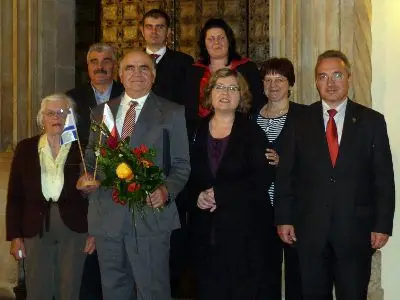
(Bolesławiec Municipal Office information/ii)