
Danuta Maślicka, a former Solidarity activist interned in 1984 for distributing anti-state leaflets, wrote down her memories from the 1980s. The impulse to write the book came from the news that Prosecutor S., who had arrested her, was suffering from Alzheimer’s disease. Wanting to leave a trace in the memory of herself, her loved ones and the times that had passed, Danuta Maślicka wrote “Znikopis”.

Today, it is not only Prosecutor S. who suffers from memory loss. Poland’s historical memory is not in the best condition. Everyone remembers the distant days of the Battle of Grunwald, when we defeated the Teutonic Knights, yet no one wants to remember those who dared to oppose Dear Socialism* just a few decades ago.
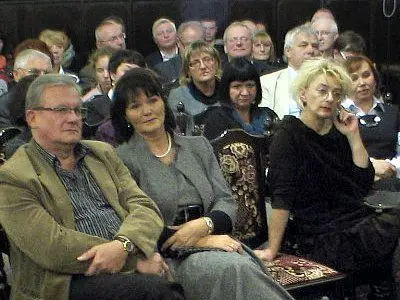
Young, twenty-year-old Kamila, who transcribed Maślicka’s book, read the notes about times she knew absolutely nothing about with great fascination. Without any embarrassment, she said at the meeting that she had not been taught about them at school. She received applause from the witnesses and heroes of those times gathered in the room.

For the first time, I felt stupid
Danuta Maślicka was interned for two months. When she was transported from the prison on Kleczkowska Street in Wrocław to the detention centre in Lubań, she asked herself whether everything she had done made sense. Would what had happened to her and many others bear fruit, and would it be remembered? Then, as she writes in “Znikopis”, she felt stupid for the first time. She did not feel like a heroine fighting for freedom. She did not even believe that Solidarity would win. She fought for other reasons. She was driven by rage. She was furious at the greyness, mediocrity, queues and humiliation. Others were the heroes: Father Jerzy Popiełuszko, Kuroń, the shipyard workers dying in strikes, Wałęsa.
After her internment, Maślicka waited for more than a year to have her right to work as a teacher restored. Eventually, she got it back. But she could not freely choose where to work. She was sent to the most remote village, under the wing of a female headteacher—the wife of a secret-police officer.
In the book, she quotes a fragment of a poem by Herbert: “It did not require great character at all / our refusal, dissent and stubbornness”. Mrs Ania brought anti-state leaflets to her home. An older, sick woman with perpetually swollen legs, dressed unfashionably. Is that what unbreakable heroines look like?
They were a small group struggling against a powerful system, as Maślicka writes of her friends. They played bridge, read Mrożek, distributed leaflets and once sheltered Kuroń. They attended Masses for the Homeland, sang patriotic songs, and in the cemetery in Bolesławiec placed a cross commemorating those murdered in Katyn on All Saints’ Day. They were watched by the Security Service and did not feel any safer because of it.
I would join Solidarity if I were certain it would win
In the autumn of 1981, after a meeting of regional Solidarity in Wrocław, Maślicka and her friends established a branch of the Solidarity Trade Union in Bolesławiec. Teachers’ involvement varied. People, writes the author of “Znikopis”, were not eager to take on new responsibilities, accept challenges or fight. They were tormented by poverty, queues, ration coupons and the country’s persistently uncertain situation. A colleague who was an economist wanted to be certain of victory before joining the union, while a colleague who was a historian said that a cactus would grow on her hand before Solidarity’s idiotic demands were accepted.

Then came martial law. There was a shortage of everything. Maślicka recalls Saturday hunts for food, Dino the dog tearing up her rationed tights, school assemblies praising martial law, monitored conversations, queues and putting up leaflets. Everyday life. Neither hope nor faith in victory.
A living hero
A good hero is a dead hero. Then one can write songs about him, praise him and worship him. A living hero—and God forbid one living next door—is not very heroic. He makes mistakes, sometimes swears and, unfortunately, has to use the toilet. He is so unheroic that he himself does not believe in his own greatness.
Heroes are not needed after the battle. They remind cowards and traitors that, despite everything, it was possible to persevere. To stand on the other side. So they are erased from memory. Their achievements are silenced or disparaged. They can also be accused of not being prepared for the change and seizure of power, of not trying hard enough, so that things are now worse than under Gierek.
Maślicka writes that nobody needs her today at Solidarity headquarters, so she does not go there. She wrote “Znikopis”, sensing more intuitively that something bad was happening to people’s memory of Poland’s recent history.
The author is mistaken in thinking that she is not needed. Every witness of those times, and the small groups of friends who fought the regime, are still needed. To bear witness. Human solidarity remains an important idea. And it still needs to be defended.
If the heroes of those times believe that things were easier then because white was white and black was black, while the enemy was clearly defined, they are very much mistaken. It was just as difficult then as it is today to convince people to show solidarity.
It is high time to set aside nostalgia for the old days and stop looking back. Being a living hero entails an obligation to act—whether by writing down one’s memories or through some other activity. Winning freedom was only the first battle won. An equally important struggle is taking place today: for the quality of freedom.
If a hero did not fall in battle, they must go on and keep fighting.
* The expression Dear Socialism comes from Sławomir Mrożek’s “Donosy”. “Donosy” is a separate part of the writer’s work. It was created in response to the introduction of martial law, and three of its pieces were quoted in Danuta Maślicka’s book.
(editorial information ii)