
In May this year, we wrote that twenty-five students from II General Secondary School were travelling to Veszprém, Hungary. In September, the Hungarians came to Bolesławiec. The guests were officially welcomed on Tuesday, 15 September, in the school’s assembly hall.
The return-visit programme was packed with attractions. The Hungarians had an opportunity to visit Bolesławiec’s ceramic factories, the capital of Lower Silesia, and also travel to the Sudetes. “Our ceramics absolutely delighted them, which was a pleasant surprise for us,” says Beata Sulska, headteacher of II LO.
“What impressed me most was the hospitality we encountered here,” emphasises Balazs Csihos, the Hungarian project coordinator. “We are glad we came to you. We met people here who are fantastic to work with. We want to continue this cooperation.”
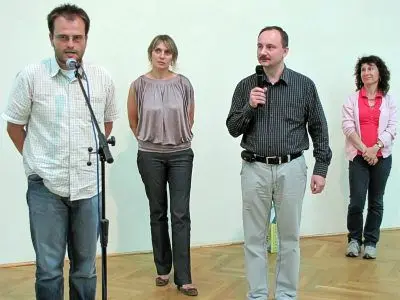
“People in Poland are very kind and friendly. They stick together. In Hungary, things are a little different,” says Bettina Baltai, a student at a school in Veszprém. The Hungarians got on very well with their Polish peers. “The first friendships were formed back in May. Now they have essentially only grown stronger,” notes Adam Dominek, an exchange participant.
What surprised them in Poland? “The cuisine,” they reply. “Polish dishes are very different from Hungarian ones. But that does not mean they were not tasty.”

In May, Beata Sulska told us that “every cooperation breaks down interpersonal barriers and makes young people realise that the only barriers between people are geographical ones.” We asked whether the September visit confirmed those words. “Definitely,” emphasises the headteacher. “In reality, at a certain point, exchange participants gain such confidence that even language ceases to be an obstacle.”
“These exchanges motivate students to learn languages,” says Krzysztof Żuromski, a German teacher and one of the project coordinators. “They give students the satisfaction of being able to communicate in a foreign language,” he adds.

As the II LO teacher points out, cooperation with Hungary benefits both sides. “During the exchange, the Hungarians also practise a foreign language. Cooperation with Germany would be different. Germans might not be satisfied with a conversation with someone whose German is weaker,” he states.

II LO has been cooperating with foreign countries since 1992. Its students have visited, among other places, the Netherlands, Belgium, Sweden, Denmark and Latvia. The school also maintained contacts with Australia and New Zealand. “Meetings of this kind are needed not only by young people, but also by the entire teaching staff,” concludes Beata Sulska. “The atmosphere in which they take place convinces me that young people are worth living for and that it is worth devoting one’s private time to them.”
(ii information)