
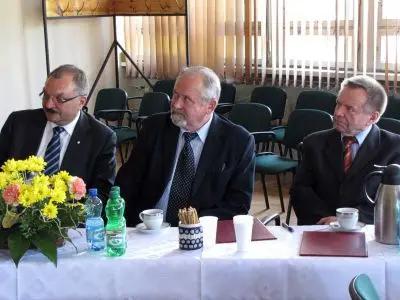
On Monday, 27 April, a meeting was held in the conference room of the Bolesławiec District Office with Jarosław Duda, a Civic Platform senator and secretary of state at the Ministry of Labour and Social Policy, and Wojciech Skiba, president of the State Fund for Rehabilitation of Persons with Disabilities. The officials met with the district authorities and representatives of district organisations working to support people with disabilities.

Those attending included district governor Cezary Przybylski, deputy district governor Stanisław Chwojnicki, chairman of the District Council Karol Stasik, Barbara Kostyra, head of the Social Affairs and Health Department of the District Office, Krystyna Boratyńska, deputy chair of the Health and Social Assistance Committee, Jadwiga Bobek, president of the Bolesławiec branch of the Friends of Children Society, Danuta Marecka, head of the District Family Support Centre, Maria Szpak, president of the Association of People with Disabilities, and Małgorzata Goleńska, chair of the District Disability Assessment Team.

Cezary Przybylski spoke first, discussing, among other things, the district’s activities for people with disabilities. “Our flagship event is the Christmas wafer gathering. This year’s edition brought together around a thousand people,” said the district governor. He added that this year the local government was honoured with the Order of Joy in the “Disability-Friendly District” category. “We certainly would not have managed to do so much without the support of organisations, associations and foundations,” Cezary Przybylski emphasised.
Monday’s meeting was also an opportunity to thank all those who work to support people with disabilities. Jarosław Duda and Cezary Przybylski presented letters of congratulations to local-government officials and representatives of organisations.
The deputy minister of labour spoke primarily about the situation of people with disabilities in Poland. “For years, the prevailing philosophy was that people with disabilities should be granted a benefit and preferably stay at home,” said Jarosław Duda. “My aim is to make society and employers aware that people with disabilities also want to be active,” he added. Why is this so important? “Poland has one of the lowest employment rates for people with disabilities in Europe,” the deputy minister explained.

Jarosław Duda also spoke about the government’s plans: “Prime Minister Donald Tusk has appointed a team to standardise the disability assessment system. There are currently five assessment systems in operation. I personally know people who have three different assessments.
In addition, the Civic Platform–Polish Peasant Party government will seek to pass two laws: one on equalising opportunities for people with disabilities and one on sign language. “Many offices do not have sign-language interpreters,” Duda explained.

The deputy minister also said that in June the State Fund for Rehabilitation of Persons with Disabilities would provide districts with additional funding. “We want to strengthen local governments. The money should be available locally,” the politician emphasised.

During the remainder of his visit to Bolesławiec, Jarosław Duda visited the premises of the Occupational Therapy Workshops. “I talked with the minister about what we do,” said Justyna Ambroży, head of the Occupational Therapy Workshops in Bolesławiec. “Mr Jarosław Duda learned that we had recently managed to find jobs for three people. He asked very pertinent questions. He knows a great deal about social assistance,” she added.
The deputy minister toured all the Occupational Therapy Workshops’ rooms. He had the opportunity to try French biscuits prepared by the workshop participants in the home economics room. At the end of the visit, Justyna Ambroży presented the deputy minister with an angel made by people with disabilities in the arts and crafts room.
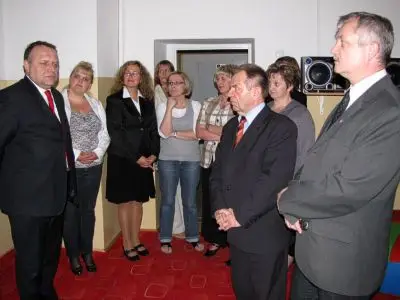
Jarosław Duda also visited the District School and Special Education Facilities Complex. Among other places, he visited the sensory experience room and the gymnasium. “One of our goals was to make the minister aware that around 95% of special schools are housed in buildings unsuitable for the needs of people with disabilities,” said Zdzisława Woźniak, head of the institution. “The minister promised that the government would certainly look into this issue.”
(paid article)