
Janusz Kocielski told officials and the contractor responsible for the project more than a year ago that the sewerage design was flawed. They did not want to listen to him. "They made me out to be a troublemaker, a crank," the embittered resident of Bolesławiec says. – "I said just one thing then. We’ll wait until the first rainfall."
The nightmare began in May this year. The Kocielskis and other residents of Kubika Street were flooded twice by torrential rain. Under pressure, municipal sewage began overflowing onto the street and running downhill. "The water and sewage reached a depth of 70 centimetres. We had to carry it out ourselves with buckets. The fire brigade refused to pump it out. They said we had to wait for it to soak in. I asked: where will it soak in? Into the sandstone?" Kocielski says.

The tenement building where the affected residents live is more than 130 years old. It stands on sandstone blocks. Sandstone becomes saturated and absorbs sewage like a sponge. The house began cracking in the spring. The basement is infested with fungus, and the walls are covered in mould. None of the residents of the flooded homes will keep potatoes or other vegetables there anymore. Dampness can be felt everywhere. How are the Kocielskis coping? They are forced to wash clothes frequently and air the flat. However, as Janusz Kocielski admits, "winter is approaching, and no one will keep the windows open all the time."

What did the City Office do?
At the turn of May and June, a barrier made of sandbags was built. "Those bags saved us. Thanks to them, the subsequent floods were less intense," admits Maciej Kocielski, Janusz’s son. Basement windows were bricked up. A drain well was built in the garden. A pavement is now being constructed. "This pavement is supposed to protect us. But the kerb is 15–20 centimetres high, while the water reached 70 centimetres," Maciej adds resignedly. All of this is merely removing the effects of the flooding. Has anyone thought about eliminating its causes?
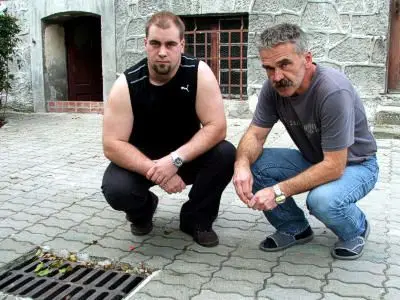
For now, the search for someone responsible continues. "Who made such a decision?" Janusz wonders. – "This is a construction project that threatens people’s lives, health and property." Until now, it had been a taboo subject at the City Office. "We are no longer writing any letters. The officials do not see this issue," the Bolesławiec resident adds.
The family is hurt by the indifference of the city authorities. "None of the officials took the trouble to visit us personally, despite our invitations. They avoid the street like the plague. The rule is: if you want something done, do it yourself," Maciej says. "We are waiting, but how long can you wait?! Especially since this is our own flat. We are fighting for our property. But it is obvious that no one will buy it now," his father adds.
The Kocielskis tried to settle the matter amicably. They demanded compensation. It turned out to be impossible. "We will simply have to sue the Mayor of Bolesławiec," the head of the family says.
For now, the family checks the weather forecast on an ongoing basis. Janusz Kocielski has lost 18 kilograms since May. From stress. Friends ask him in the street whether he is ill. His son Maciej is increasingly disappointed with the reality in Poland. Like many of his friends, he is thinking about leaving the country. The entire family is considering moving. They do not want – and it is difficult to blame them – to live in a mouldy house. "This house stood for 130 years; it certainly will not last another 130," Janusz Kocielski adds sadly.
What next?
"Mr Kocielski was right," Wiesław Ogrodnik, the city’s deputy mayor, finally admits. The worst part is that even before the major project, which included replacing the sewerage system on Kubika Street, the City Office hired a specialist from Wrocław University of Technology who found several dozen errors in the design. The company Ekosystem took into account approximately 12.
"It was a huge project. Obviously, the officials were unable to check it themselves, which is why an external engineering company was hired; it identified many errors in the design, including an error in the chamber on Kubika Street. The contractor insisted that the design had been prepared correctly and that there would be no problems. The contractor is responsible for what it did. Unfortunately, the company does not admit to the error," the deputy mayor explains.
After one of the City Office’s letters, the company wanted to repair the defective sewerage system for half the price. Later – citing the good cooperation, as it explained – it decided to do so free of charge. However, the contractor set certain conditions. The City Office would have to prepare an up-to-date map for design purposes. And it was precisely the defective maps that were allegedly one of the causes of the shoddy work on Kubika Street. Yet, as Wiesław Ogrodnik admits, "before such a major project, the designer should have hired a surveyor to verify the data on the map for design purposes."
But what about the Kocielski family? Wiesław Ogrodnik admitted that – provided procedural deadlines were met and an agreement was reached with Ekosystem – the sewerage system could be repaired at the earliest in June 2008. That is a very optimistic scenario, however. Even that seems like too little, too late. Storms will probably start again in the spring, and history will repeat itself. Until then, the city can offer only temporary solutions.
A Courtroom Finale?
According to Ogrodnik, there is currently no question of paying the Kocielskis compensation. "If the mayor had such authority, he would settle this immediately. The mayor cannot make such a decision because of the responsibility for public finances resting on him," Piotr Roman’s deputy says. It appears that the matter will end up in court, especially since the City Office is considering suing Ekosystem. And such a trial, as is well known, may also take some time.
(GA information)