
Like the rest of Lower Silesia, it became a new home for Polish settlers. They also arrived from France. More and more is being written and said about the emigrants “from the banks of the Seine.” After 1945, the western lands became a mosaic of many cultures. This part of Silesia is also home to Poles from the Eastern Borderlands, Ukrainians, Lemkos, Jews, Armenians, Tatars, and newcomers from central Poland.
Little-known settlers include Polish re-emigrants from Romanian Bukovina. They have much in common with re-emigrants from Yugoslavia.
First, we should answer the question of what Bukovina really is. The “Geographical Dictionary of the Kingdom of Poland and Other Slavic Countries,” published in Warsaw between 1880 and 1914, may help us. According to the dictionary:
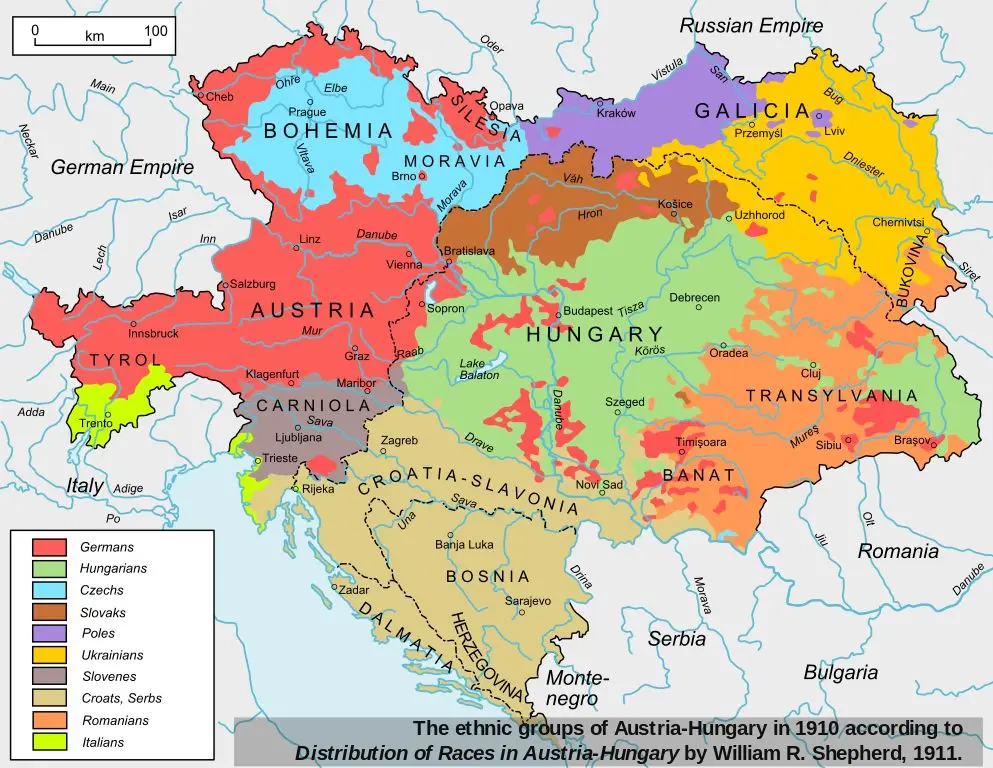
[Księstwo Bukowiny] lies in the eastern part of the Austrian Empire; its name is derived from the beech forests that once covered the entire country, initially limited only to the areas between the Dniester and the Prut […]. It borders Galicia to the north, Russia and Moldavia to the east, Moldavia and Transylvania to the south, and Transylvania, Hungary, and Galicia to the west.
Put simply, this land lies between the Eastern Carpathians and the Dniester River. Its northern part is now within Ukraine, while its southern part lies in Romania.
Poles emigrated to Bukovina for the same reason as all emigrants: to earn a living. In 1775, Austria acquired this area at Turkey’s expense. At the time, it was densely forested land. It needed to be developed quickly. To this end, people of various nationalities were brought in from other parts of the Austrian Empire. For centuries, the Austrian Empire had been a melting pot of many cultures. At one point, when the monarchy was already severely weakened and devastated by the Great War, various ethnic groups took the opportunity to create their own states. Some nations, however, failed to do so. The Ukrainians, for example.
Another common denominator shared by Poles from the Balkans is their origin. Residents of Galicia and Western Lesser Poland came to Bukovina. People also arrived from the Čadca region (in present-day Slovakia). This district was very densely populated. Its inhabitants migrated to Bukovina, 700–900 kilometres away.
Chernivtsi became the capital of Bukovina. At first, Bukovina was incorporated into Galicia, and from 1849 it formed an independent crown duchy. This further improved its economic situation. The region developed rapidly. The best officials and teachers were sent to the duchy. Their selection was supervised by the emperor himself. The people appointed could expect high salaries. The mayor of this important administrative centre was a Pole—Jakub von Piotrowicz, as was, on two occasions, Antoni Kochanowski. In the 1930s, the city had more than 112,000 inhabitants: Jews (38%), Romanians (27%), Germans (15%), Ruthenians (Ukrainians, 10%), Poles (8%), and Russians (over 1%).
In the first half of the nineteenth century, villages such as Nowy Soloniec, Plesza, and Pojana Mikuli were established. Toward the end of this period, some of the population emigrated to Bosnia and Brazil.
Romanian Bukovina was also inhabited by Polish miners from Bochnia and Wieliczka, as well as miners from Ruthenia. They worked in salt extraction in the town of Kaczyka.
According to Professor Eugeniusz Kłosek, as late as the turn of the eighteenth and nineteenth centuries, the population of Bukovina had no clear national consciousness. This changed in later years. The Church and education were the main institutions that sustained ethnic and cultural distinctiveness.
An important Polish centre is the village of Pojana Mikuli. It was founded jointly by Poles and Germans. The settlement was established in 1838. The upper, less accessible section was occupied by German settlers from the Sudetes, while the lower section was settled by Poles from Stara Huta Krasna. The village had a bilingual school, with German and Polish as the languages of instruction, as well as a Polish House. During World War II, the German inhabitants of Pojana left for Silesia and the Żywiec region. Romanian refugees from Banat took their place. It should be noted that during the interwar period, a certain group of Poles returned to Poland.
Pojana Mikuli was completely destroyed during World War II. In 1944, Slovaks informed the German occupiers of the alleged cooperation between the Poles and Soviet partisans. In retaliation, the Germans burned the village.
After the war, the issue of Polish settlers returning to their homeland resurfaced. Once again, as before the war, the campaign was conducted by both Poles and Czechoslovaks. Following agreements between Poland and Romania, numerous returns began. The journey home took place in unimaginably difficult conditions—in cattle cars, cramped together with small children. The journey lasted two weeks under extremely harsh conditions. Many people died of typhus during the transport.
The Poles of Bukovina faced problems similar to those experienced in other parts of the Austro-Hungarian monarchy. One of the most painful was the prohibition against teaching in Polish. As Jan Bujak, a researcher of Polish settlement in the Balkans who was himself born in Bukovina, claims:
[…] it should be noted that Bukovina was the only country of the Habsburg monarchy in which, during the second half of the nineteenth century, Polish children alone were deprived of instruction in their mother tongue, contrary to the law guaranteed by the constitution, and forced to study religion in German, while all other nationalities benefited from instruction in their own languages and from religious lessons in their native languages, German, Romanian, Ruthenian, or Hungarian. The Poles waged a long struggle to change this situation, and only after considerable resistance did they manage to establish elementary schools with Polish as the language of instruction—first in the Chernivtsi elementary schools, and later in only some elementary schools in towns and villages with large Polish populations. [Zob. https://www.jas-czytalski.pl/articles/bukowina/Polacy_na_Bukowinie.html].
Another important event for Poles from both Bukovina and Bosnia was the collapse of Austria-Hungary. Polish settlers found themselves in a new reality. Romania and the Kingdom of Serbs, Croats and Slovenes were established, later renamed Yugoslavia.
The fundamental difference between the two lands was the level of education among the Polish population. In Bosnia, largely uneducated peasants predominated. Let us remember that they had mainly emigrated from Galicia, a backward region. The level of education was no better on Bosnian soil. Often, the distance to school was an obstacle to obtaining an education. This does not mean that education was entirely absent. Bosnia was also home to educated Polish settlers who had arrived as part of the Austrian administrative apparatus.
In Bukovina, the Polish intelligentsia represented a larger proportion of the population. In both cases, some of this educated population returned to the reborn Poland during the interwar period.
The Second World War also brought death and fear to Bukovina. Before the war, individual ethnic groups, such as Ukrainians and Germans, lived peacefully alongside Poles. Unfortunately, the turmoil of war changed everything. After the war, Bukovinians eagerly returned to a homeland known to them only from stories. In total, in 1945–46 more than 10,000 of our compatriots left Bukovina for the so-called Recovered Territories. They settled in the Lubusz and West Pomeranian voivodeships. In our area, re-emigrants from Bukovina were settled in Lubań, Pisarzowice, and Uniegoszcz, and further afield: in the area of Dzierżoniów, the Sowie Mountains, and Mount Ślęża.
It must be remembered, however, that a large part of the Polish population remained in Bukovina. During the communist era, they had very limited opportunities to cultivate their traditions. This changed after 1990. Today, the Adam Mickiewicz Polish Culture Society is active in Ukrainian Bukovina, while the Union of Poles in Romania operates in the Romanian part.
Bukovina is an extraordinary land. Historically, it belonged to Moldavia, the Ottoman Empire, and the Austrian Empire. Poles appeared in Bukovina much earlier than 1775. As early as the time of Casimir the Great, Polish people settled in this area. It is an extraordinary twist of fate that the descendants of Poles living in the former Eastern Borderlands (from the Jagiellonian era) returned to the country’s western borderlands.
Galicia, the region from which Poles most often emigrated to the Balkans, is frequently called the “cursed arcadia.” For many ethnic groups, it was simply “too cramped.” They sought independent statehood or some form of distinctiveness. Despite this “crampedness,” many nations lived alongside one another in relative harmony for centuries, without conflicts or quarrels. When remembering the Poles of Bukovina or Bosnia, let us not forget Galicia. We draw so much from Galician tradition, often without even realising it. An excellent example is Galician cuisine, from which mămăligă and ruskie pierogi originate. The latter have nothing to do with Russian cuisine. The word “ruskie” refers to Ruthenia, today’s Ukraine and the former Eastern Galicia. Another, less familiar name for this dish is Galician pierogi.
Among others, Jaromír Nohavica sings about this wandering journey, also evoking the “cursed arcadia” in the words of a beautiful song: “Across Galicia’s meadows a cold wind roams/ The wicked world took everything we had/ Like passing birds when they change their land/ Like homeless letters, we will fly away from here.”
Paweł Skiersinis

The author is a blogger and a history enthusiast, particularly interested in the history of Lower Silesia and Poland. Why Lower Silesia? As he himself says: “Why not? The most interesting history is all around us, concerning ourselves and our ancestors.”
He adds: “I try to present history from a different perspective, in an interesting way, not in the typically textbook style, full of dry dates and facts. My articles concern facts that we will not find in textbooks and well-known publications. The history of Lower Silesia is undoubtedly fascinating and captivating, so it is sometimes worth devoting even a brief moment to it.”