
Below we present an interview given specially to the Istotne.pl portal by Wojtek Zimerman, who lives in Switzerland and is a former player of BKS, Unia Racibórz, Chrobry Głogów and the Swiss clubs SC Kriens, FC Baar and FC Luzern.
Marcin Zabawa: Please tell us how the club from Chorzów found out about you and that you could help them.
Wojtek Zimerman: Top-flight clubs travelling abroad always look for contacts with trusted people. As you can see, I am one of them. Ruch Chorzów president Mirosław Mosór called Wisła Kraków president Jacek Bednarz and received a positive opinion of my organizational work. I am personally pleased to have the opportunity to cooperate with Polish clubs, as I get to meet wonderful people. My latest experience with Ruch Chorzów’s officials, players and fans was exceptionally successful.

What did this help involve?
My work begins when I receive exclusive rights to organize a stay in a particular place. This time, it was Liechtenstein. Basically, I have one week to organize everything needed for the team to prepare calmly for a football match.
As a former coach, I know what it should look like and can anticipate emergency situations—some have already happened to me. Contact with club officials is also very important. It is the basis of cooperation. UEFA competitions begin during the holiday season, and finding a hotel for 50 people at that time is not easy. It is almost a miracle.
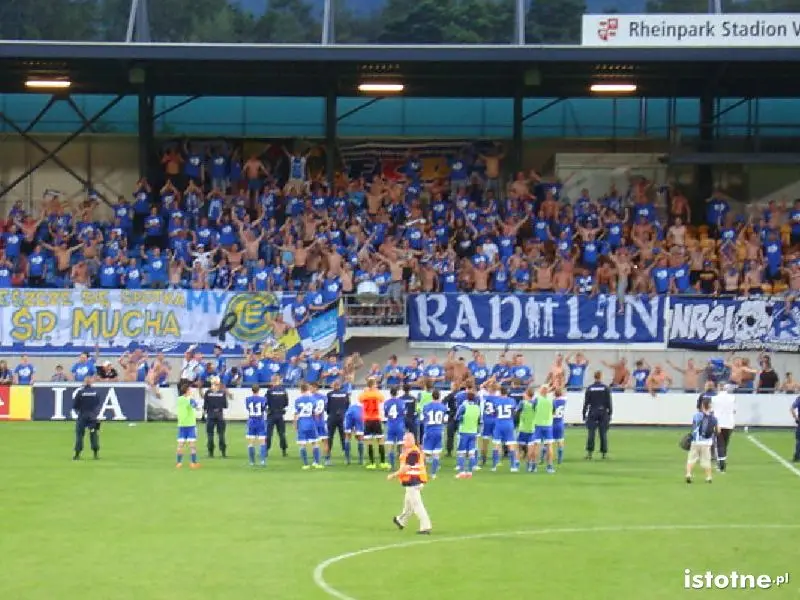
The Blues played a Europa League qualifying match and advanced to the next round. Were there reportedly concerns about Polish supporters?
FC Vaduz was very concerned about Ruch’s supporters. I was even asked whether a police escort would be needed on the way to the stadium. Swiss police were additionally asked to help secure the match. On match day, the capital of the small principality was already in the hands of the Blues. People sang and celebrated everywhere. Almost 1,000 Ruch supporters appeared at the stadium and cheered on the Chorzów team. The support provided by the Poles was described as “fabulous.” The local people had never seen anything like it. Full decorum and respect for the locals, while the police were “unemployed.”
Ruch Chorzów supporter Vaduz
You live in Switzerland every day. The country’s national team is achieving footballing success and climbing higher in the rankings. How would you comment on this?
In every respect, Switzerland follows the example of Germany. Football development was no different. In the 1990s, it ended its focus on Dutch training methods. We remember the youth academies for children at Ajax and PSV Eindhoven very well; at the time, they were the best example for coaches. I remember the days when people competed for videos of demonstration training sessions for work with children and young people. The Swiss opted for German training methods. Coaches from that country were hired, and training sessions were organized with the best Bundesliga experts.
The German Ottmar Hitzfeld took over the national team and introduced well-trained players to it. He brought a German mentality—a mentality of fighting, discipline and the will to win. The same thing began happening in clubs and youth national teams. Results did not take long to arrive. In 2009, the U-17 national team qualified for the World Championship finals for the first time in its history, only to return home with the trophy for the best team on the planet. Today, most of those boys form the core of Switzerland’s first team and play for Europe’s best clubs.

And how do you assess Polish football?
I am surprised that the PZPN and league clubs do not follow the example of the Swiss, who are considered among the world’s footballing elite. For many years now, footballers trained in Poland have found employment in the Bundesliga. Okoński, Furtok, Buncol, Leśniak, Wojcicki, Matysek, Hajto, Wałdoch, and now Piszczek, Błaszczykowski and Lewandowski are the best examples that we have the closest ties to the Germans. Our neighbor across the Oder has the best coaching school in the world, and that is where we should look for examples. We should hire coaches from Germany so that they can instill in us what they instilled in the Swiss. Let me remind you that in the FIFA world ranking, Germany is in first place and Switzerland is ninth.
You still live in Switzerland, but you probably still miss Bolesławiec a little.
Yes. I miss Bolesławiec and Poland. It is not easy to forget the places where you grew up. I visit our town very often. I feel good there; I have family and good friends.
What are your plans for the future, both near and distant?
I am currently working on a major sports project, the details of which I do not want to reveal because I do not know whether I will receive exclusive rights to it. I am also considering organizing a coaching course for youth-team coaches with a very high-class coach. I am thinking of Rolf Fringer, a good friend of mine whose pupil was Joachim Löw. Joachim was Fringer’s player and later his assistant at VfB Stuttgart. Fringer himself was a pupil of Othmar Hitzfeld. I should also add that Fringer was an official candidate for the position of coach of our national team. Everything, however, depends on sponsors and people willing to conduct such training.
Do these plans also include returning to Bolesławiec?
I often think about returning to Bolesławiec. The longer I stay there, the harder it is for me to leave.