
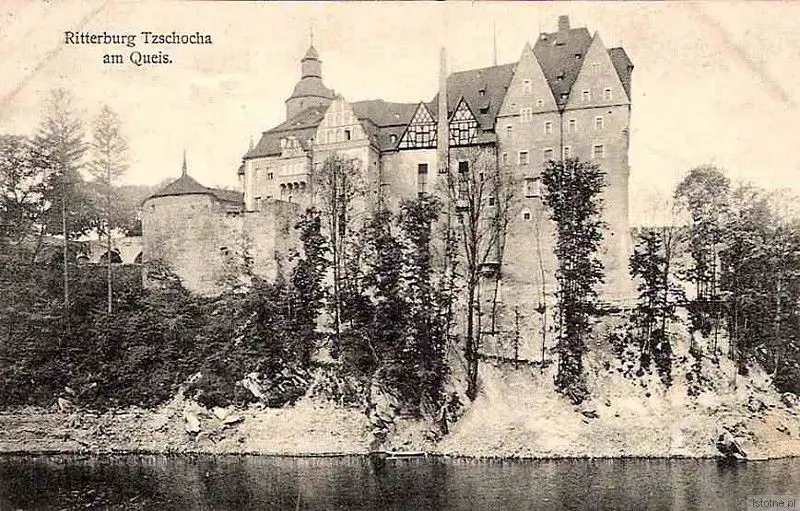
By the Kwisa River, between Gryfów and Leśna, stands Czocha Castle, surrounded by water on three sides. Its history is exceptionally fascinating and steeped in legends of fabulous treasures hidden inside the castle or in its nearby surroundings. The first references to the masonry structure date back to the 13th century, when King Wenceslaus II initiated the construction of a defensive castle on the left bank of the Kwisa, which at that time formed the border river between Silesia and Lusatia.
In 1453, the castle came into the possession of Kaspar von Nostitz, a military commander who served in the Teutonic army and took part in military operations against Poland. The descendants of the von Nostitz family rebuilt the property in the Renaissance style, enriched the castle chambers with numerous works of art, and established a library and archive in which they gathered numerous old books.
During the Thirty Years’ War, the fortification was besieged, but the enemy failed to capture it. On August 17, 1793, a great fire struck the castle, leaving only ruins and wreckage. The force of the disaster caused the rich collection of books and numerous volumes to be lost forever.
After the fire, the building was rebuilt and reopened in 1798. At the beginning of the 20th century, the castle was acquired by the Dresden industrialist Ernest Gutschow. He decided to rebuild the property and adapt it to his needs. He commissioned the task to the famous Berlin architect Eberhard. Five years after undertaking the project, the architect transformed a rather unremarkable building into an architectural gem.
During the interwar period, the industrialist stayed at the castle only during the holidays, while during World War II he moved with his family into his castle estate to escape the fighting.
As the war drew to a close, at the beginning of 1945, he evacuated with his immediate family and the most valuable treasures from his estate to Dresden. Legends circulated about his treasures: he was said to possess priceless icons and jewelry belonging to the tsars of Russia.
Treasures of lesser value remained at the castle, and a local librarian indicated where they had been hidden. The items were inventoried in a deliberately careless manner and then looted by local officials. Those involved included, among others, the deputy starost of Lubań, the mayor of Leśna, and the commander of the local militia station.
Ernest Gutschow, as a sophisticated entrepreneur and merchant, probably left some of the less valuable treasures at the castle in order to create a legend and protect the building from vandalism and destruction. After the owner fled, a rich library of approximately 25,000 books remained at the castle. They were transported to Wrocław, where they were piled up in a square near the market square and deteriorated throughout the winter of 1946.
Approximately 20,000 items from this valuable collection of books were successfully saved. During the period of the Polish People’s Republic, the castle was thoroughly examined and searched by the people’s army, but no fabulous treasures were found. In the 1990s, the building was once again opened to tourists. Today, we can admire a property that survived World War II and the period of the Polish People’s Republic intact. In the next article, I will present the legends and mysterious family secrets concerning the castle’s inhabitants.




Sebastian Zielonka – historian and graduate of the University of Wrocław. Specialization: archival studies and conservation documentation. He is interested in the history of the region and the social life of Europeans in the 20th century. In his free time, he travels.
(information: Sebastian Zielonka)