
Immediately after the Red Army captured Bolesławiec, in February 1945, the Russians began organizing a museum in the city dedicated to Russian field marshal Mikhail Illarionovich Kutuzov (1745–1813). The main initiator and coordinator of the project was Red Army Colonel Aleksander Ipatov. The institution was established in an imposing building where the field marshal had died of typhus while pursuing Napoleon’s defeated army.
The Russians create their museum
Anna Bober-Tubaj found a survey concerning the course of wartime operations in our area (she published her research in the book “Bolesławiec 1945–1966. Destruction and Reconstruction”). The German inhabitants of Bunzlau spoke of deliberate arson attacks on the city by the Soviets, which consequently caused extensive fires. The city did not suffer greatly as a result of military operations, but it was deliberately set on fire by the Red Army soldiers entering triumphantly. The Soviets dismantled equipment and fittings from many Bolesławiec factories and transported them to the USSR, including those from Concordia and large ceramic-production plants. They committed numerous acts of looting and vandalism.
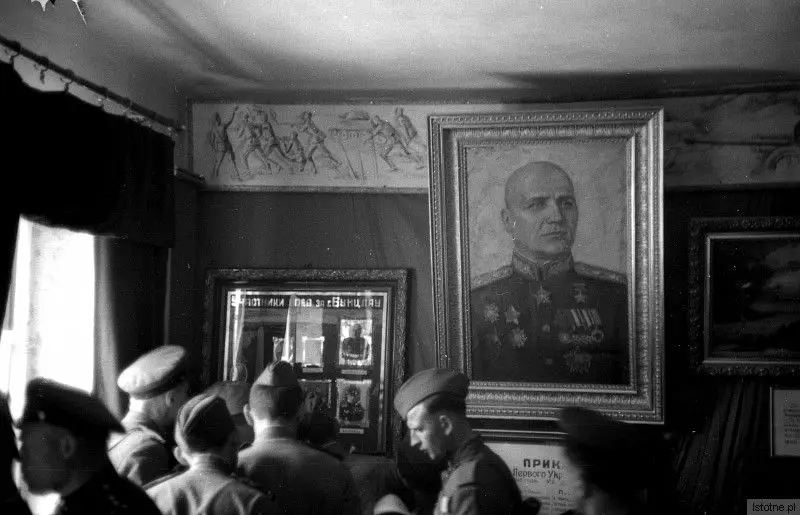
For the Soviets, creating a museum dedicated to Field Marshal Mikhail Kutuzov, a Russian hero and Napoleon’s vanquisher, was extremely important. In February 1945, the Red Army seized the building where the hero had died (today’s Museum of Ceramics on Kutuzowa Street). It confiscated mementos of the field marshal from the Municipal Museum (on Mickiewicza Street), as well as from private homes and bookstores. The purpose was to organize a ceremonial military parade two months later, on the anniversary of Kutuzov’s death.
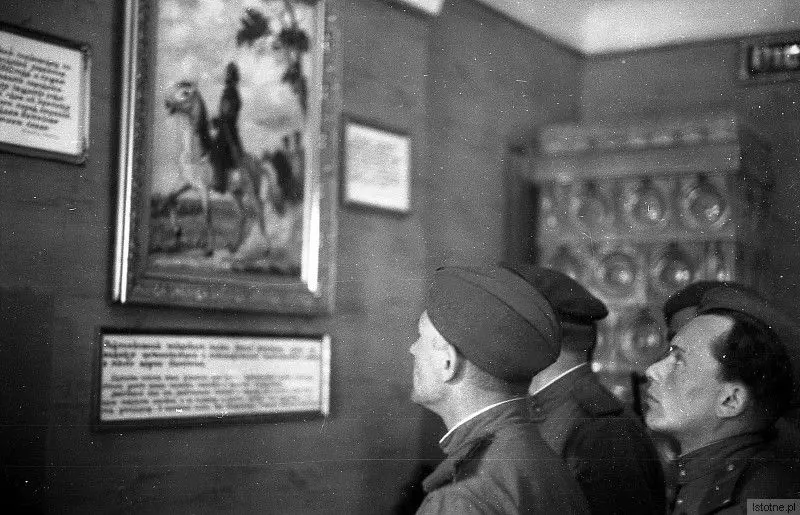
The new museum displayed, among other things, furniture, paintings and prints, some firearms and edged weapons, as well as a bronze model of the monument to the deceased marshal in Bolesławiec (objects from the former Municipal Museum). A special place in the museum was given to mementos of Paweł Zajcew, who shielded the firing port of a German bunker with his own body; his remains were buried in the war cemetery in Bolesławiec.
One and a Half Million Visitors
According to Russian data, 1.5 million people visited the Kutuzov Museum during its 46 years of existence. Objects connected with the Russian commander were displayed in the room on the first floor where Kutuzov died. They included a sofa on which the marshal was allegedly supposed to have died and a large Meissen porcelain vase given to Kutuzov by the grateful residents of Toruń for liberating them from the French occupation.
In the 1970s, the Russians added a section to the historic building containing a cinema hall (today, the temporary exhibition rooms of the Museum of Ceramics). Soviet films were shown there to visiting guests. In this cinema, Bolesławiec residents also watched the popular and well-liked Russian cartoon “Nu, pogodi!”, modeled on Disney-style American productions.


At the beginning of the 1990s, after Poland regained full sovereignty, the Russian troops left our country. In 1991, the Kutuzov Museum was also closed, and its furnishings were transported deep into Russia. For many years, it was not known what had been transported or where exactly it had gone, especially since the process was not subject to any reliable oversight; no lists or inventories of the exhibits survived either.
A Museum Like an Embassy
Interestingly, in 1991 there were no legal means of securing the museum. Dr. Andrzej Olejniczak, curator of the Museum of Ceramics, says that the Kutuzov Museum operated for several decades under rules similar to those governing an embassy; it was effectively extraterritorial and, like the evacuation of military units from Poland, was not subject to inspection.
The legends circulating among Bolesławiec residents about the possibility of buying museum exhibits from the Russians for next to nothing seemed plausible. At the time, the main objects of interest were military artifacts, but people also talked about porcelain and malachite vases, among other things. Russians who had befriended some residents gave them museum objects of lesser value “as souvenirs.”
In 2010, however, the main part of the collection was found. It was in Saint Petersburg, in the storage facilities of the Museum of Artillery, Engineer and Signal Troops. In April 2010, this institution organized a temporary exhibition displaying furniture and furnishings from the room where Kutuzov died (these objects are now presented in its permanent exhibition). Representatives of the Museum of Ceramics in Bolesławiec, Andrzej Olejniczak and Adam Faltyn, also attended the ceremonial opening of the exhibition. They tried to learn about the fate of the military collection but received an evasive answer. They also had the opportunity to meet the aforementioned founder of the Kutuzov Museum, Colonel Ipatov. Their hosts were very cordial and hospitable and readily discussed future cooperation, but the status of the museum objects was clearly defined—they would remain in the collection of the museum in Saint Petersburg.