
Everyone knows Julian Tuwim’s poem describing a locomotive with many carriages carrying goods, animals and people. The Polish poet of Jewish origin was admired for the flexibility and brilliance of his language and the humorous character of his works.
In “The Locomotive,” the poet masterfully used the rhythm and rustle of Polish words, making the entire poem an example of onomatopoeia (a sound-imitating word).

During the art classes, the children visualized what the carriages of the famous “Locomotive” looked like. They wondered whether Santa Claus had travelled by rail, or perhaps the train mentioned in the poem was heading to the Baltic Sea, carrying a family on holiday. In children’s imagination, anything was possible.
The classes, titled “Illustrations for the poem The Locomotive,” were led by painter Kamila Michoń. “We work using tearing and cut-paper collage techniques,” the instructor explained. “The children transfer what they find in newspaper illustrations into a completely different reality. They combine and supplement the whole with paints, crayons and markers.”
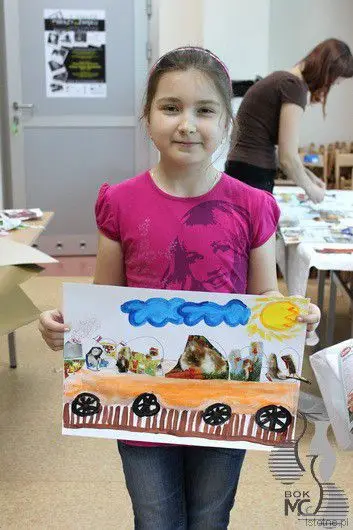
The children enjoyed the classes very much. “There are animals in my carriage,” said Roksana, a workshop participant. “There is a rabbit because I have a rabbit and we always take it with us on holiday.”
Kamila Michoń chose Julian Tuwim’s poem because it is very well known and popular with children. “My son loves this poem, and knows it by heart. The poem is also very rhythmic,” she added.

Various free classes at BOK-MCC are held throughout the holidays. Details are available on the BOK-MCC website.
(information: BOK-MCC/ii)