
Twelve artists from Bolesławiec and Kamenz worked in Bolesławiec during the summer at the “Boundless Fascination with Art” symposium. The results of their work can be viewed at the BOK-MCC gallery. Before a cinema screening, it is worth entering the “Długa” gallery to see the city through the eyes of foreigners and view the works of artists from Bolesławiec.
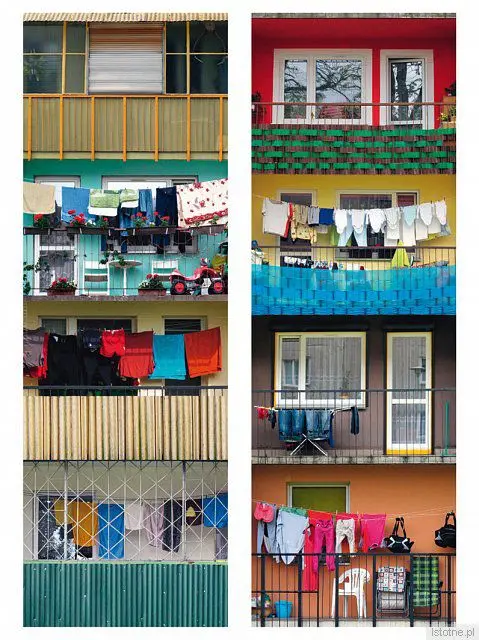
The work of Katja Springer is particularly striking. While taking a walk around the city, the artist noticed the balconies of apartment blocks. “At first they seemed hideous to me,” the artist says, “but then I saw that they express the creativity of the residents of Bolesławiec. Colourful, unusual, each different in its composition. I arranged the photographs I had taken of them into blocks, and that is how my work came into being. They remind me a little of the GDR,” Springer adds.
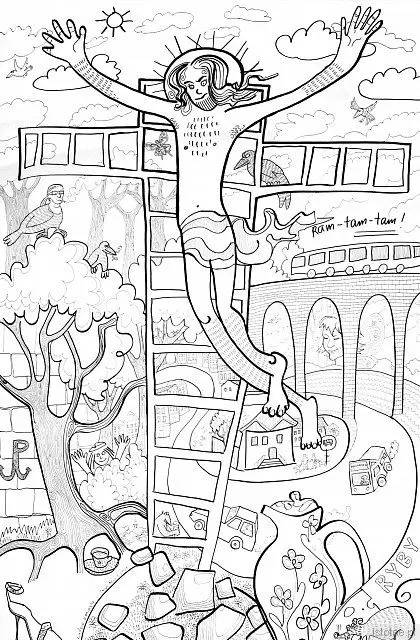
The graphic triptych by Tanja Rein also catches the eye, mainly through its numerous references to places familiar to the residents of Bolesławiec. It features the viaduct, the city parks, the market square and caricatures of the symposium participants. With the catalogue, one can identify most of the participants and the author herself, Tanja – a bird with a human head, smoking a cigarette. In this work about Bolesławiec, an unusually cheerful Jesus hanging on the Millennium Cross towers above the city.
Magdalena Konieczna presented a formally interesting work. Three slender, slightly curved columns are made of clay and rectangular panes of glass layered on top of one another. The texture of the glass is intriguing – cool, ice-cold and sparkling in the light. The clay is warm, dry and matte brown. Combining these two materials is, in a way, perverse and alluring.

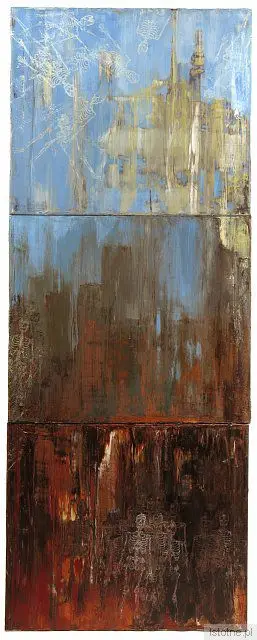
The untitled work (oil on canvas) by Kamila Michoń also draws attention. A vertical triptych filled with colour – warm at the bottom and cool in the upper part of the work – it is decorated with skeletons reflected in the paint. While talking about creating her works and her fascination with the destruction of objects discarded by people, Kamila discovered where the skeletons in the painting came from. “I collect finds at flea markets or antique fairs,” Kamila Michoń says. “My husband found this skeleton for me, and I decided to use it in my work.”
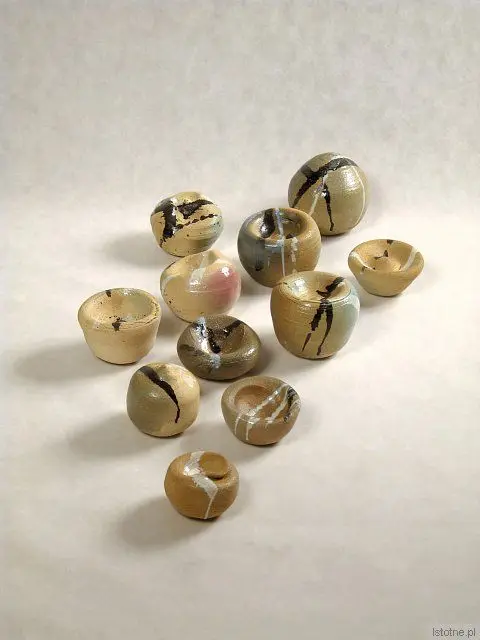
Mateusz Grobelny – the artistic commissioner of the symposium – presented the result of his happening “Residents’ Breaths…”. Fired clay balls, deformed in their raw form by the breaths of local residents, are traces of encounters with passers-by. Each “breath” is identified by the name and occupation of the person who gave it to the artist.
The project “Boundless Fascination with Art Bolesławiec – Kamenz 2011” is co-financed by the European Union through the European Regional Development Fund and by the state budget, with the support of the Nysa Euroregion.


(information: Grażyna Hanaf)