
Participants in the “Boundless Fascination with Art Bolesławiec – Kamenz 2011” symposium, organized at the International Ceramics Centre, found exceptional places, images and structures in Bolesławiec. Based on them, they created works in which our city appears fairy-tale-like, joyful, or predatory and dangerous.

Bolesławiec seen through the eyes of foreigners is dominated by the Millennium Cross. Spirituality and Catholic religiosity were the first things noticed by Volker Lenkeit and Tania Rein.
Tania created a comic in which she presented Bolesławiec as something like a fairy-tale town. Her work, full of little stories and anecdotes, depicts a walk through the city. It features birds with human heads, funny cars gliding along winding streets, princesses and lost slippers, as well as a family of mice drinking tea from Bolesławiec pottery. In her work, a train on the viaduct travels along making a cheerful sound: “Ram-tam-tam”.

The main accent of her three-part work is a gigantic Jesus Christ rising above everything from the Millennium Cross. The figure of God is painted in a comic-book style. Jesus is somewhat hippie-like and smiling. He raises his hands upward, giving the impression that he is about to fly away. The artist’s work contains neither pathos nor unnecessary solemnity, but lightness, joy and imagination.
Volker Lenkeit was intrigued by what is invisible—spirituality and Catholicism, which for him form the atmosphere of Bolesławiec. Christianity inspires the artist; his clay sculpture depicts a “Blessing Hand”.

Fascinated by the old Evangelical cemetery on Gancarska Street, he made several imprints of gravestones (from the 16th century to the beginning of the 20th century, it was Bolesławiec’s main cemetery; it contained many valuable monuments, mindlessly destroyed after the Second World War). Lenkeit noticed deliberate human actions aimed at destroying history. He had already explored a similar subject by seeking out political (election) posters in which important information, such as details about a candidate, is altered or obscured.
Photographer Katja Springer described Bolesławiec with the words: colourful, old and new, and open. She also noticed the architectural similarity between Bolesławiec and towns in the former GDR. The city’s housing estates fascinated her both through their ugliness and their originality. When she entered the city, the sight of the blocks struck her. At first glance they seemed banal, even hideous. But when she looked at them more closely, she noticed that every balcony module was different and original. She created a work that recorded the extraordinary, everyday creativity of the people of Bolesławiec.
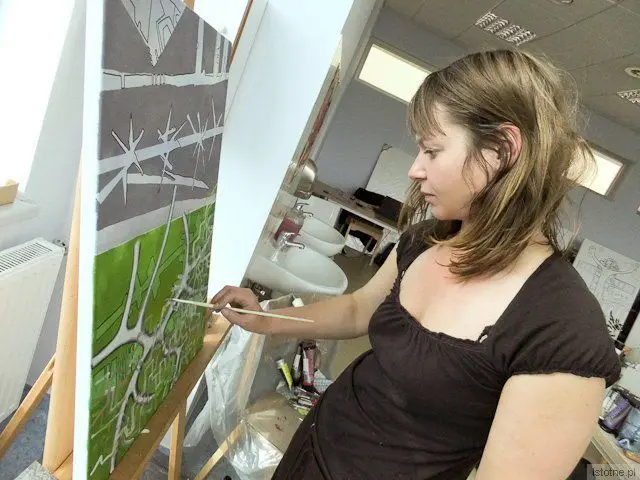
Moni West first went on a photographic tour of the city. She searched for structures—patches, signs and graphic elements abstracted from urban landscapes. She transformed the peeling walls of houses, the boards of fences surrounding construction sites, indelible graffiti and vulgar writing on walls into the aggressive structures of her abstract painting. She gave the painting a large Polish inscription: attention.
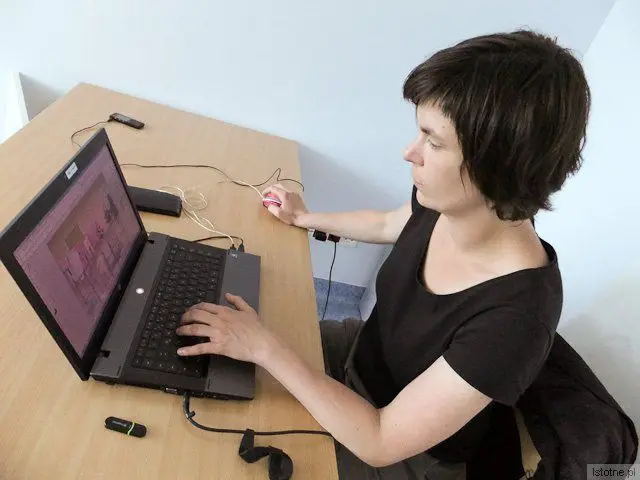
Graphic artist Frank Voigt discovered a material new to him in Bolesławiec: clay. Previously, he had created his works on a computer, and the mere touch of this simple, primal material brought him great pleasure. The artist is experimenting by creating clay tile-medallions. He is both anxious and curious about the final result, when he fires the work in a kiln. For the first time, he will passively wait to see what happens to his creation. When the work is fired, he will be deprived of control over it. This new experience was also given to him by our city.

Art happening
The artists taking part in the symposium invite all residents of Bolesławiec to a special happening. The event will begin at 14:00, on Thursday, 21 July, in the foyer of the Bolesławiec Water Park “Orka”. Together with the symposium participants, residents will be able to create a joint work—tiles on which they can paint their own compositions.
The project “Boundless Fascination with Art Bolesławiec – Kamenz 2011” is co-financed by European Union funds under the European Regional Development Fund and by state budget funds, with the support of the Nysa Euroregion.

(commissioned information: Grażyna Hanaf)