
– And where’s the beret? – Piotr Roman jokingly asked Piotr Roman Dean Andrzej Jarosiewicz before a meeting with Jan Pospieszalski, who had been invited to Bolesławiec to give a lecture and show the film “Solidarity 2010.” No answer was given to the question. But in one fragment of the film, one of the men recorded addressed a defender of the cross on Krakowskie Przedmieście in Warsaw: – You have berets too, but you’ve hidden them.
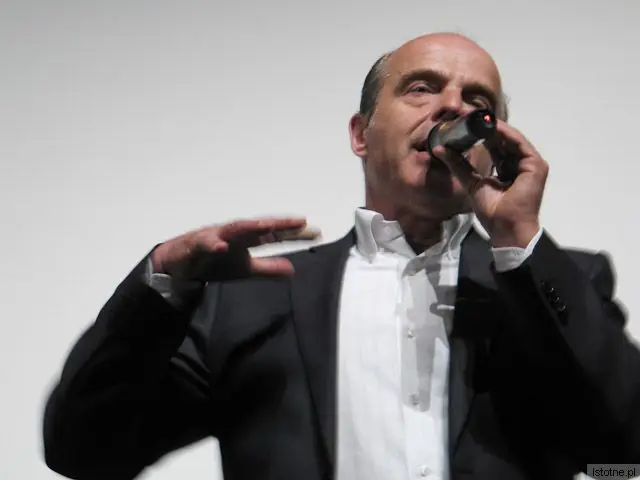
Jan Pospieszalski was invited to Bolesławiec by the Local Government Forum of the Bolesławiec Region, whose president is Piotr Roman. More than 350 people attended the meeting; the Forum cinema hall was almost full. The journalist began his speech by describing how he and other journalists had been removed from public television. – Schymalla [szefowa TVP przyp. red.] dismissed journalists who were characterized by a certain inquisitiveness concerning the Smolensk disaster.

Pospieszalski then spoke at length about the unreliability and manipulation practiced by the media in Poland. When describing how his documentary about events beneath the cross in Warsaw had been rejected, he compared public television to the mafia and quoted the words of the film’s director, Ewa Stankiewicz, who supposedly concluded that she had encountered disciplinary pre-emption. – Just as the mafia leaves a dead dog at someone’s door to show that it knows where the victim lives and can do anything to them, so the head of television treated us by dismissing us from our jobs – Pospieszalski explained. – This is a clear signal to young journalists if they want to be politically incorrect – he added.
He named, among the main manipulators, TVP, TVN, TOK FM radio, and later Gazeta Wyborcza, Newsweek and Polityka. He did not mention “Trwam” television. When asked about his impressions after the meeting, Rev. Dr. Andrzej Jarosiewicz agreed with the view that the media manipulate society. – At first glance, it was clear that what reached us [po tragedii – przyp. red.] from the public and government media was not an authentic picture of what was happening in Warsaw – Jarosiewicz said. – Each of us had the impression that the images in the official media were constructed in such a way that the authentic truth would not reach ordinary people. After this meeting, I became even more convinced of this.
Krzysztof Gwizdała from the “Istotne Informacje” website and newspaper asked Jan Pospieszalski whether he knew that the people who had invited him exerted the same influence on the media [miasto ma 40% udziałów w lokalnej telewizji – przyp. red.] and did not like it when someone wrote something contrary to their views. – I have no influence over who invites me. I always say what I think and I am able to defend it. But if things are as you say, I hope that my lecture and film will be good catechesis for them.
The deaths of 96 people are dividing Poland ever more deeply into two ideological camps. The film “Solidarity 2010” does not bring people together. Nor is that the purpose of Jan Pospieszalski’s lecture. It was rather a commentary on excerpts from a film in which the author sought to convince those who were already convinced that the Tupolev crash was a mysterious and strange disaster.
Only one man caught the journalist issuing judgments too quickly. Pospieszalski stated that his next documentary, “The Passenger List,” had been broadcast on TVP only once, and at night. A man in the audience checked this information on the Internet. – This film was broadcast twice more during the daytime by TVP. It is possible that your entire lecture was also not as reliable as your information about the television’s mistreatment of “The Passenger List” – the young man said.
Pospieszalski thanked him for the information about the film’s broadcasts. He said that he traveled frequently and had not checked carefully enough when else the film had been shown. He did not engage in a discussion about the infallibility of the rest of his claims. At the end, he said that he had found a fragment of free Poland—in Bolesławiec today, at the Forum cinema.
Gallery (6)


Show remaining photos (3)


(information: Grażyna Hanaf)