
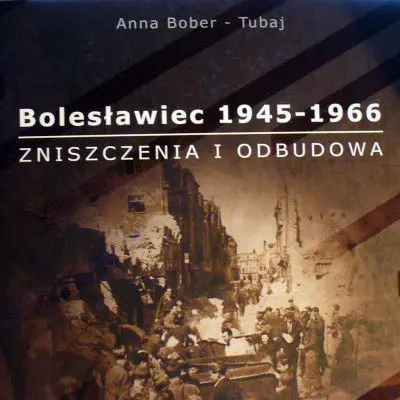
Anna Bober-Tubaj published her painstaking work, “Bolesławiec 1945–1966. Destruction and Reconstruction,” two years ago. I have only just read it, compelled to do so by professional duty. On the surface, it is merely a dry account of the city’s devastation and reconstruction, created from archival documents. In reality, by documenting these events, the author captured the birth of the city. This is a book about how Bolesławiec’s soul was saved.
Whenever I asked my grandfather about the post-war years, he would always tell me that there were things he could not yet tell me. At the time, I was required to learn Russian at school, subscribed, like all the students, to Russian children’s magazines, and corresponded with a Soviet schoolmate. I do not remember whether my late grandfather revealed the secret to me or not. But I recalled those questions while reading the book by the director of the Museum of Ceramics in Bolesławiec.
Anna Bober-Tubaj found a questionnaire concerning the course of wartime operations in our area. The German residents of Bunzlau described deliberate arson attacks on the city by the Soviets, which consequently caused extensive fires. The city did not suffer greatly as a result of military operations. It was deliberately set on fire by Red Army soldiers entering it in triumph. The Soviets dismantled and transported to the USSR machinery and equipment from many Bolesławiec factories, including Concordia. They also committed acts of looting and vandalism. In the archive’s holdings, the author found a letter from the City Administration to the Commander of the Soviet Forces concerning the firing of live ammunition at electric lamp bulbs on Asnyka Street. She also writes in her book about the interventions of the city’s mayor at the time, who was unable to secure uninhabited houses. The Russians were dangerous looters. They removed windows, doors and portable stoves, and vandalized whatever they could not take.
For the Soviets, it was more important to create a museum dedicated to Field Marshal Mikhail Kutuzov, the vanquisher of Napoleon and a Russian hero, than to secure the city for the Poles. In February 1945, the Red Army occupied the building where the hero had died—the present-day Museum of Ceramics on Kutuzowa Street. It requisitioned Kutuzov memorabilia from the City Museum on Mickiewicza Street, as well as from private homes and bookshops. All this was done so that two months later, on the anniversary of Kutuzov’s death, a ceremonial military parade could be organized. A show of strength.
When the Soviets left the city, the new people’s government did not favor the pre-war German city or its reconstruction. As Anna Bober-Tubaj documents, a government plenipotentiary ordered German inscriptions to be carefully erased. Failure to carry out the order was punishable, with mayors and village heads held responsible. The Poles themselves were not favorably disposed either. After five years of the horrors of war, they not only wanted to forget German rule. They wanted to destroy everything associated with Hitler.
As the author writes, reconstructing the city in its historic “German” form succeeded thanks to historians’ arguments emphasizing the Italian and Silesian-Lusatian elements in Bolesławiec’s architecture, rather than the German ones. But when a restaurant in the market square was given the Italian-sounding name “Toscano” (after the Italian architect’s surname), the residents of Bolesławiec also protested. The local radio station eased tensions by reporting on the great merits of the Italian builder for Bolesławiec. And the foreign-sounding name remained. In addition to the radio station, as the author reports, the County Information and Propaganda Office was active and effective. Its employees created triumphal arches and slogans such as “Long Live Generalissimo Stalin and Polish-Soviet Friendship” and “The Piast Lands Were and Will Be Ours.”

Historic preservation therefore had to contend not only with actual damage, but also with propaganda. This was how Bolesławiec was built. It was meant to be entirely new. Polish. People’s. A struggle was waged to preserve some historic monuments. Anna Bober-Tubaj describes the exchange of letters in defense of a former Protestant church—today the Church of Our Lady of Perpetual Help—which had been slated for demolition. After many refusals, it was possible to save the nineteenth-century tower. Today, it is a familiar and indispensable element of the city panorama. Once, it was the building of a hated nation of oppressors.
Thanks to the efforts of people who love stone and art—historians, preservationists, art historians, architects and museum professionals—the city’s historic urban layout was preserved. Bolesławiec’s soul was hidden in the old stones and streets dating back centuries. Anna Bober-Tubaj deserves the highest praise for documenting this phenomenon. Richly illustrated with archival photographs, including those by Bolesławiec native Alojzy Skorupa, the book is an important publication for local residents. I encourage you to discover it.
Grażyna Hanaf