
Palace in Kraszowice
The Renaissance-style manor house, founded in 1578 by Winzent von Bibrant, is a historic gem. Although it flourished in the 18th and 19th centuries, its history after 1945 is rather sad. After the war, it housed the Kraszowice state agricultural farm, but no one thought about conservation. In the 1990s, it came into the hands of the Agricultural Agency.
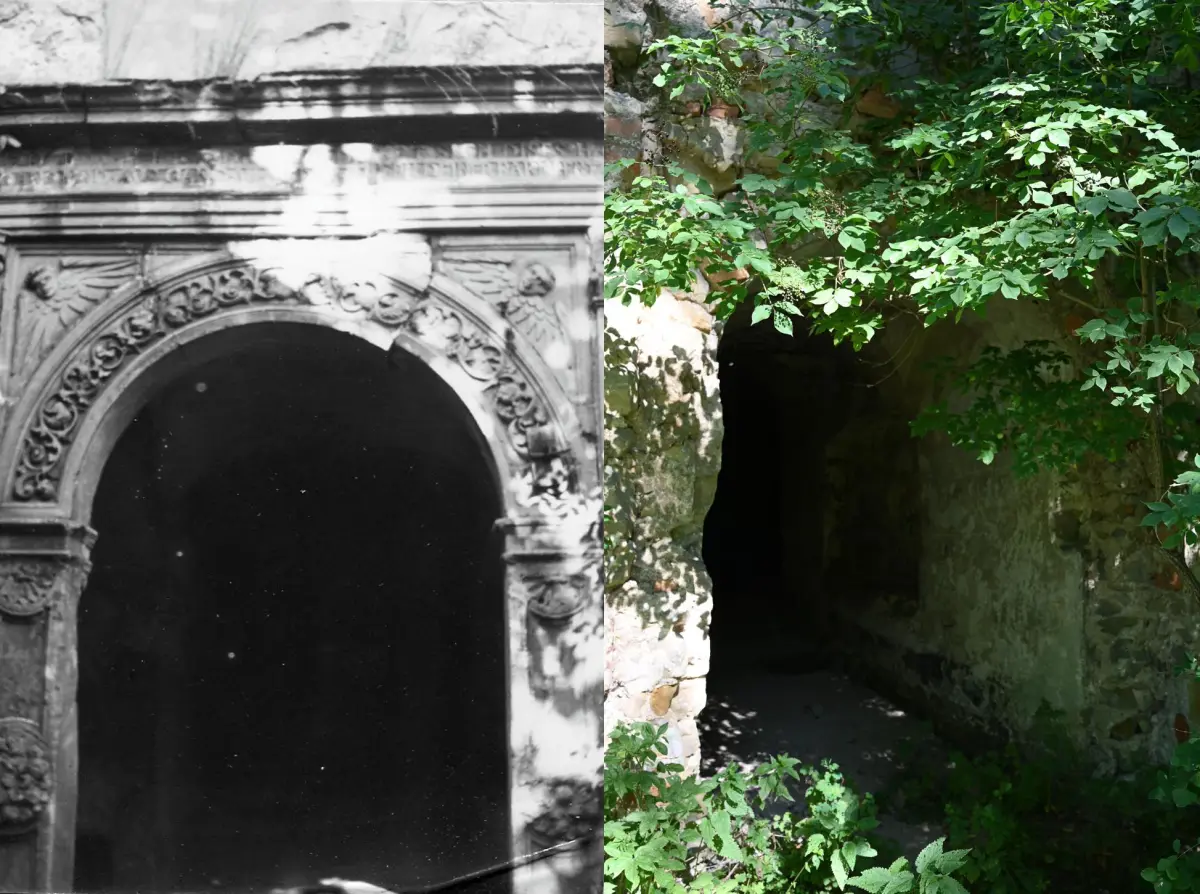
Only a fragment of the portal leading to the manor has survived. It had an arched vault, pilasters with composite capitals, and candelabra ornamentation. It was richly decorated with rosette motifs, vegetal ornamentation, and winged putti heads. The whole was topped with a tall entablature featuring a frieze filled with a foundation inscription and the initials of the founder, Valentina Ladislausa von Bibran the Younger, who took over the Kraszowice estate after his father's death in 1574.
“15 BV 78 DU-HEILIGE-DREI-FALDIGKET-SICH-DISES-HAUS // EINGANG-UND-AUSGANG-AN-MIT-DEN-AUGEN-DEINER-BARMHERTZKEIT” (“O Holy Trinity, look upon the entrance and exit of this house with the eyes of Your mercy”).
The portal was stolen in 1994. Only part of it was recovered: the jambs and the lower section of the entablature with the inscription. These fragments, deposited by the Regional Office for the Protection of Historic Monuments, are currently kept in the Department of the History of Bolesławiec at the Ceramics Museum.
Several monumental trees stand behind the manor. Remnants of a plaque have survived on two of them. The broad-leaved lime is named “Haneczka.” The oak bears the name of Julian Malinga.
Palace in Kraśnik Dolny
In the first postwar years, Kraśnik Dolny operated under the name Piękna Wieś. Located on the Bobrzyca River, a tributary of the Bóbr, it was the seat of the Wendland family. The palace was built in the second half of the 18th century and remodeled around 1860 and in 1923.
Today, the building serves a residential purpose, providing homes for many families. The somewhat neglected park surrounding the palace recalls its former glory, when the building played a key role in the life of the local community.

Water Castle in Gościszów
The first references to Schloss Gießmannsdorf appear in 1294. Its location on an artificial island, on the site of a former Slavic fortified settlement, testifies to the strategic importance of the place. The castle was initiated by Henry III of Głogów, underscoring its historical significance.
At the end of the 14th century, the castle underwent a significant change. However, it was the Late Renaissance remodeling in 1603 that determined its form. It is worth noting that the original fragments were preserved during this remodeling, giving the building a unique character.
The castle's architecture was carefully planned: the residential and utility sections were arranged around a quadrangular courtyard, forming a coherent whole. The entrance led through a Baroque bridge suspended over the moat and an ornate entrance gate. A Renaissance semicircular portal, inspired by the Arch of Constantine in Rome, with Doric columns and a frieze bearing family coats of arms, enriched the castle's architectural composition and emphasized its prestige.
The castle was destroyed toward the end of World War II, when it was mistakenly destroyed in a Luftwaffe air raid on March 3, 1945. As a result, the castle and the library collections and works of art housed inside it burned down. Plans for its redevelopment emerged in the early 1960s, but they were not carried out. In 1965, it was secured as a permanent ruin.

Palace in Warta Bolesławiecka
The manor house in Warta Bolesławiecka was built in 1540 by Hansa von Zedlitz. After construction was completed, von Zedlitz sold the estate to the von Glaubitz family, and shortly afterward the palace passed into the hands of successive families: von Stiebitz and von Sommerfeld.
At the turn of the 16th and 17th centuries, the palace's structure was remodeled: a north wing, dated to 1612, was added. This expansion demonstrated not only the ambitions of its owners but also the influence they held in contemporary society.
After Abraham von Sommerfeld's death, his wife Barbara, née von Reibnitz, became the estate's sole heir. Her subsequent marriage to Otto, Baron von Hohberg, contributed to the palace's flourishing. After Barbara's death, the baron married Sophia Hedwig von Schellendorf. Their union resulted in the birth of a daughter, Helena Sophie Magdalena, who in 1683 married Hans Wolfgang Wenzel von Frankenberg, Vice-Chancellor of the Kingdom of Bohemia.
The history of the manor in Warta Bolesławiecka reflects not only the fortunes of its owners but also the broader sociocultural context of the eras in which it functioned. These changes show how significant and influential the people managing the property were, and how their decisions had a substantial impact on the region's development.
After 1945, the palace was systematically destroyed and looted. Until the 1970s, it was part of a state agricultural farm. Abandoned after 1989, it fell into ruin. In 1993, the Agency for Agricultural Property of the State Treasury announced a tender to lease the farm, which was won by farmer Stanisław Kuduk. In 2006, he became the owner of the property.

Editor's note: bolecinfo journalist Dariusz Gołębiewski misleads his readers to motivate them to make payments, providing information that departs from the truth—that “anonymous, unauthorized summaries” of his historical essays are appearing on a competing portal, whose name he does not mention. For such a reliable historian, these suppositions without facts and sources—which he apparently cares so much about in his work—are rather weak. We do not know where the idea came from that only Dariusz Gołębiewski may write about the region's history. He is another person who has decided that something belonging to the common good belongs only to him. We encourage Dariusz Gołębiewski to have an honest conversation with his principal, Marcin, and his colleague Kazimierz Marczewski, who shamelessly draw extensively on the work of our editorial team. After all, imitation is the highest form of admiration.