
Buying contact lenses using a glasses prescription
As we know, glasses are purchased based on a prescription from an ophthalmologist or optometrist. However, not everyone knows that a glasses prescription is not the same as a contact lens prescription. The corrective values may be identical, but they may just as well differ. This applies to optical power as well as to additional parameters found in lenses for people with astigmatism or presbyopia, namely cylinder power and addition.
This is why people who are unaware of this relationship sometimes experience discomfort when buying lenses based on their glasses prescription. It may even be severe enough to cause problems with clear vision and lead them to conclude that contact lenses are not for them. In reality, this is the result of an error caused by a lack of knowledge. Of course, it can happen that someone should not wear contact lenses. This may be the case with dry eye syndrome, glaucoma and other eye diseases, as well as allergies, blood pressure problems or diabetes, for example. This is another reason to begin the lens-selection process with a specialist. They will identify any contraindications to wearing contact lenses in general or specific types of lenses. And what types are there?
Types of contact lenses
Contact lenses can be divided according to several different criteria. The most obvious is matching them to the type of vision defect. The most popular are spherical lenses that correct near and distance vision (plus and minus powers). People with astigmatism use toric lenses, while progressive lenses are prescribed for presbyopia.
Another selection criterion, which mainly depends on the user, concerns how the lenses are worn and used.
Daily disposable lenses are worn for one day, from morning until evening. You cannot sleep in them, although you can take a nap. Once removed, they should not be put back in—they must be discarded, which is why they are also called single-use lenses. These lenses are intended for people who want to minimise all the additional tasks associated with storing and caring for lenses. The second group that chooses them consists of people with allergies, a tendency to irritation and sensitive eyes. These are the softest and most delicate lenses available on the market, so they may be the only choice when we want to maintain visual comfort. They are also chosen by people who alternate between glasses and contact lenses, putting the latter on, for example, for social events, sports matches or training sessions. The vigorous movements that accompany such occasions can cause glasses to slide down, get in the way or become damaged. Daily disposable lenses effectively solve this problem while also ensuring excellent visual quality.
In addition to disposable lenses, there are lenses that can be worn repeatedly over a specified period. They are significantly cheaper when calculated over their usable period, which is why they are the most popular. These are two-week and monthly lenses, which can be worn for 14 or 30 days from the moment the package is opened.
Monthly contact lenses can also be divided into two groups. Those worn in daily mode are put in in the morning and removed in the evening, while extended-wear lenses can be worn for thirty consecutive days, including at night. The choice is individual, although it may be determined by an optometrist’s recommendations, for example because of possible eye irritation when wearing lenses for several consecutive days.
Do our contact lenses require more care than glasses?
Lens care—is it time-consuming?
Caring for glasses usually involves regularly wiping them with a cloth, washing them occasionally, and remembering to keep them in a case and protect them from mechanical damage. Contact lenses fare slightly worse in terms of time, but over the course of a day the difference is literally just a few minutes.
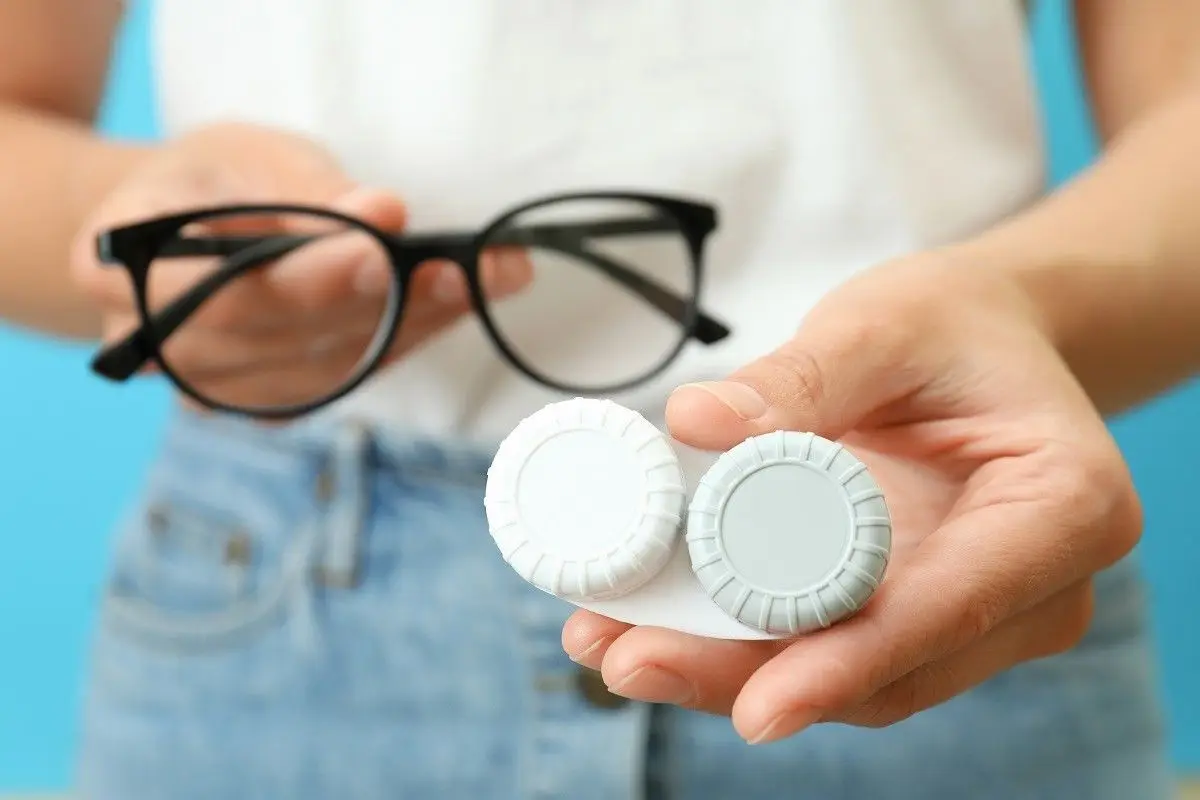
Reusable lenses should be cleaned after removal using a multipurpose solution. Depending on the product, the lens can be cleaned traditionally by gently rubbing it with a fingertip, or you can choose a solution with a “no rub” formula, in which the lenses only need to be immersed. The next step is to place the lenses, immersed in the solution, in a storage case, from which they are taken out in the morning. This is essentially the end of the care routine. Naturally, you need to remember to purchase solution regularly (once opened, it remains usable for several months) and replace the cases (they should be replaced every month), but these tasks really do not take much time. It is also much easier to keep an adequate supply of these accessories by buying them at the same time as the lenses. This is especially recommended because one of the largest Polish online stores, BezOkularow.pl, often offers promotions in which prices are reduced by up to 30%. This is certainly an incentive to shop.