
Thermal modernisation simply pays off!
More and more Poles realise that thermal modernisation of a home is no longer just a trend, but simply a necessity. What is this due to? Above all, a well-insulated home uses little energy while providing its residents with a high level of thermal comfort. The average cost of heating an uninsulated home accounts for as much as 70% of all building operating costs, meaning that a heating season lasting several months may result in bills running into thousands of zlotys. Why are the costs so high? In winter, heat escapes outside through the walls despite intensive heating. Approximately one-third of buildings’ heat-energy losses result from heat passing through uninsulated walls. It is therefore clear that using insulation made of polystyrene with a suitably selected thickness and lambda value is one of the most rational and cost-effective investments, generating savings on heating.
Choose a Complete Insulation System – and enjoy a durable façade for years
When looking for an advantageous, modern thermal-modernisation solution, it is worth choosing polystyrene in a Complete Insulation System. Why? Experts recommend using an insulation system in which all components come from a single manufacturer, because only such a complete system guarantees the proper operation of the entire assembly, its durability and effective reductions in home-heating costs. An additional advantage is that, by choosing a complete insulation system, you can select a ready-made, optimal solution. You therefore do not have to look for products from different manufacturers and match them yourself – saving time as well!
Where can you buy a Complete Insulation System?
All the products discussed here can be purchased from WOBIS, 3F Wojewódzka Street in Jelenia Góra.
Check the distributor map – click here.
Polystyrene – how do you choose the optimal type?
The basic thermal-insulation material and, at the same time, the most important component of the Termo Organika Complete Insulation System is polystyrene. The range includes “FASADA” polystyrene boards in as many as seven variants, differing in their insulating properties and mechanical parameters, as shown in the graphic.

Lambda is crucial – the lower it is, the better the thermal properties of the polystyrene
Thermal insulation is the most important factor. The parameter that must be checked when choosing insulation materials is λ (lambda), the coefficient of thermal conductivity. In recent years, the most frequently selected material has been TERMONIUM PLUS façade graphite polystyrene, whose thermal-conductivity coefficient (lambda) is 0.031 W/mK, making it the material with the most favourable thermal-conductivity coefficient. It is worth remembering that the lower the lambda value, the better the insulating properties of the polystyrene boards, and consequently the better the building’s thermal protection – with thinner boards. For example, a 20 cm layer of insulation made from TERMONIUM PLUS façade boards protects a building’s walls as effectively as a 28 cm layer of ordinary polystyrene with a lambda of 0.045 W/mK. In the case of polystyrene, tensile strength (TR) is also an important parameter. The minimum level is 80 kPa. Material with a poorer tensile-strength parameter may tear under a considerably lower force and consequently detach from the wall.
Which adhesive should you choose for polystyrene?
Polystyrene alone will not “stick” to a wall surface, which is why appropriately formulated types of adhesive are used to install polystyrene boards and permanently attach the insulation. Adhesive is, of course, part of the complete insulation system, but it is worth knowing a little more about it.
Adhesives for attaching thermal insulation:
- TERMONIUM adhesive for attaching polystyrene boards and embedding the mesh
- TO-KU Universal Adhesive for attaching polystyrene boards and embedding the mesh
- TO-KS adhesive for attaching polystyrene boards
- TO-KPS polyurethane adhesive for attaching polystyrene boards
Installing polystyrene on the exterior wall surface with adhesive is one of the most important tasks. However, the second, equally important stage of insulation work using adhesive is reinforcing the façade with fibreglass mesh embedded in a layer of universal adhesive several millimetres thick. Adhesives for embedding mesh additionally contain dispersed reinforcement in the form of polypropylene fibres that strengthen the entire insulation assembly. Universal adhesive can be used for two tasks: bonding polystyrene to the surface of the insulated wall and embedding the mesh, that is, creating a layer reinforced with fibreglass mesh.
Universal adhesives – for embedding mesh and attaching polystyrene:
- TERMONIUM adhesive for attaching polystyrene boards and embedding the mesh
- TO-KU universal adhesive for attaching polystyrene and embedding reinforcing mesh
- TO-KUB white universal adhesive for attaching polystyrene and embedding reinforcing mesh
Plaster – which type should you choose?
Plaster forms the final façade layer and therefore serves as the building’s calling card. It must consequently be not only attractive, but above all durable, long-lasting and resistant to the growth of algae and moss. It should not get dirty. It is worth remembering that, in practice, no plaster is completely resistant to dirt, just like other building elements—the best example being window panes. Sooner or later, they gradually become dirty. Particular attention should nevertheless be paid to the types of plaster. You can choose acrylic plaster, mineral plaster, silicone plaster and many hybrids, such as silicone-acrylic or silicone-silicate plaster.
It is worth remembering that when insulation is made from polystyrene boards, the options for choosing plaster are almost unlimited.
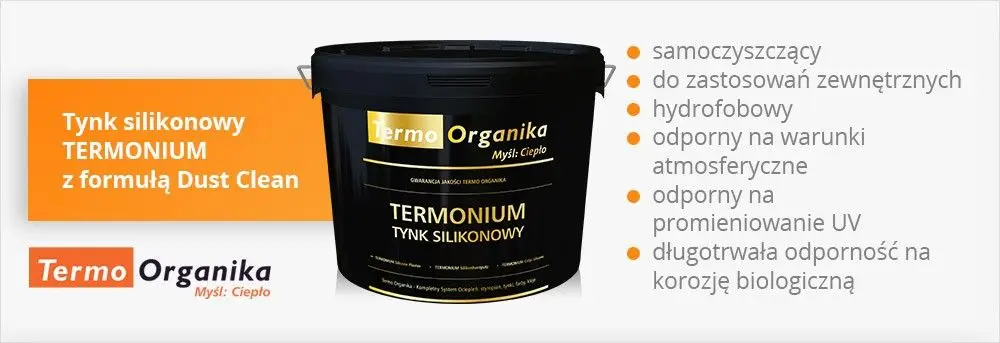
The best solution currently available is TERMONIUM silicone plaster, which features the DUST Clean formula, meaning it can self-clean. As a result, dirt has more difficulty adhering to it because rain washes its surface. Such plasters are particularly worth using in areas with heavy traffic, near trees and tall shrubs, and close to bodies of water, where air humidity may be higher. Silicone plaster will retain its properties for longer.
The best TERMONIUM variant
The TERMONIUM System is the best variant of the Termo Organika Complete Insulation System. It is based on the warmest graphite polystyrene from the TERMONIUM range and fixed using TERMONIUM universal adhesive, which is also used to create the reinforced layer. The entire system is finished with the technologically most advanced TERMONIUM silicone plaster, available in a wide range of colours from Colors of Termo Organika.
The TERMONIUM Complete Insulation System is exceptionally durable and resistant to external conditions. It also offers outstanding stability, significantly improving insulation quality and guaranteeing energy savings, even under extreme conditions.

Experts agree that the high quality of insulation materials is crucial when choosing an insulation system. There is no room for compromise here – quite simply, the TERMONIUM Complete Insulation System has no equal.
Choose a Complete Insulation System – the best way to insulate walls
For exterior walls, the best and proven way to reduce losses is to use a complete insulation system from a single manufacturer. Properly performed work using the highest-quality wall-insulation materials will provide effective and durable thermal protection against buildings cooling down. A complete system also guarantees compatibility between its individual components, which translates into safe use and a durable, attractive façade. Termo Organika products, such as polystyrene boards and the complete insulation system, hold a Technical Recommendation, making them a reliable choice for years.