
During this year’s Congress of Women, a meeting in Warsaw attended by women from all over Poland, one of the main demands was to introduce a parity system into the electoral law: a mandatory 50 percent presence of women on electoral lists and the alternating placement of women and men on them.
A discussion is under way in Poland about whether such a solution is good for women and whether they will want to participate in political life. Whether they are suited to be good politicians. And whether, consequently, this would not constitute discrimination against men.
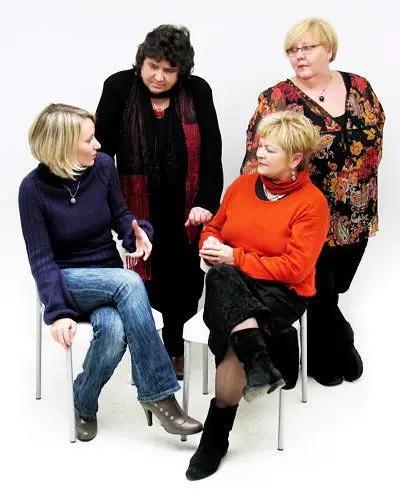
They discussed parity:
- Jadwiga Bobek – social activist, president of the Society of Friends of Children and a county councillor
- Danuta Maślicka – first-term city councillor, one of the founders of the local television station in the city, and founder of Bolesławiec’s Teachers’ Solidarity in 1980.
- Ewa Ołenicz-Bernacka – city councillor, teacher at Gimnazjum Samorządowe No. 2.
- Majka Nowak – press spokesperson for the Bolesławiec County Office.
Grażyna Hanaf: The parity system in electoral law is controversial. It is commonly believed that it involves forcing women into the Sejm, parliament and local councils. Men most often put it this way: “We like women very much. But does that mean they will be forced into governing?” A mandatory half of women on electoral lists does not necessarily mean their presence either in the Sejm or in city and county councils. Discussing the parity system, however, takes us onto the slippery ground of exercising power. So let us begin with the question: Who runs Bolesławiec? Women or men?
Danuta Maślicka: That is a rhetorical question…
Jadwiga Bobek: Surely no one doubts that the mayor is a man… Unless we have doubts…
Majka Nowak: …and if anyone does, they will not state them publicly.
Jadwiga Bobek: If we are asking about the city, it must be said that the most important person on the City Council is a woman. The chairwoman of the City Council.
Ewa Ołenicz-Bernacka: And some men are probably afraid of her.
The chairwoman was open to meeting with us, and we hope to host her when discussing other topics. But who really runs things? The City Council has 21 councillors, only 4 of whom are women. The County Council has 5 women and the same number of councillors.
Danuta Maślicka: Arithmetic is the answer.
What is it like to co-govern with men who are in the majority?
Jadwiga Bobek: I do not think contact with men is bad. I have no problems reaching an agreement, or, one might say, pressing my points, or getting them to accommodate my request.
What is it like in the city?
Ewa Ołenicz-Bernacka: The chairwoman’s position on the Council is certainly very strong. The chairwoman has a strong personality. She is respected without having to demand it. She often repeats that she defends the interests of all councillors. And even when she sometimes inadvertently gets drawn into political disputes, she comes to her senses and tries, in a womanly way, to ease the matter. Recently, there was even a situation when one councillor attacked another. The councillors harbour animosity toward one another. The chairwoman objectively defended the aggrieved councillor.
Majka Nowak: This is not a matter of sex; I believe it is a matter of working style. The same could be said about the man who chairs the County Council, who stresses that he is decisive, objective, and so on. To answer the question of who runs the county, however, it is men. Exactly three men.
I have a question for Danuta Maślicka. Who, in your opinion, won the current democracy after 1989? Women or men?
Danuta Maślicka: The men certainly receive more attention. The role of women is not discussed. I even mentioned it somewhere once. There is a book, “Lipstick on the Banner” (by Ewa Kondratowicz), which shows the role of women during the Solidarity period and martial law. That role is simply underestimated. Because thanks to what women did, the men were able to emerge.
After 1989, we had more women in politics. Józef Burniak reminded us that in the first term of the City Council there were 11 women. Then that number declined.
Ewa Ołenicz-Bernacka: This may not reflect public sentiment, but rather ways of thinking and approaching various issues. I asked my husband what he thought about parity. In his view, it is important and without its introduction there would be no question of genuine democracy and genuine equality.
Historically, things happened somewhat differently here. During the so-called communist era, the myth prevailed of the woman tractor driver who built houses with a trowel and exceeded work quotas. Thanks to that system, she was made equal to men. Has the opposite stereotype now emerged, and have we begun to distance ourselves from this woman of action? Perhaps women themselves withdrew from politics into their traditional roles?
Jadwiga Bobek: Women decided they no longer had to fight.
Danuta Maślicka: A historical stereotype took hold here. In times of struggle and uprisings, much was said about women. They fought, supported others and made sacrifices. Later, they decided they could withdraw because the home and family were most important. That was my case. Solidarity offered me the chance to run for the Sejm. It was tempting. I knew I had a chance of success, but I made a decision. I stayed at home for my son and husband. I am also an example of a woman for whom other values were more important than pursuing politics.
Imagine that we are at some meeting, whether of a party or an association. Who leaves first? Women. Why? This is where upbringing comes in. We raise our sons badly. From an early age, boys are not accustomed to household duties. Girls have such duties. Men have no household duties, so they can stay at the meeting. If the lady of the house is absent, chaos obviously begins. Polish women have such an enormous sense of duty that they are to blame themselves. Women think that without them the house will fall apart, the child will not do their homework, and so on.
Majka Nowak: This is not a matter of 1989 or the communist era. It is an issue embedded in our culture and civilisation. Changes in customs should occur through evolution, not revolution. Parity can be compared with the economy. We have already had economies that people tried to improve artificially and by force. It did not work. In the economy, stimulation works: introducing reliefs and lower taxes. The same should apply to the approach to women’s role in politics. It should change gradually. We should feel that we have increasing strength as women. But we need stimulation to achieve this. Just as the economy needs lower taxes, women need nurseries and childcare allowances.
Could that not be achieved precisely by a woman in government?
Ewa Ołenicz-Bernacka: It is about a system that should be developed. Women alone should not be the ones to do it.
Majka Nowak: But men have not developed such a system so far.
Danuta Maślicka: If a man fully realises that the family depends on him to the same extent as on his wife, then he too will be interested in introducing family-friendly changes.
Jadwiga Bobek: A woman has a great deal to say at home. Her husband only thinks he is the most important. We raise the children, we do everything at home to make it warm and pleasant. Children are drawn to a warm mother who is at home.
Danuta Maślicka: I have finished Peter Esterházy’s book “Harmonia Caelestis.” Toward the end of the novel, he devotes a great deal of attention to the father and writes that they paid no particular attention to their mother, who had always been there for them. The father was important because they had to win him over. It gives one food for thought.
Ewa Ołenicz-Bernacka: I return to the woman with the trowel. It is important how women were treated in successive eras. Apart from upbringing in the family environment, the fate of the state determines attitudes toward certain issues. The PRL period is highly significant. The programmatic equalisation turned against women. The system treated women as objects and did not improve relations between men and women. On the contrary—it worsened them.
So is participation in politics something good or bad for women? Should they take part in politics or stay at home?
Ewa Ołenicz-Bernacka: Their participation in politics is very good.
Jadwiga Bobek: I will begin by saying that I am not a feminist. I believe that a man is a wonderful discussion partner, and we women on the Council soften the atmosphere. We calm the men down. If they were alone, there would be foul language nonstop.
Danuta Maślicka: I believe that women are more matter-of-fact, concrete and substantive. I remember that when I was on the Council, the women were generally better prepared to speak. First, they wanted the matter to be presented properly; second, they knew that if they were poorly prepared, the men would pick them apart.
In the public view, politicians are perceived negatively. Will women’s participation in politics harm the image of women?
Danuta Maślicka: I remember when Olga Krzyżanowska was deputy speaker. I do not recall any un-parliamentary remarks. She knew how to lead elegantly. Then boorishness arrived, and there was no response. When it comes to women, the media do not show the statements of sensible and elegant women, only the likes of Beger or Socha.
Jadwiga Bobek: A woman should remain a woman, and men should behave better around us.
Majka Nowak: I have a different opinion. I believe that some women are just as blunt as men, and some can also be boorish. I do not like it when a woman adopts a male way of looking at women. She says that a woman should or should not do something. I do not agree that reconciling men, motherhood and so on are culturally assigned to women. I can swear and argue too.
Danuta Maślicka: Just as men can refrain from uncivilised behaviour. That is not assigned to them either.
Ewa Ołenicz-Bernacka: The best example is the chairwoman, who was famous in Bolesławiec for swearing. The Council has been meeting under her chairmanship for three years. And nothing. She has not sworn even once. Colleague Burniak loved winding her up and was a master at it. Everyone would then wait, hanging on her every word, and she remained cultured to the end.
Or perhaps women withdraw because they were raised to withdraw when there is a fight? Because it is not proper for a woman… Or perhaps women do not know how to fight?
Majka Nowak: No, I will not believe that they do not know how. No one will believe that.
Ewa Ołenicz-Bernacka: Women can be ruthless too.
Majka Nowak: I believe that the argument over parity will ultimately end up being a dispute about political style. Women are assigned a maternal style, calming men down, while men are assigned the combative one,
So what? The end of testicle politics, and time for ovary politics?
Majka Nowak: Politics should really change. Could parity contribute to that? Changes should take place within us—in the men who look at us and in women’s way of thinking about themselves. There are certainly women who will find their place in the world of male politics. But there are also those who would like to practise maternal politics. It is a matter of finding a place for them, because perhaps they are the ones who will lead to the development of a system of childcare and assistance for single mothers that is good for women.
Danuta Maślicka: We harm ourselves by claiming that we are not interested in politics. For me, politics is one of the most fascinating subjects. But women are the first to protest when a political topic comes up in company. That is how the stereotype of a woman who is not interested in politics is created. Worse still, she does not understand it.
Does that mean a woman is afraid of being ridiculed as a politician?
Majka Nowak: It is easier to ridicule a woman’s stupidity than a man’s. Although among male politicians there are also stupid and strange ones. But a woman may additionally not be pretty. And today “beauty” should be entered on a CV alongside language skills and a category B driving licence. This mainly affects women, who are judged through the lens of their looks.
Danuta Maślicka: The latest issue of Wysokie Obcasy contains photographs of women scientists. Instead of being shown against a background of books or a computer, as men would be, they are shown in undress with an erotic lure.
So perhaps male politicians simply fear greater participation by women because of their beauty and its effect on men. One girl undresses to distract her opponent colleague, while three female party-club colleagues push for the construction of a nursery in the city?
Danuta Maślicka: And that, I think, is the heart of the matter. Men are afraid of it.
So, what is your position on introducing a parity system into electoral law?
Majka Nowak: I would introduce a parity system to see how it works.
Ewa Ołenicz-Bernacka: We are speaking from the perspective of people who understand this issue. I am also in favour. I believe parity would be a way of showing society what is important.
Danuta Maślicka: In answering this question, I would use the following comparison. Swedish preschools have gender parity. They employ 50 percent men and 50 percent women so that the feminine and masculine elements influence the child equally. It is a very good idea.
Jadwiga Bobek: I abstain from voting. And if anything, I would start with preschool, or even a nursery.
Grażyna Hanaf: Thanking you for the conversation, I invite the ladies and all other interested women to the next discussion, on the image of politicians in the media.
The ladies were guests at the café Vinci in Waryński Park. We thank them for making this intimate interior available to us, arranged with great taste under the auspices of Leonardo da Vinci. We recommend the café to everyone looking for an original place where they can spend a wonderful time with friends. Vinci is an ideal venue for organising gatherings with friends. On behalf of the owner, we also invite you to relaxed Fridays.