
Mariusz Wilk, writer and traveler, came to Bolesławiec on Independence Day. The organizers of the meeting at Piwnica Paryska presented the guest as Wałęsa’s first spokesman. We were supposed to talk about freedom. And Wilk did talk about freedom, but about the freedom he found in the northern wilderness of Arkhangelsk Oblast in Russia.
These are times when conversations about freedom are needed. That is why the subject of the meeting with Wilk suggested by the organizers (Via Sudetica and Jacek Ostrowski) was entirely appropriate. The first questions from the audience concerned the period of systemic change and the guest’s decision to leave Poland.
However, the author of “Konspira” did not want to indulge in veterans’ reminiscences. An opposition activist, interned twice in the 1980s, Wałęsa’s spokesman and editor-in-chief of the underground press, who left Poland at the beginning of the 1990s, today observes the country’s political scene from the perspective of the Arctic Circle and believes that he has not moved away too far at all.
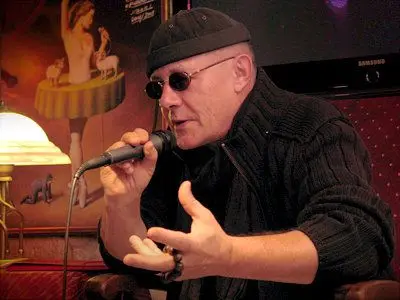
Bogusław Nowak, who led the conversation, addressed Mariusz Wilk with great deference. He asked whether he could say something about Wałęsa and reveal a few facts from those heroic times. In Poland, after all, a certain Zyzak had appeared—a historian who was tarnishing ideals. But Maro Wilk merely contemptuously called Zyzak “Zygzak” and said that his daughter had just been born and was now more important to him than Wałęsa.
But when the question of the Round Table was raised, the guest of the evening, who did not want to comment on anything or pass judgment on any of his former friends, read us a poem by Stefan Adamski. He said that he personally signed his name beneath his friend’s stanzas and regarded them as an answer to what the Round Table had meant to him. I give the poem from memory…
An inscription in Miss S’s album
Who did not love you, Jacek, Janek,
You never lacked admirers
I too sang the praises of your charms
among the crowd of your suitors
I was your Errant Knight
I fought for your honor with my sword
And fenced as best I could
Yes, yes, I fought so hard for you […]Back then you did not appear in salons
You lived in cellars
I admit, you looked beautiful
Emilia Plater—a wondrous maiden…For, praying beneath the statue
You truly looked sweet
Though even then I feared
that one day you would become a pious bigot. […]You danced the carmagnole beautifully
and led the people to the barricades
and now I will…
You can finish this rhythm yourself, to your betrayal […]Jacek is dead, Janek fell silent
Others are selling off the ethos
And someone should tell you
the truth about yourself, so I will […]I do not know when you changed
You, such a prude, I will not allow it,
and then up went your skirt
and a cancan on the Round Table
And you were kind to everyone
and smiled dutifully
And on that table you had sex with anyone who came along […]
And then I thought of all those who returned to a free Poland after the 1989 elections. And of those who did not leave it, but fought as well. Of those who sang a song with Jan Kisiliczyk at a meeting with Danuta Maślicka, who was promoting her book “Znikopis. Pamiętasz była Solidarność” (“The Vanishing Book. Do You Remember, There Was Solidarity”). Of those whom people on internet forums call “Solidarity types.” I thought of everyone who not only fought to win this freedom for themselves, but who are creating it today. Sometimes better, sometimes worse. Lost, like most of us, in the new reality and making choices every day. In the Fourth Republic, or perhaps the Fifth, or once again the Third. A person without perspective can go mad amid these changes.
In our free homeland we have a Sejm and Senate elected by us, and a president, and bad laws, and bad regulations, and the Institute of National Remembrance, and Father Rydzyk. Today we do not even know whether Solidarity won or whether the Round Table was a betrayal. We keep asking ourselves what went wrong. Few remember the ethos, Solidarity’s heroic struggle. They do not even teach about it in schools.
Mariusz Wilk seemed to have carried that time with him and preserved it in pristine form. We wanted to hear something significant about ourselves, about our choices, about recent history, which he had helped create. And we learned that white civilization is dying; we listened to stories about bears moving boulders in search of ants, about silence and Buddhist monks from a monastery in Buryatia (Russian Federation), who gave Wilk sandalwood beads threaded on a string.
The guest fingered this kind of rosary throughout the meeting, and when asked about the object’s meaning, explained that it was, among other things, a good way to calm one’s nerves. When his luggage failed to arrive at Warsaw airport, Wałęsa’s first spokesman turned the beads over in his hand several times and avoided becoming upset.
Mariusz Wilk could bring us several million beads from Buddhist Buryatia. Here in Poland, we very much need something to calm our nerves so that, in the ongoing daily struggle, we can continue choosing freedom, which is here, not beneath the polar region.
Grażyna Hanaf