
Almost exclusively women came to the meeting with Marek Krajewski. A very pleasant atmosphere developed in the room. The ladies freely exchanged views with the author about crime fiction and its creators.
Krajewski is a gentleman and an erudite through and through. One of the readers asked him whether, because of his academic education, he had wanted to raise the status of crime fiction, which is treated as popular literature. The author admitted that although he used to silence his small children at the table with Latin maxims, he had no ambition to force his books into the category of high literature. But he acknowledged that a certain professor had scolded him for engaging with such a popular genre.

The creator of the character Eberhard Mock describes himself as a defensive pessimist. He prefers not to expect too much, so as not to be disappointed, and a pleasant surprise can always happen. That was the case with his first novel (“Death in Breslau”), whose plot he invented in a few hours while cataloguing Latin treatises in the Ossolineum library. He did not even believe that the book would be published, let alone translated into 18 languages.
His creation of dark and bloody crime stories is, on the one hand, the result of his fascination with the history of old Wrocław and, on the other, a childhood inclination toward writing horror stories.
Krajewski considers himself a craftsman. The world he creates is full of details and carefully considered facts. If the main character’s wife smells of perfume, it must have come from somewhere. The author sought out a period department store where women from Wrocław bought perfume. This meticulousness even led him to a hospital ward, where he attended an autopsy.
“I needed this for precise descriptions of crime victims,” Krajewski explains. “I was told that a corpse gives off a sickly smell, but no one could explain to me what that sickly smell was. The same applied to the details of injuries. What does a ruptured spleen or a punctured stomach look like? I saw it with my own eyes and was able to describe it accurately.”
In describing his character Eberhard Mock, Marek Krajewski admitted that Mock resembles him in his tastes. Like his creator, Mock enjoys good food and tosses out Latin maxims as easily as others swear. Krajewski discovered that, physically, Mock was the well-known Polish actor Janusz Gajos: stocky, of medium height, with a strongly defined jaw.
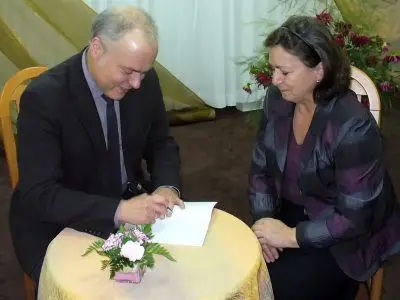
The meeting with Marek Krajewski ended with an anecdote he recounted. During meetings with readers in Germany, a man approached him and said: “Do you remember the scene from your first novel, ‘Death in Breslau,’ in which you describe the beautiful Polish wife of the city library director entering her husband’s office with her ten-year-old son? That son is me!”
It turned out that the fictional, incidental character invented by the writer merely to enliven one of the scenes had really existed. What is more, he had come to the meeting with Krajewski. When they met again in Wrocław, Marek Krajewski looked at the city through a German’s eyes. The University building was, to him, St. Maciej Gymnasium, while the “Na Piasku” library was his family home, because its directors had apartments there. In this way, the world of the novels overlapped with the real world, highlighting both Krajewski’s talent and the magic of his writing.
(information: Grażyna Hanaf)