
The research agency ARC Rynek i Opinia published the “Café Monitor 2018” report, examining where Poles most often drink coffee. As it turned out, cafés rank above only grocery stores in popularity. Even in large cities, where cafés and restaurants can be found on every corner, Poles still choose to drink coffee at home. This trend results from the relatively high price of a cup of the steaming beverage: in a café, an espresso costs an average of 6 złoty, whereas at home the same coffee can be prepared for as little as 2 zł using a coffee machine. So, if they buy a coffee machine, which type do Poles most often choose?
Small capsule coffee machines are winning
Capsule coffee machines are currently the most convenient way to prepare a beverage, as well as one of the most popular solutions available on the market. There are several reasons for their popularity, but the main one is the purchase price of the appliance. A good capsule machine for home use costs between 200 and 500 złoty, while pressure coffee machines can cost up to twice as much. It is also worth noting that powerful manufacturer campaigns contribute to their popularity—one need only mention the campaign featuring George Clooney and Nespresso capsules. In addition, capsule machines are characterized by very simple operation, modern design and compact dimensions.
In the “Top 5 – best capsule coffee machines up to 550 złoty” ranking prepared by Tech.wp.pl (https://tech.wp.pl/top-5-najlepsze-ekspresy-kapsulkowe-do-550-zlotych-6034828392522881a), the Krups Piccolo model ranks first and is described as “the most popular capsule appliance on the market.” The model could be purchased for as little as 219 złoty (as of July 2018). Piccolo reflects everything consumers are looking for: speed, convenient operation, guaranteed cleanliness and consistently well-prepared coffee. Operation consists entirely of inserting a capsule containing the precisely measured amount of coffee needed to brew a beverage in the chosen flavor, such as latte, espresso or cappuccino. Flavor variants are also available, including chocolate-, fruit-, caramel- and vanilla-flavored coffees; coffee can also be prepared both hot and cold. It is worth adding that most capsules contain no stabilizers and consist exclusively of a ground-coffee blend with an addition such as sugar or powdered milk.
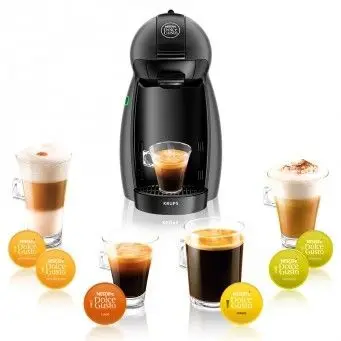
Another advantage of the Piccolo model, and of other similar machines, is that they can be used to prepare tea and hot chocolate in addition to coffee. Coffee-machine manufacturers also focus on attractive design so that the appliance fits into any interior. As a result, machines are available in various colors, including black, red, silver and anthracite. The capabilities of the capsule machine and the Piccolo model can be checked on the manufacturer’s website: https://www.dolce-gusto.pl/piccolo-matt-black.
Which coffee do Poles choose?
Nespresso conducted consumer research to determine which type of coffee Poles most often choose. The report indicates that 47% of Poles choose coffee with milk, while 38% choose a strong brew without any additions, even sugar.
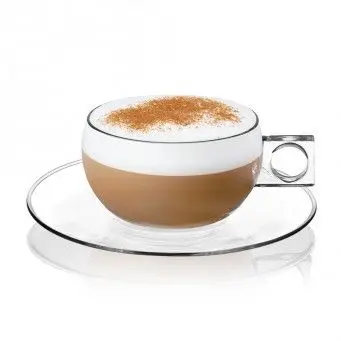
This is also confirmed by Adam Ringer, president of Green Caffe Nero, on the “Na czasie” program (https://www.chillizet.pl/Styl-zycia/Kuchnia/Wiadomo-juz-po-jaka-kawe-najchetniej-siegaja-Polacy-I-wcale-nie-jest-to-espresso-3226). He pointed out that Poles love milk, which is why caffe latte is the most popular choice in cafés—a coffee combining espresso with frothed milk: “Latte coffee is absolutely dominant in Poland. Cappuccino is number two. Milk coffees and various new trends are number three. The coffee that I believe is the best, espresso, accounts for 8–10%, which is still a lot, because people drink less of it in other countries.”
Is coffee healthy?
It is already clear that Poles are very willing to drink coffee, but is it healthy? Opinions that drinking coffee is harmful can still be encountered—it raises blood pressure and is said to cause, among other things, the body to become overly acidic and magnesium to be depleted. However, the latest research leaves no doubt: drinking coffee in moderate amounts has a beneficial effect on our health.
In November of this year, the prestigious scientific journal “British Medical Journal” published an extensive study analyzing and summarizing more than 200 analyses concerning the health benefits of coffee. It found that drinking three to four cups of coffee a day may, among other things, reduce the risk of heart disease and cancer, neurological and metabolic disorders, and may also extend life. This includes a positive effect on conditions such as MS (multiple sclerosis), type 2 diabetes and Alzheimer’s disease.
Experts agree that caffeine is an excellent natural stimulant that provides a range of health benefits. It should nevertheless be remembered that excessive coffee consumption may increase the risk of fractures in people suffering from osteoporosis, while in pregnant women it may lead to premature birth or miscarriage.
Although as many as half of Poles cannot imagine their morning without coffee, it is worth remembering that anything in excess can be harmful. When choosing coffee, quality should be the primary consideration. If the choice is a coffee machine, only capsules free of artificial additives and guaranteed to be hermetically sealed should be selected—only then will the aroma not escape and it will be possible to enjoy the full flavor.
Sources:
- https://www.focus.pl/artykul/kawa-przyszlosci-5-naprawde-istotnych-funkcji-ekspresu-do-kawy
- https://naukawpolsce.pap.pl/wyszukiwanie/kawa
- https://www.portalspozywczy.pl/raporty/73-proc-polakow-pije-kawe-codziennie-a-46-proc-nawet-kilka-razy-dziennie,134282_0.html
- https://tech.wp.pl/top-5-najlepsze-ekspresy-kapsulkowe-do-550-zlotych-6034828392522881a
- https://kobieta.wp.pl/jesli-kawa-to-z-fast-foodu-czyli-jak-pija-kawe-polscy-millenialsi-6265528849725569a
- https://biznes.newseria.pl/news/prawie-50-proc-polakow,p1183973698 https://www.chillizet.pl/Styl-zycia/Kuchnia/Wiadomo-juz-po-jaka-kawe-najchetniej-siegaja-Polacy-I-wcale-nie-jest-to-espresso-3226