
The director of the Adam Mickiewicz Museum in Vilnius and poet and prose writer who runs the museum’s Poetry Club were invited to our town by Józefa Witas. She proved very popular with the residents of Bolesławiec. After the lecture, a number of probing questions came from the audience.

Tadeusz Samborski, who hosted the meeting, stressed that an important issue was the extent to which Polish artists become the property of other nations. Their work, after all, has universal significance. It may be considered an interesting fact that not only Poles and Lithuanians hold our national bard in high regard. The Ambassador of Belarus to Poland, as it turned out, initiated the erection of a monument to Adam Mickiewicz in the centre of Minsk. Someone in the audience immediately added that Lukashenko had taken the liberty of calling Mickiewicz a great Belarusian in Nowogródek. Tadeusz Samborski appealed to people not to deny other nations the right to take pride in the fact that the poet was born in territories that currently lie within their borders.
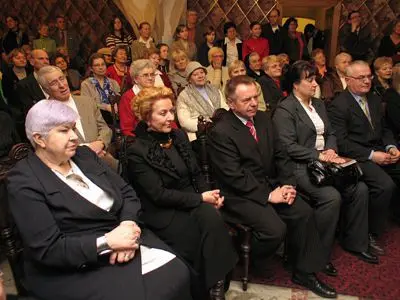
Poet Wojciech Piotrowicz commented on the discussion with a humorous observation: “Mickiewicz is not sausage, he is not bread. He cannot be divided among nations.” An expert and researcher of Mickiewicz’s work, he believes that the national bard was always Polish, considered himself Polish, and nothing will change that—not even an entry in a Belarusian cultural dictionary stating that Adam Mickiewicz was a great Belarusian poet who wrote in Polish about Lithuanians.
(GH report)