
Jan A. Choroszy, editor and employee of the Institute of Polish Philology at the University of Wrocław, came to Bolesławiec at the invitation of Józefa and Marek Witas, owners of Agora bookshop. The author devoted 25 years of his life to compiling “Our Father – Ours.” The book contains 499 texts: translations, paraphrases and adaptations of the Lord’s Prayer.

Why did the editor devote so much time specifically to this prayer? “Chance played a major role,” Jan A. Choroszy told the IstotneInformacje.pl portal. In 1983, the author of the study came across two different texts referring to the Lord’s Prayer: a paraphrase by Stanisław Vincenz and “Apostrophe for the Time of Martial Law” by Kazimierz Wójtowicz. “The stylistic, emotional and, above all, ideological disparity between the two texts was shocking,” Choroszy adds.
The variety of texts collected in the book “Our Father – Ours” can indeed be surprising. In addition to religious works, it also contains political and iconoclastic texts, and even... a hip-hop prayer taken from the internet. “Some of these paraphrases are shocking precisely because they deny the sacred,” Choroszy said during Saturday’s meeting at the Church of Our Lady of Perpetual Help.

The study “Our Father – Ours” was published at the end of 2008. “People like the book. So far, I have not met anyone who said that this publication let them down or disappointed them,” Choroszy says with a smile. What is more, the anthology was warmly received by clergy, not only by hierarchs of the Roman Catholic Church. “‘Our Father’ is a prayer shared by all Christians. This book shows its ecumenical character very well,” the study’s author notes.
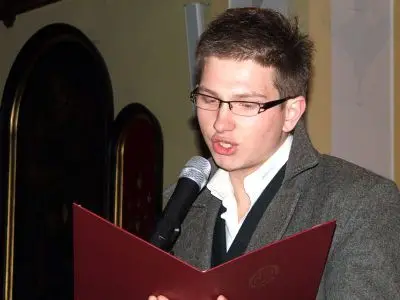
The meeting was enhanced by a performance from Marek Pilch (organ) and Maria Zygmaniak-Lesiak (soprano), who performed Polish Lord’s Prayer songs from the 16th–19th centuries, both Roman Catholic and Lutheran. The paraphrases of the Lord’s Prayer were read by Danuta Maślicka, Kinga Pokojowy and Grzegorz Roman. The conversation with Jan A. Choroszy was conducted by Prof. Stanisław Bereś of the Institute of Journalism and Social Communication at the University of Wrocław.
(GA information)