
Over 400 years of searching, Truso became a legend of the Baltic—a mysterious sunken city compared with Atlantis or ancient Troy. Like the Mediterranean Sea in antiquity, the Baltic in the early Middle Ages served as the main communication route for contacts and trade between Scandinavians, Frisians, Balts, Finns and Slavs. The Vikings were exceptionally skilled at exploiting this, undertaking daring expeditions that led to the establishment of emporia in foreign lands—such as Truso.
Until recently, this settlement was known only by a name recorded by the Anglo-Saxon traveller Wulfstan, who around 890 set sail from the Danish port of Hedeby to Truso, located near the mouth of the Vistula. The English king Alfred the Great included the account of the journey in his translation of Paulus Orosius’s Chorography.
Attempts to determine Truso’s location lasted nearly 400 years, beginning with the discovery of Wulfstan’s account and its publication in 1598 in the work of the Oxford geographer Richard Hakluyt, “The Principal Navigations, Voyages, Traffiques and Discoveries of the English Nation”. Finally, in 1981, on the eastern shore of Lake Drużno, near the village of Janów, several kilometres south of Elbląg, Dr Marek Jagodziński discovered Truso.
Archaeological research into the port and trading-and-craft settlement situated on the Slavic-Baltic border made it possible to verify the hypotheses and speculations that had accumulated around Truso. Over more than 35 years of research, tens of thousands of artefacts were recovered from the emporium, which at the height of its development—from the mid-9th century to the late 10th century—covered approximately 20 hectares. They were made of amber, horn, bone, metal, glass, ceramics and stone. Unfortunately, objects made from organic materials such as wood, leather and textiles have not survived.


The exhibition at the Bolesławiec museum presents more than 160 artefacts from the excavations: silver, glass and amber jewellery; bone combs and ice skates; metal weapon fittings; as well as balance scales, weights, silver coins and cut-up coins—all clear evidence of Truso’s important role as a trading centre.
Visitors to the exhibition can learn about Norse mythology and, with the help of a model of the sacred tree Yggdrasil, discover the origins of beliefs and the secrets of Ragnarök, Asgard and Thor. A special educational trail has been prepared for younger visitors, enabling those who wish to find the key to deciphering runic inscriptions, try their hand at a game of hnefatafl—the most popular Scandinavian board game—or learn about the medieval system of weights and measures used in trade. The exhibition is accompanied by a digital visualisation of Truso based on the results of interdisciplinary research carried out at one of Europe’s most fascinating archaeological sites.
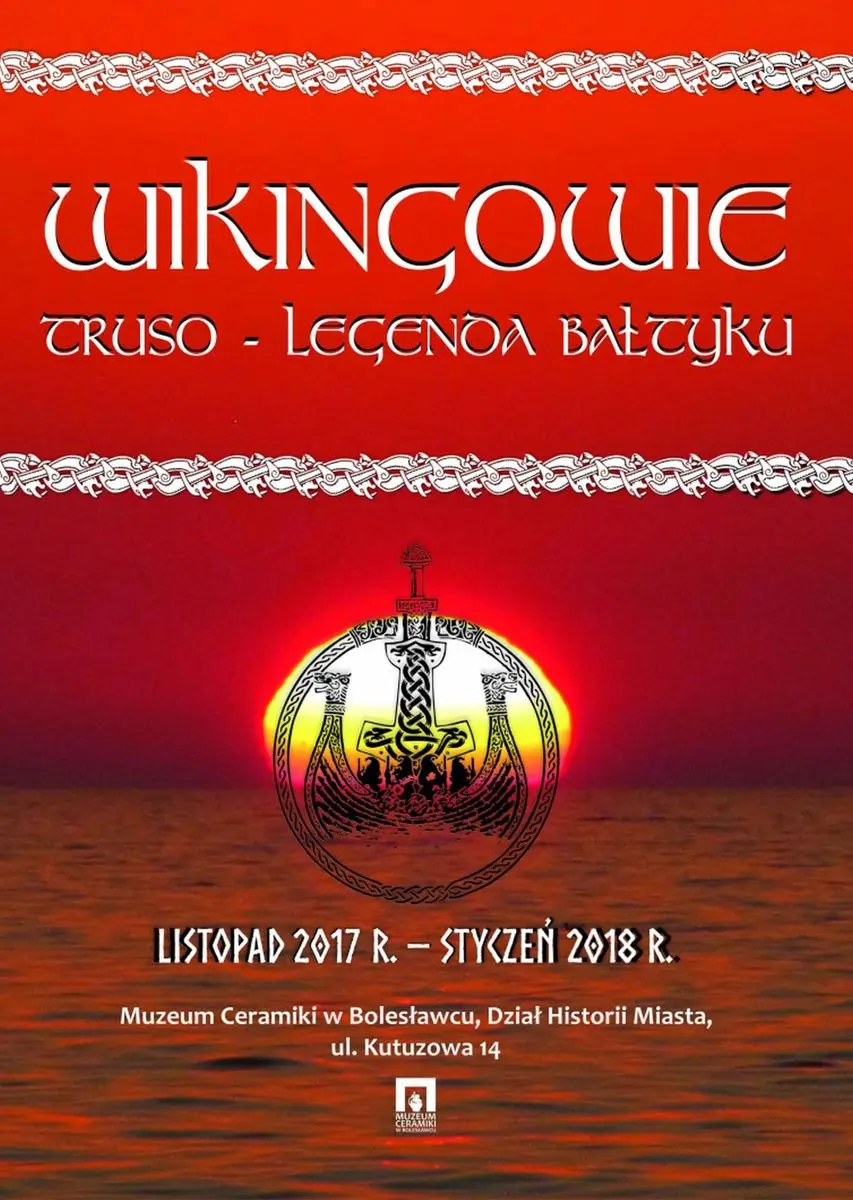
The exhibition “Vikings. Truso—the Legend of the Baltic” was prepared in cooperation with the Archaeological and Historical Museum in Elbląg, the Lusatian Museum in Zgorzelec and the Serbo-Lusatian Warriors’ Group—Biełoboh. It will be on display until the end of January 2018.