
First, it must be clearly stated that Wrocław was a dangerous city after World War I. This large urban agglomeration, home to many industrial plants, attracted all kinds of people. Often they were people of the “underworld,” adventurers and criminals.
The tragic events I mentioned took place on 5 June 1926. At their grandfather’s request, the children of the Fehse family went to the Parcel Post Office to collect a package. Erika and Otto lived in a tenement building near Koenigsplatz (today’s Jana Pawła II Square). The post office was about 30 minutes away at a leisurely walking pace. After several hours of their absence, Erika and Otto’s parents began to worry. The first information about the children was bad. Dismembered bodies were found near the local polytechnic. Residents of Breslau came across more remains in Schleitniger Park (today’s Szczytnicki Park). They belonged to the girl.
The parents and grandparents still hoped that the children had merely gone missing and were still alive. Unfortunately, two days later, the grandfather received a mysterious package containing his granddaughter’s remains.
The murder of the Fehse siblings shocked the city. Residents gossiped and developed their own, often ill-considered theories. Suspicion immediately fell on Jews, who were thought capable of committing a ritual murder of defenseless children. The Wrocław police, however, did not take this into consideration. The officers stuck firmly to the facts. The case was taken up by the Wrocław murder commission. The famous investigator Ernest Gennet was brought in from Berlin.
The investigation was conducted with great thoroughness. The route the children had taken from their home toward the post office was analyzed several times. It was established that they had last been seen on Dominikplatz. The investigation was extremely difficult. Above all, the internationally recognized criminologist faced a difficult task. In the capital, he was well known and had numerous contacts. In Breslau, the opposite was true. The residents were distrustful and had already decided that the Jewish community was guilty. In this respect, Wrocław was a distinctive city. Right-wing, and later Nazi, movements dominated there. Like most Germans, the people of Wrocław felt embittered after losing World War I. The border with Poland ran not far from Wrocław. The emergence of a new Polish state was a shock. It was in Wrocław and throughout Lower Silesia that the Nazis won elections by an enormous majority.
Let us set these tragic events aside for a moment. What exactly was—or is—a ritual murder? Initially, Christians in ancient Rome were accused of such acts. From the 12th century onward, religiously and ethnically motivated murders were attributed to Jews. Jews were said to murder defenseless Christians, namely children, especially boys (as an equivalent of the murder of Jesus, for which the Jewish people are blamed; let us remember that Jews rejected Christ’s divinity). They were said to drain all the blood from kidnapped and murdered children and add it to matzah (unleavened bread baked from flour without leaven). They supposedly smeared it on the eyes of newborn Jewish children. It was believed that these children were born blind like kittens and that Christian blood had miraculous properties. This blood was allegedly used to stop bleeding during circumcision, as well as for witchcraft. Few people know that the origins of the ritual-murder myth lie in the British Isles. In 1144, William of Norwich was murdered in England. The Jewish minority was accused, and the myth of ritual murder spread across Europe like a plague…
Such beliefs were also fairly widespread in 20th-century Germany and Poland.
Returning to the murder of Erika and Otto, unfortunately, the investigation revealed nothing. Gennet did have several suspects, but he lacked evidence. Eight years later, the weekly newspaper “Der Stuermer” took up the case. It wrote, among other things:
The children’s remains were found in a square in Breslau. The bodies had been mutilated and drained of blood. Their genitals were missing. A Jewish butcher was believed to be responsible. He disappeared without a trace.
[“Der Stuermer” 1934/32, https://www.tvn24.pl/wroclaw,44/makabryczna-zbrodnia-w-breslau-zabojstwo-chcieli-wykorzystac-nazisci,584665.html]
The article was titled: “Ritual Murder in Breslau”. The fact remains, however, that the murder had a sexual motive. At that time, child disappearances were common in Wrocław.
The police took up the unsolved murder for a second time. Two suspects were arrested: 35-year-old Dr. Arthur Engel and 32-year-old Herbert Hoell, a student from Czechoslovakia. The investigators focused on Hoell. Hundreds of notes bearing children’s names and addresses were found in his apartment. Notes concerning Eryka Fehse were found on one of the postcards. The student did not confess, and the police had only the relatively unreliable testimony of witnesses and circumstantial evidence.
Accusations of Jewish ritual murders were widespread throughout Europe, including Poland. In 1926, two months before the tragic events in Wrocław, an incident took place. Two Poles tried to dump a body at a Jewish matzah bakery in Radom. They were arrested by the police while carrying the body, and the vile plan failed.
Unfortunately, the Jews of Kielce were not so lucky. In 1946, someone spread a rumor that an 8-year-old boy had been murdered. Jews were blamed. Thirty-seven people died in the resulting pogrom.
Similar events took place in Sandomierz in the 18th century. A painting by Karol de Prevot can still be found in Sandomierz Cathedral. The work is titled “Ritual Murder”. It served as evidence in a trial in which, naturally, Jews were accused. De Prevot’s painting resembles a comic strip. Individual scenes depict children being lured with sweets, their sale, an examination of whether they are healthy, and the murder itself. It is difficult to imagine a painting being used as evidence in a case. Such were the times, however.
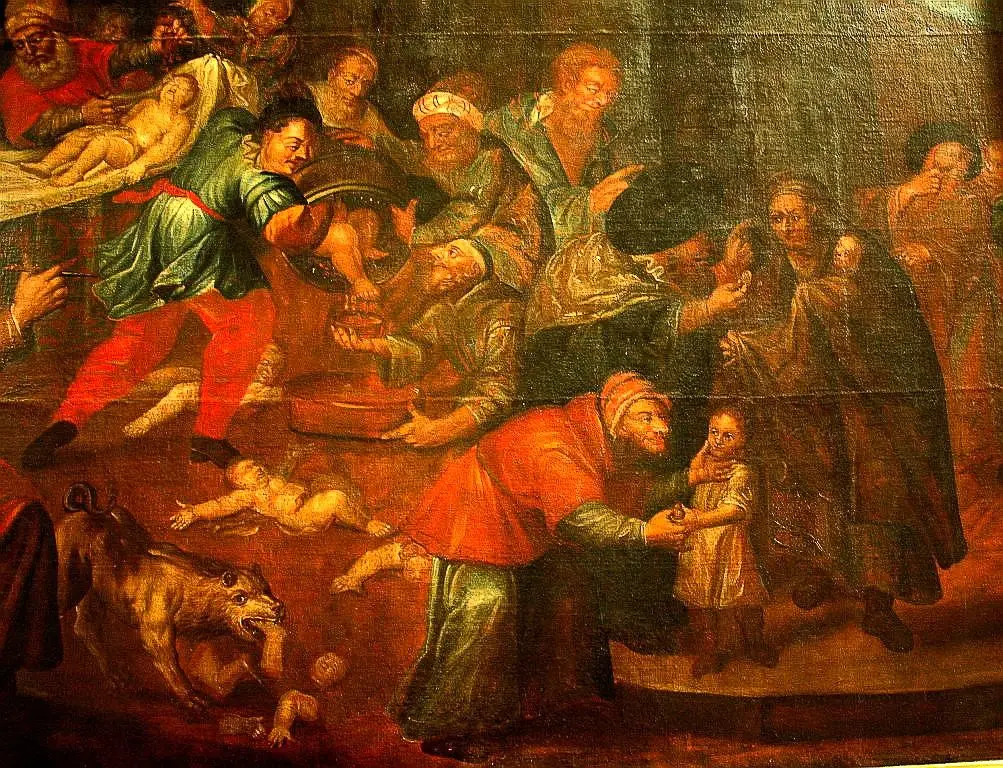
The above painting is quite controversial, but even more debatable is the way people tried to deal with this “bloody work.” From 2006 to 2014, the painting was covered, and when that was not enough, it was additionally concealed with wooden panels. The official reason for this action was to prepare the painting for conservation. It was undoubtedly the best-prepared object in Poland. The “preparatory” work lasted as long as eight years. The painting is now open to visitors. A plaque beside it explains that ritual murders never took place and that such claims are incompatible with Judaism.
The story of Erika and Otto is deeply tragic and multifaceted. It shows how easily baseless accusations are made. This stems primarily from hostility toward the Jewish community. We do not know for certain whether ritual murders ever took place. Historians do not agree on this issue. Some allow for such a possibility. Perhaps it was not all Jews, but only some kind of Jewish sect that committed such inhuman acts. This does not change the fact that these are merely speculations.
Several years ago, a survey was conducted among Poles asking whether they believed that ritual murders of Christians by the Jewish community might actually have taken place. The results were surprising. As many as 10% of Poles said they believed so.
It is worth remembering, however, that human wickedness has no nationality, and all the wrongs suffered by Jews and Poles on both sides merely prove that every nation contains people with distorted values.
If any of you are interested in this subject, I warmly recommend reading and watching “A Grain of Truth.” The book was written by Zygmunt Miłoszewski, while Rober Więckiewicz played the lead role in the film. Both the book and the film perfectly convey the mystery and horror of the era of anti-Jewish pogroms.
Paweł Skiersinis

The author is a blogger and a history enthusiast, particularly interested in the history of Lower Silesia and Poland. Why Lower Silesia? As he says: “Why not? The most fascinating history is the history around us, concerning ourselves and our ancestors.”
He adds: “I try to present history from a different perspective, in an engaging way, not in the typical textbook style, full of dry dates and facts. My articles concern facts that cannot be found in textbooks and well-known publications. The history of Lower Silesia is undoubtedly interesting and fascinating, so it is worth devoting at least a brief moment to it from time to time.”