
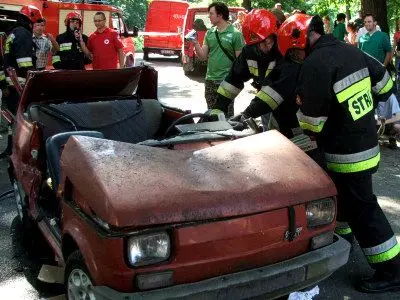
The incident occurred on Tuesday, June 10, in the municipal park on Tyrankiewiczów Street. A dozen or so people were injured in the accident, including a young married couple with a child. PCK rescue groups from Bolesławiec and Lwówek Śląski, among others, joined the rescue operation. To free some of the injured, firefighters had to cut open the bodywork of the Fiat 126p.
The collision between the Fiat 126p and the bus was, of course, simulated, but everything looked very realistic. Much of the credit goes to the young people from Powiatowa Szkoła Policealna nr 2 at Zespół Szkół Handlowych i Usługowych in Bolesławiec. The young medical-rescue students played the roles of accident victims convincingly.


The future paramedics will soon take their professional examination. During Tuesday’s demonstration, they had the opportunity to test their skills. “They come to the school for various reasons,” Anna Kaźmierczak, a teacher at PSP nr 2, says of her students. “And they stay because they get hooked.” According to the teacher, the paramedic profession is attractive to young people because it requires activity. It is a profession in which nothing can be predicted. “Besides, they want to help people in the most dramatic situations,” she adds.


“First aid in Poland is rather poor,” Robert Mikłaszewski, head of the PCK rescue group from Lwówek Śląski, told the IstotneInformacje.pl portal. “We are far behind Western countries.” According to the rescuer, people do not want to provide first aid because they are afraid of criminal liability.

Meanwhile, as Mikłaszewski explains, there is no reason to worry. Especially since the rules for providing first aid have been simplified. “We teach first aid that anyone can provide, without medical training,” the rescuer notes. “The simplification consists primarily in the fact that rescue breaths may be omitted. There are two life-saving procedures: opening the airway and chest compressions,” he adds.
(GA information)