
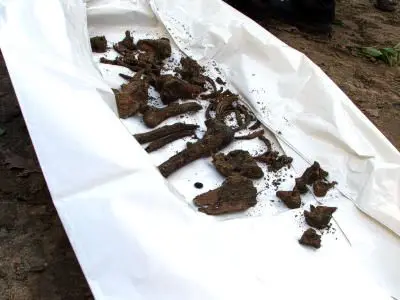
The exhumations began in the morning and lasted nearly four hours. Earlier ground-penetrating radar surveys showed that the soil structure had clearly been disturbed in several places near the Młodzieżowy Dom Kultury. As is known, during the Second World War the building that now houses the MDK contained a Gestapo headquarters, and immediately after the war it was taken over by the UB. The secret police held opponents of the system there—in inhumane conditions—probably until the end of the 1940s. Moreover, two unburied skeletons were found here in September this year. All this suggested that more human bones would be found.
That is exactly what happened. Human remains were exhumed in two different locations. However, not a single skull was found. In other places, branches and dog remains were discovered. “It was worth coming here to determine what can still be found in this area and what can never be found again,” Krzysztof Szwagrzyk, head of the Branch Office of Public Education of the Wrocław IPN, told Boleslawiec.org.
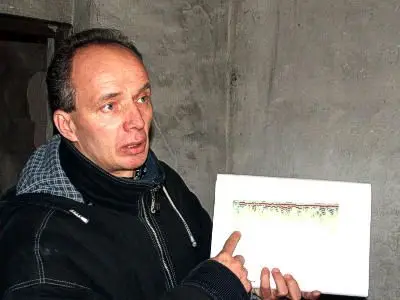

The exhumation team would find almost nothing today if not for new information from the workers who built a wall behind the cultural center in September. At the time—as it turned out today—they reported only some of the bones they had found because they feared that the research work would delay construction. Today, when the IPN came to examine the site once again, they arrived and pointed out where they had buried the rest of the September discoveries.
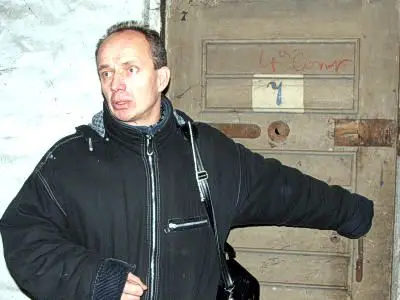
“It is a great shame that there are commercial pavilions behind the MDK today. We could conduct research under completely different conditions,” Szwagrzyk admits. For several decades, the land between the cultural center and the present-day marketplace was occupied by plots belonging to officers of the repressive apparatus. Human remains, buttons and combs were also unearthed here at that time. What is more, these horrifying discoveries were often made by children.

The case only gained publicity in September this year, although people had been saying for years that the remains of victims of fascism and communism might be located near the MDK. As the media began taking an interest in the case, a letter from a German woman who had been imprisoned for a year in the dungeons of the former Security Office headquarters reached IPN researchers and Zdzisław Abramowicz. She was 15 at the time. “In her letter, this woman writes that these were the most dramatic moments of her life,” says Abramowicz, an expert on the history of Bolesławiec. “She was held in one cell with several other female prisoners. On a bare floor. She was constantly ordered to admit that she belonged to various organizations,” he adds.
What happens next?
“I think a breakthrough will come now,” says Krzysztof Szwagrzyk. “The case is so widely discussed in Poland at the moment that I cannot imagine the authorities of any city saying, after all this media attention, that they are not interested.” For now, however, the scientists are ending their work in Bolesławiec.
IPN staff now face extensive research work. Other sites of torture will be examined, including those in Legnica, Jelenia Góra, Jawor and Wałbrzych. Work in our city is also to continue. It is not yet known when this will happen. The scientists want to meet with representatives of the city authorities and the County Office in the near future to consider how to preserve the MDK dungeons—the site where victims of totalitarianism were tortured—for future generations. A memorial room may be established here.
(report GA, video KG)