
To receive the Giftedness-Supporting School Certificate, a school must meet at least 75% of the requirements set from above. Primary School No. 1 in Bolesławiec, as Wanda Górajewska, a consultant at the Lower Silesian Teacher Training Centre in Wrocław and chair of the audit committee, acknowledged, was rated higher. The assessment took into account both the appearance of the school and the implementation of the programme. The committee members were particularly impressed by the institution’s cooperation with parents. “This is more than volunteering,” Górajewska stated.
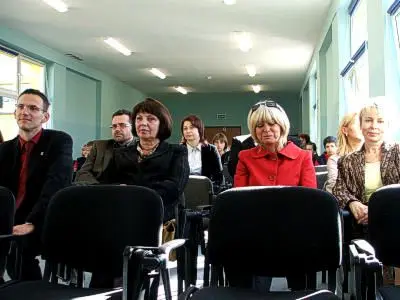
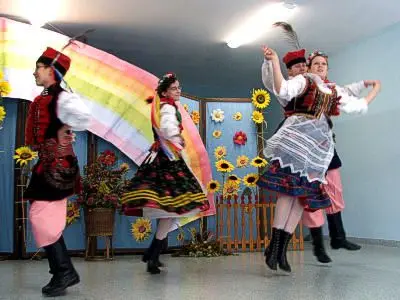
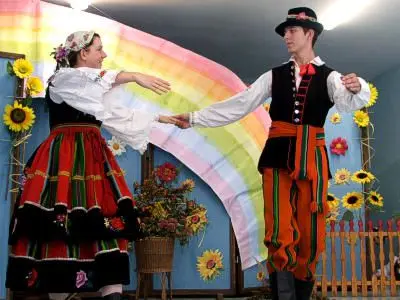
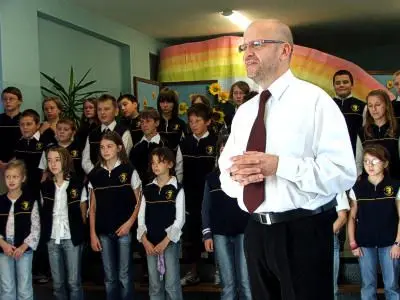
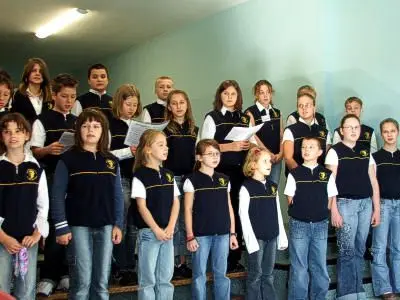
Before the verdict was issued, however, the inspectors had an opportunity to watch an artistic programme prepared by the pupils. In the primary school’s assembly hall, choir singers, a young keyboard player, a talented reciter and members of the Duży Bolesławiec dance group performed. Just before the decision was announced, a display of sports and artistic gymnastics was presented to the parents, assessors and the school’s friends.
Supporting gifted pupils
The school had been working to obtain the certificate since as early as 2004. “Each form tutor keeps a child observation sheet—a giftedness record,” explains Kornel Filipowicz, the school’s headteacher, describing how the giftedness-support programme works. “The philosophy is that every child is talented to the extent of their abilities. The problem is to discover those abilities and reach the child,” he adds.
The school teaches English to its youngest pupils already. Classes are not overcrowded; each has an appropriate number of pupils so that teachers can work individually with every student. The institution’s openness to Europe is also demonstrated by the fact that it cooperates with schools in the Czech Republic and Germany.
Working together
The primary school strives to develop its pupils in various areas: through classes using activating methods, interest clubs and… cooperation with parents. “The key to the school’s existence is parental support. They support us very strongly, both on the School Council and the Parents’ Council,” Filipowicz emphasises. How is this achieved? “You have to identify them and encourage them. And sometimes you have to give them a little push to get involved,” the headteacher explains.

Kornel Filipowicz admits that he tries to base his contacts with parents on mutual goodwill. As can be seen, this approach is paying off. The goal was ultimately achieved through joint efforts. “It was our children, parents and teachers who managed to convince the committee that the school was implementing the programme’s requirements,” the headteacher says. “Now we are waiting for the chapter’s decision. It is a matter of two weeks. We have to introduce a few changes and… implement the programme,” Filipowicz says with a smile.
Plans
Although there have been many successes—the 20th-anniversary celebrations last year; in June this year, the Lower Silesian Council for Safety awarded the institution the “Safety-Conscious School” certificate; and an award for promoting the city—Kornel Filipowicz has no intention of resting on his laurels: “I hope that next year we will manage to open at least one sports class and invite children from all over Bolesławiec and the surrounding area to the school.” The headteacher is also considering introducing an innovation in the assessment system, the so-called formative assessment, meaning frequent assessment that helps in selecting appropriate teaching methods. “There is still a lot of work to do,” the headteacher concludes.
(GA information)