
The “Dignity and Human Rights” conference was held on 7 September in the assembly hall of I Liceum Ogólnokształcące. It was the first meeting devoted to this type of issue in Bolesławiec County. The event was organised primarily by the District Board of the Polish Red Cross in Bolesławiec, together with two Wrocław universities: the Lower Silesian University of Education TWP and the Lower Silesian Higher School of Public Services “Asesor”. The conference was held under the honorary patronage of the Bolesławiec County Governor Cezary Przybylski and Commissioner for Human Rights Janusz Kochanowski. Boleslawiec.org was the meeting’s media patron.
Disseminating international humanitarian law is one of the statutory tasks of the Polish Red Cross. Therefore, the main aim of Friday’s meeting was to build awareness of civil society among secondary-school students. The conference’s leitmotif was the quotation: “I learned to see a human being in everyone, even in my own enemy.”
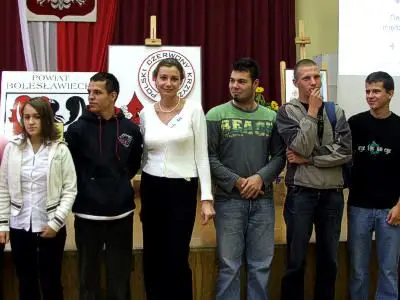
The issue of the four fundamental rights enjoyed by people—the right to life, freedom of speech, the prohibition of discrimination, and the right to privacy and protection of correspondence—was addressed in the lecture “Relay Race with Human Rights” by Dr Anna Śledzińska of the Lower Silesian Higher School of Public Services “Asesor”. The researcher noted that these norms are a kind of weapon that limits the will of the majority so that it does not become absolute. Twelve people selected from among the audience actively took part in the presentation. The 12 justices argued for or against controversial cases involving violations of the fundamental rights mentioned above. The young people’s decisions were usually consistent with the judgments of the European Court of Human Rights in Strasbourg.

Prof. Krzysztof Kubiak of the Lower Silesian University of Education TWP presented the origins and current state of international humanitarian law. The professor discussed the reasons behind the establishment of the Red Cross organisation. He also spoke about the origins of the PCK symbol and its numerous variations. He noted that the crime of our times is that even children can fight in wars—some rifles weigh only 3 kg. Part of the lecture, Krzysztof Kubiak devoted to the history of radical violations of human rights, from Nazi Germany and Soviet communism to contemporary examples such as Tibet and the Gaza Strip.

The lecture section was concluded by Bartosz Kokoszka, acting head of the Promotion Department of the Main Board of the Polish Red Cross in Warsaw, who spoke about both the origins and the present day of the International Red Cross and Red Crescent Movement. Kokoszka discussed the seven fundamental principles guiding the organisation’s volunteers. He also presented the structure of the PCK.
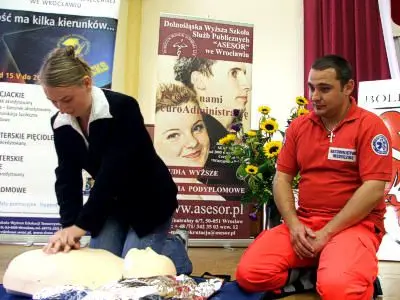
After the series of lectures, the PCK Rescue Group in Bolesławiec gave a first-aid demonstration, in which conference participants also took part. The event concluded with the announcement of the results of a competition on international humanitarian law and the presentation of prizes to the winners.


“It is worth organising such conferences so that young people can learn what rights they have and how humanitarian law should be observed,” Adam Fornal, president of the Bolesławiec PCK, told Boleslawiec.org. “I do not hide the fact that we hope this event will increase the number of our volunteers. There are many of them, but we are always open to having even more,” the president added.
The county governor Cezary Przybylski shared this view. “The conference is a valuable local initiative,” the county governor noted. “Issues concerning dignity and human rights were presented in an accessible way. This is thanks to the lecturers, who were able to establish direct contact with the audience,” the politician added.
The organisers and university representatives announced further meetings devoted to various contemporary issues. “I hope it will work out,” said Cezary Przybylski.
(information and photos by MZ/GA)