
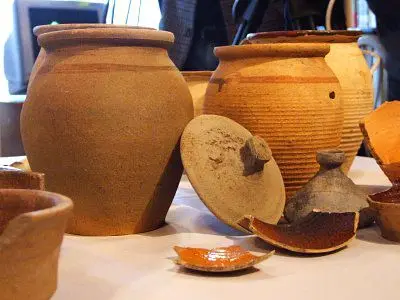
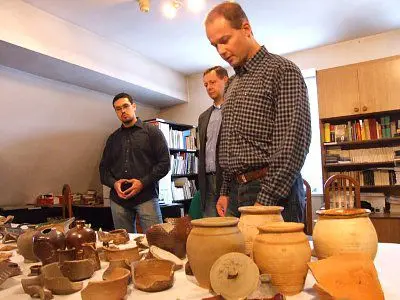
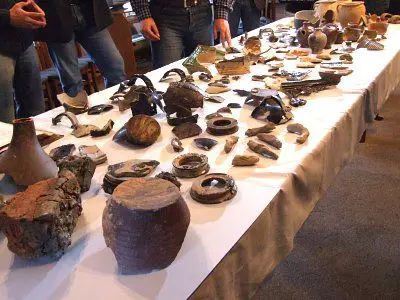
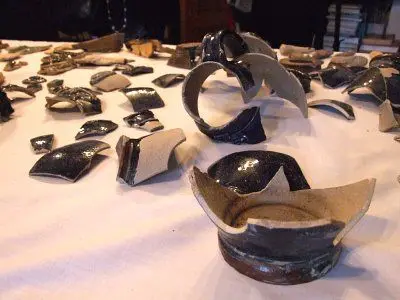
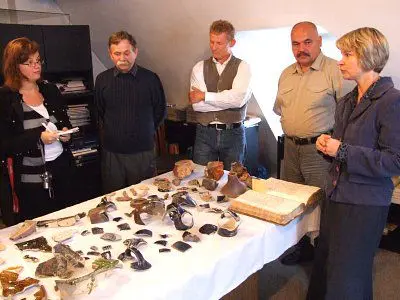
Jugs, bowls, plates, coasters and even richly decorated stove tiles – these are the results of archaeological research recently conducted in Bolesławiec on Piaskowa Street. The sensational discovery is expected to make waves in the academic community and beyond. More than 9,000 ceramic fragments were found in total. At a specially organised conference, media representatives were shown only a small, particularly interesting part of the excavations.

Only a small number of the vessels can be reconstructed. The overwhelming majority are damaged fragments. Archaeologists discovered a disposal pit belonging to one of Bolesławiec’s oldest potteries. The finds are a joint success for researchers from the Institute of Archaeology in Wrocław, members of the Bolesławiec Association of Collectors and Enthusiasts of the City’s History, and employees of the Museum of Ceramics.
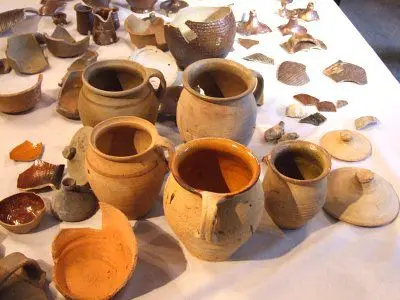
“This is a complete breakthrough when it comes to ceramic research. I am also pleased that the boundary of our knowledge about the oldest objects is being pushed back by a hundred years, or perhaps even more,” says Anna Bober-Tubaj, director of the Museum of Ceramics. “Until now, we assumed that some of the vessels were associated with various centres in Germany. No one linked them with Bolesławiec, which in specialist literature was regarded as a rather provincial centre,” she adds.
Bolesławiec – a ceramic powerhouse
Thanks to the breakthrough discovery, the opinion held by ceramic experts may change dramatically. First, however, Museum employees face the painstaking work of cataloguing the collection and conducting a series of studies. If the preliminary conclusions are confirmed, Bolesławiec may emerge from the shadow of centres so important to ceramics as those in Lusatia and Saxony. “It turns out that we were not a provincial centre at all, but a genuinely excellent artistic centre. People experimented here with form, decoration, glaze and colour,” points out Anna Bober-Tubaj. – “Who knows, perhaps it was others who learned from us.”
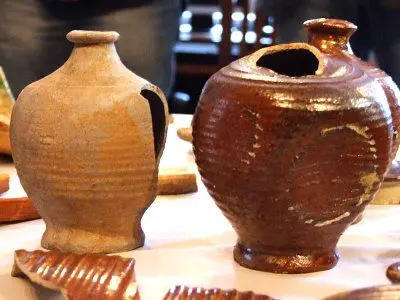
Much points to this being the case. Some of the vessels represent the so-called courtly ceramics tradition—ceramics that found their way onto the tables of the wealthy. The chronicles contain an entry from 1612 stating that the then mayor of Bolesławiec, setting out on a journey to Prague, took a “blue vessel” with him. Another record says that a stoneware service was prepared for King Frederick I himself. “The very fact that these vessels reached royal courts clearly demonstrates their quality,” emphasises the Museum’s director. Meanwhile, Robert Szwed, an archaeologist from Wrocław, admits that he had never before discovered a vessel bearing cross-shaped stamps. The researcher did not hesitate to use the term “Bolesławiec type”.
A new era in the history of ceramic research
“I hope this will provide an impetus for cooperation with major academic centres and archaeological institutes in Germany and Austria, and above all with centres in Lower Silesia,” concludes Anna Bober-Tubaj. Unfortunately, the great enthusiast of Bolesławiec ceramics, Prof. Konrad Spindler, did not live to see such a momentous discovery.
(GA report, photos by MZ)