
Before World War II, many local orchestras and bands operated in Lower Silesia. Lower Silesia is also the birthplace of outstanding composers—musicians of the highest calibre.
Focusing on Nowogrodziec today, it is worth mentioning Józef Ignacy Schnabel, a composer well known in the region. For several years, his music and work have been the central theme of the International Music Festival “Muzyka u J.I. Schnabla”. Schnabel’s compositions, unearthed after years of cultural oblivion, are once again becoming fashionable and worthy of attention. The forgotten master from Silesia is returning in his former splendour.
Schnabel is now a fairly well-known figure. However, Nowogrodziec can also boast a composer of an even greater stature, with an international reputation. This musician is Paul Hindemith, one of the principal pioneers of modernism in music. The greatest masters of this movement include, among others, Igor Stravinsky, Witold Lutosławski and Hindemith himself.
The neoclassical trend is a form of contemporary, avant-garde music. Its main premise is a return to the roots of Romanticism while using modern musical techniques. This genre of music is rather difficult to take in. Goebbels himself described Hindemith’s music as total noise, worthless. In the 1930s, such modern forms clashed with the simplicity of National Socialism.
Paul Hindemith was not born in Nowogrodziec. However, he conducted very detailed research into his family origins. It turned out that his ancestors on his father’s side lived in the region of Lower Silesia, between Lubań and Jawor. Nowogrodziec, formerly known as Namburg am Quies, also appears in the history of his ancestors.
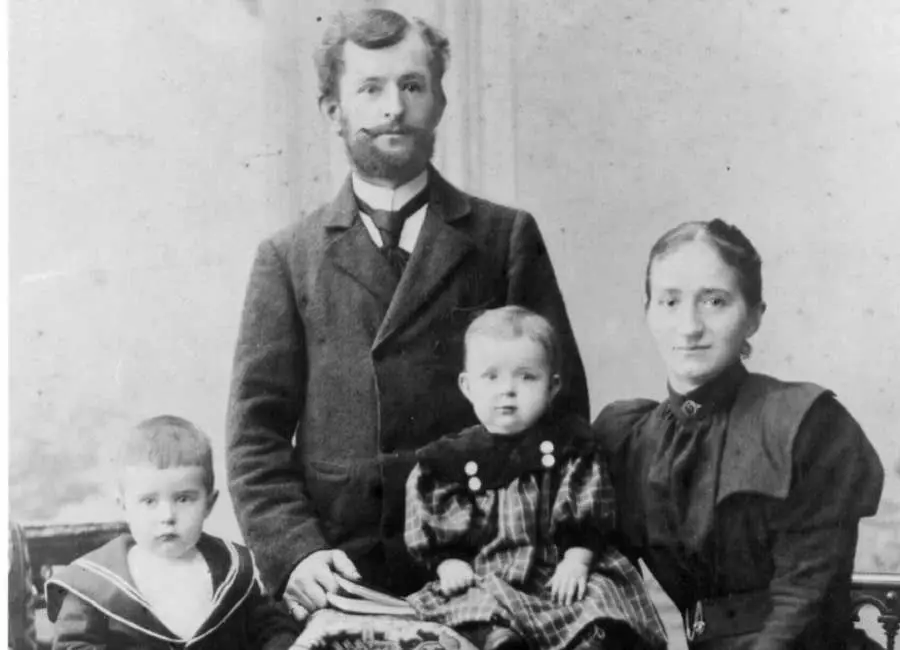
Paul Hindemith’s father, Robert Rudolf Emil Hindemith, was born in Nowogrodziec on 15 May 1870. His parents were Carl Hindemith and Marie Franziska Monica Seeliger. At that time, the Hindemith family belonged to the town’s affluent middle class.
Paul Hindemith was born on 15 November 1895 in Hanau am Main. His childhood was not particularly happy. His father raised his children very strictly. Nevertheless, Paul spent three happy years of childhood (1899–1902) with his grandparents in Nowogrodziec. His grandfather held the office of mayor [zob. www.hindemith.info/en/life-work/, oficjalna strona Fundacji Hindemitha].
Paul began his education at a school in Mühlheim. It was also there that he began learning to play the violin. At the age of 13, he began studying at the conservatory in Frankfurt. Initially, he continued learning the violin, and from 1912 he also studied the principles of composition, followed later by conducting. After his father was killed in the war in 1915, he had to support his family financially. He therefore began working as a violinist in a theatre orchestra in Frankfurt. In summer, he played at health resorts.
In the penultimate year of World War I, he was drafted into the army. This did not interrupt or even disrupt his career. As it turned out, his commanding officer was a great music lover. Hindemith was provided with the conditions to play and compose. While serving in the army, he wrote the piece “String Quartet Op. 10”. The composition was performed publicly at a concert in Frankfurt in 1919.
In Frankfurt, he learned, studied and worked, and also met his wife, Joahnnna Gertrud Rottenberg. Joahnna was the daughter of the conductor of the Frankfurt opera. They were united by great love and a shared passion for music. They often played music together.
The second half of the 1920s and the entire 1930s brought tremendous growth in Paul Hindemith’s career. He collaborated with the finest composers and conductors. He undertook a major project: writing “Konzertmusik” for strings and brass instruments on commission from the Boston Symphony Orchestra.
Unfortunately, from 1933 onwards, when the Nazis came to power in Germany, it became increasingly difficult for Paul to work. His works were banned from the radio. The atmosphere surrounding him became unbearable, affecting his well-being. He increasingly considered emigration. At the end of the 1930s, he visited the United States three times.
It was there that he emigrated in 1940. He began teaching at Yale University. In 1946, he received American citizenship.
His time in the United States undoubtedly marked a further development in his international career. He was already a composer, educator and music theorist known throughout the world.
After the war, in 1949, he was offered a position at the University of Zurich. Initially, he divided his academic duties between Zurich and Yale. Over time, however, this became burdensome. At the beginning of the 1950s, he moved permanently to Blonay, Switzerland. In 1955, he was already teaching only occasionally as an emeritus professor.
Paul Hindemith died on 28 December 1963 in a hospital in Frankfurt am Main.
His contribution to the development of contemporary music was immense. He composed a great many works, including orchestral pieces—concertos and symphonies—as well as sonatas for various instruments with piano.
Hindemith is a figure perfectly well known in the musical world. Although he never lived here permanently, he spent a happy childhood with his grandparents in Nowogrodziec.
After years of oblivion and neglect, Schnabel is returning to the region’s cultural life. Hindemith’s name, by contrast, has never been associated with the tiny Silesian town. If these two figures can be compared, one thing must be remembered: the composers created very different kinds of music. Schnabel wrote primarily religious works. Hindemith was a creator of avant-garde music and a figure better known internationally and, of course, in Germany. He was honoured by the German post office—his likeness appeared on postage stamps.
J.I. Schnabel, on the other hand, was a Silesian composer. During his lifetime and while he was creating, he was well known throughout Silesia and in Wrocław, where he worked and lived. He was also buried there. Until the 19th century, Schnabel’s works were frequently mentioned in the finest German music journals. Later, however, his name was forgotten. It was rediscovered at the beginning of the new millennium.
Both Schanbel and Hindemith have found their place in the history of Nowogrodziec and Lower Silesia. But it was the latter’s work that gained international recognition.
Paweł Skiersinis

The author is a blogger and a history enthusiast, particularly interested in the history of Lower Silesia and Poland. Why Lower Silesia? As he says himself: “Why not? The most interesting history is the history around us, concerning us and our ancestors.”
He adds: “I try to present history from a different perspective, in an engaging way—not in the typically textbook style, full of dry dates and facts. The articles I present concern facts that cannot be found in textbooks and well-known publications. The history of Lower Silesia is undoubtedly interesting and fascinating, so it is worth devoting at least a brief moment to it from time to time.”