
The circumstances of his death remain highly controversial to this day. The discussion on the subject is very lively. Several authors, historians and local history researchers have already expressed their views. The residents of Bolesławiec also have their own opinions on the matter. Recently, I became interested in a text by Sebastian Zielonka entitled “Former Bolesławiec: Bolesława Kubika Street” (Istotne.pl). A discussion broke out beneath it. Some facts that do not correspond to the truth began to be pointed out. One internet user wrote: “And ignorance emerged […] along with the repetition of nonsense. Kubik and the others did not die from a mine; it was an unexploded ordnance [...]”. Another commenter stated: “But the real nonsense […] is the claim that a German underground movement operated in Bolesławiec and ‘in this area’!”
So what exactly happened? There are many inaccuracies. To answer the basic questions, we must first focus on the moment of the accident—if it really was an accident—and Kubik’s death. We must also confront the facts: did a German underground movement exist, and in what form? Only then will a fuller picture emerge for further discussion.
One of the first texts to refute the conspiracy theory is Dominik Broniszewski’s article entitled “How Bolesławiec History Is Made” (bobrzanie.pl). The author points out that there is no evidence to claim that the mayor’s tragic death was the result of a conspiracy. He also points to the repetition of falsehoods, including by Wikipedia. I once came across such a conspiratorial reference on Wikipedia myself, but it was later changed and in no way mentions an assassination.
Bernard Łętowski (“Accident or Assassination?” in bolesławiec.naszemiasto.pl) and Zdzisław Abramowicz, mentioned in that text, also addressed the subject. Both authors consider whether this was actually an organized operation by the post-Hitler underground or simply a tragic accident. Z. Abramowicz argues that nobody could have expected the new city administration to work during the harvest in one of the former farms. Moreover, Germans themselves also took part in the work, and Freies Deutschland (hereafter: FD) would not have risked the deaths of its own compatriots. What is more, the unequivocal blame placed on FD was also an effect of communist-era propaganda. According to Z. Abramowicz, Bolesław Kubik was seriously wounded as a result of the explosion of an anti-personnel mine or other unexploded ordnance.
This assumption is indeed rational; nevertheless, it is best to consult the sources and form one’s own opinion. One of the basic historical sources is the report kept at the Lubań branch of the State Archives in Wrocław. Here is the text of the report:
Report
testimony of eyewitnesses to the tragic accident resulting in the deaths of the late citizens Józef Jasztal, Bolesław Kubik and others as a result of the explosion of a mine on 21 July of this year in the village of Tylinów (Tillendorf) near Bolesławiec.Witness: Włodzimierz Jamski, born on 25 September 1921 (the IX was corrected by hand), testifies:
On 21 July of this year, a harvest operation was organized on the initiative of the District Office, in which officials and the local German population took part. At 9:30 a.m., at the municipal farm in Tylinów (Tillendorf), while sheaves for binding bundles were being carried, someone stepped on a concealed mine, as a result of whose explosion four people were killed. Jasztal and Kubik died in hospital as a result of their severe injuries.
[…] Bolesławiec, 29 October 1945.”
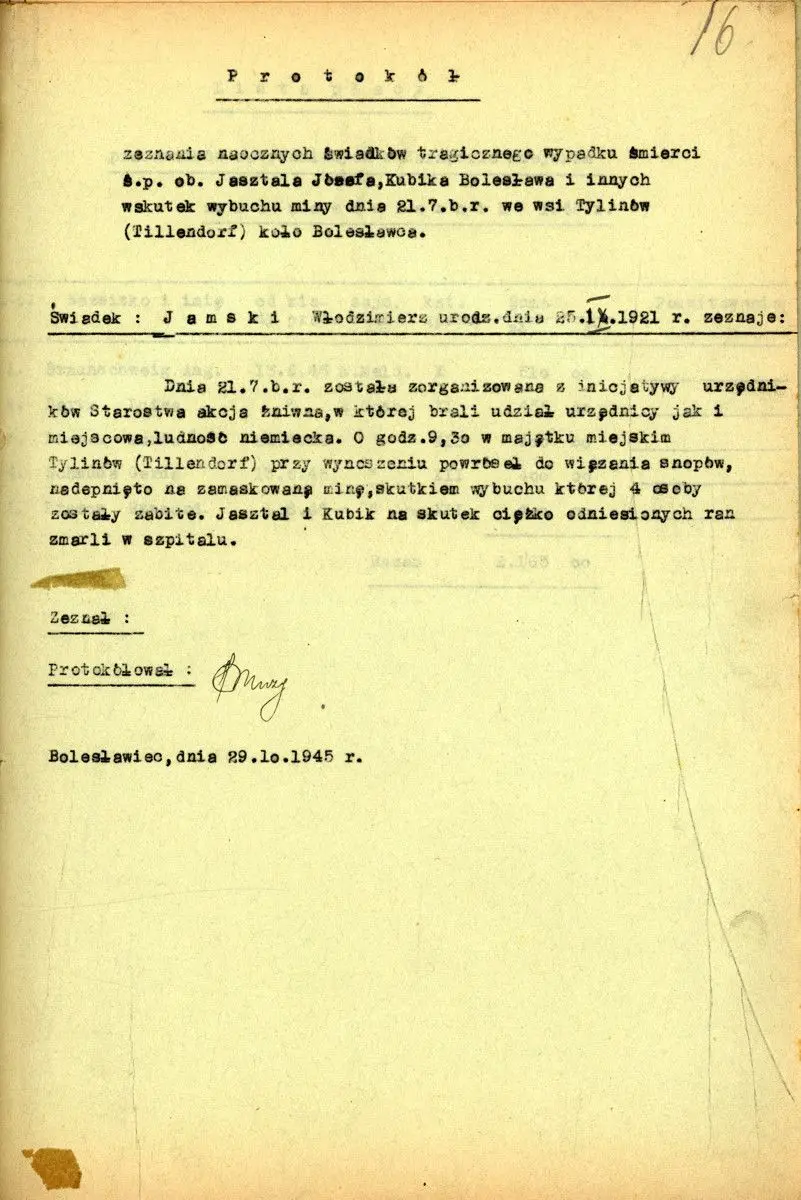
Jamski’s report clearly indicates that the cause of the injuries and subsequent death was stepping on a mine. This closes the speculation about an unexploded ordnance explosion. In black and white, the eyewitness identifies a mine as the cause.
Another piece of source evidence is the death record, which confirms that Bolesław Kubik, born on 12 July 1918 in Starachowice, died in Bolesławiec on 22 July 1945. The record was issued on 24 July 1945.
Kubik, seriously wounded in the abdomen, died the next day in hospital. He was initially buried in the cemetery on Garncarska Street. His remains were later transferred to the new cemetery on Śluzowa Street. Anna Pawełkiewicz, Władysław Orlik, Władysław Burakowski and one German died at the farm.
Bolesław Kubik was only 27 years old when he died. He came to Bolesławiec together with the government plenipotentiary for District 36. He had served as mayor for only a few weeks. In July, during the harvest, he decided to gather the crops from a 20-hectare farm with his colleagues. In this way, he wanted to replenish the grain supplies, which were desperately needed. The unfortunate accident ended tragically. We know almost for certain that the post-Hitler underground was not involved in the incident, but did German underground structures exist in Bolesławiec and its surrounding area?
Such structures certainly existed, and the Freies Deutschland (“Free Germany”) organization was one of the most active German militant groups. In Bolesławiec itself—German Bunzlau—around 3,000 Germans lived after the war, until the expulsions, and around 6,000 lived in Bolesławiec County. FD’s role as a dangerous organization intended to destabilize and destroy the Polish administration was significant. Robert Primke and Maciej Szczerepa also put forward this thesis; in their work “Werwolf: Secret Operations in Poland,” they do not minimize the organization’s role—in fact, quite the opposite. Some time ago, an interesting comment about FD appeared on my blog. The internet user wrote, among other things:
FD is a creation of communist propaganda; even the Regional Military Court in Wrocław, which tried this alleged group in 1946, established that there was no evidence attributing responsibility for the destruction of the named plants to the accused [mowa o zakładach w Czernej i Zebrzydowej (gmina Nowogrodziec), podpalonych przez organizację „Wolne Niemcy”].
However, the sources unequivocally state that FD set fire to both plants. Wiesław Dobrzycki (“In the Trap”) presents the following account:
At night, a sabotage unit set out for Czerna. Groups of several saboteurs broke into the factory. Some poured petrol over the machines, while others placed explosive charges inside them. […] When the first Polish workers arrived, explosive charges began detonating in the burning factory buildings. There could be no question of launching a rescue operation. Powerful detonations shook the walls of the factory halls. The fire consumed the machines and equipment. […] The factory burned almost completely to the ground. [R. Primke, M. Szczerepa, Werwolf. Tajne operacje w Polsce, s. 110, Kraków 2008].
The tile factory in Czerna was burned down in November 1945. A few days later, the ceramic plants in Zebrzydowa were destroyed. During their retreat after the successful operation, the militants shot two militiamen. Similar events also occurred in the Bolesławiec area. “Free Germany” carried out sabotage at a brickworks in Bolesławiec. A mine was also planted at the swimming pools; its explosion killed 38 Soviet soldiers. The mine exploded in the Bolesławiec barracks, killing several Polish soldiers. Members of FD probably also blew up a Soviet freight train. Seven Soviets died as a result.
As can be seen, FD (“Free Germany”) was not merely a product of Polish propaganda. To understand this, one must bear in mind that the Lower Silesian region, as the Recovered Territories, was a special area. There was no established Polish administration in Lower Silesia. Polish structures did not exist, and, above all, the German population constituted the overwhelming majority. This made it easier for German militants to organize and operate. They had the support of the German population. Bolesławiec and the surrounding towns were enclosed by dense forests, which facilitated underground activity.
Around 200 members of “Free Germany” were present in Bunzlau. Their leader was Artur Kühne, a well-known engineer in the city. Freed from Soviet captivity, he began work to restart the city’s electricity and water-supply networks. He was an exceptionally cunning man who used his position. He surrounded himself with German workers who were de facto also members of the sabotage organization. The engineer often traveled to Wrocław and even Berlin to obtain spare parts necessary for the networks to function. Such parts were not easy to obtain at that time. However, the trips also served as liaison missions. Kühne reported to his superiors, informing them exactly what was happening in Bolesławiec and how the Polish administration was functioning.
After about a year of activity, “Free Germany” was dismantled. Unfortunately, the investigative operations were conducted somewhat blindly. The tragic case of Father Paul Sauer is an example.
The clergyman was unjustly accused of cooperating with FD. This situation suited the Security Office very well. The priest’s alleged sabotage activity perfectly illustrated how a German priest was destroying everything Polish. Unfortunately, all denunciations against Father Sauer were falsified. These denunciations and false reports were written by Dr. Georg van Tall, a Dutchman by origin. The doctor was a UB agent and also cooperated with the Soviet services—NKVD or SMERSH. Dr. van Tall was a cynical man devoid of honor. He himself invited the priest to listen to radio broadcasts at his home. He later claimed in his reports that the priest carefully wrote down the information he heard on the radio. Based on these notes, he allegedly spread false information, including that a war between America and Russia was about to break out and that Lower Silesia would never become Polish.
Father Sauer was imprisoned and tortured in the basement of what is now the Youth Cultural Centre. He was released, but died soon after regaining his freedom as a result of the torture.
The priest’s case shows how determined the authorities were to deal with Freies Deutschland. During the investigation, 100 people involved in anti-Polish activity were arrested. Among others, engineer Kühne and his close associates were sentenced to death. German youths aged 14–16 who allegedly belonged to FD were also executed. Above, it was alleged that the military court had found no evidence of the organization’s existence or of its sabotage operations. Yet if that had been the case, many people, including minors, would not have been sentenced to death. Many FD members died in prison.
I believe that FD’s role is nevertheless underestimated today. Such extreme repercussions against Germans are one indication that German militant groups were feared desperately. The UB had to solve this problem at all costs. In many cases, it acted blindly, but it managed to capture the main leadership of “Free Germany.” The Security Office’s successful operation was used for propaganda. The evil Germans had been defeated and captured by highly effective Polish services.
Thus, the matter of Mayor Bolesław Kubik’s death may appear definitively settled. However, the question of Freies Deutschland’s activities will continue to raise doubts. Recently, I read many different comments in a discussion on the subject. Many people deny that such an organization existed. Others argue that it was communist propaganda and that these claims should be consigned to the dustbin of history. Yet if we accept that “Free Germany” was fictional, how can we explain the burning of the tile factory in Czerna and the ceramic plants in Zebrzydowa? And who blew up the bridge on the railway line to Jelenia Góra and, on the same route, the entrance to a tunnel (8 May 1945)?
These events took place, and someone must have carried them out. They are attributed to a German militant group, and this is a fact that is difficult to refute. The fact that communist propaganda turned Freies Deutschland and Werwolf into “large and dangerous organizations” is one matter; nevertheless, they did exist and genuinely posed a threat to Polish statehood in the Recovered Territories.
Paweł Skiersinis

The author is a blogger and history enthusiast, particularly interested in the history of Lower Silesia and Poland. Why Lower Silesia? As he himself says: “Why not? The most interesting history is the history around us, concerning us and our ancestors.”
And he adds: “I try to present history from a different perspective, in an interesting way, not in the typical textbook style, full of dry dates and facts. My articles concern facts that cannot be found in textbooks and well-known publications. The history of Lower Silesia is undoubtedly interesting and fascinating, so it is worth devoting at least a brief moment to it from time to time.”