
The mystery of a forgotten Bolesławiec necropolis. Today, it is a place where local residents relax and take their daily walks. Years ago, however, it served other purposes...
Life Unworthy of Life
There are countries in the world that carried out the mass extermination of their populations during wartime. Often, however, these shameful actions targeted their own citizens. This was also the case in the Third Reich, which launched the T4 programme in 1939. Its purpose was to eliminate from society people deemed useless to the state system: the sick, the mentally ill and various “deviants”. According to Hitler, these people were an unnecessary burden on German society; Nazi doctrine used the concept of LIFE UNWORTHY OF LIFE.
The first high-profile case of euthanasia justified in the name of “racial hygiene” was the Knauer case. In February 1939, a letter arrived at Adolf Hitler’s Chancellery from the father of a child named Knauer. He wrote that his son had been born disabled, with undeveloped limbs and “congenital idiocy”. He asked the Führer to grant the child an “act of mercy through death”.
Hitler ordered his personal physician to examine the German citizen’s child once again and, if all the facts were confirmed, to kill him, since such citizens constituted “life unworthy of life”. He ordered that other cases of this kind also be handled in this “humane” manner.
Knauer’s son, born on 20 February 1939 in Saxony and given the names Gerhard Herbert, was killed at a clinic in Leipzig with a morphine injection on 25 July of the same year.
This case marked the beginning of mass euthanasia in Germany. Initially, it was carried out using injections, but this method was considered “ineffective”, and work began on mass extermination using makeshift gas chambers.
Bolesławiec Hospital for the Mentally Ill
The German state did not always care so “diligently” for people who were not fully fit. German medical care was a fairly well-developed system, particularly when it came to psychiatric hospitals. There, efforts were made to treat people with various emotional problems as effectively as possible.
That is why, in the second half of the 19th century, between 1856 and 1863, a modern asylum was built in the Silesian administrative district. The hospital was located in Bolesławiec, formerly the German town of Bunzlau. Construction cost more than 320,000 thalers, less than the amount spent on building Bolesławiec’s viaduct over the Bóbr.
To this day, we can admire this enormous hospital complex, which resumed operations after the war in 1956.
The Bolesławiec hospital operated until 1945. When the Red Army approached the city, the patients were evacuated to other parts of Germany. For its time, the facility was modern and well equipped, and genuine efforts were made to treat patients and help those who could still be helped recover. Incurable patients with no prospect of improvement were kept in humane conditions.
One of the most distinguished people to have been a patient at the hospital was the German photographer and traveller Wilhelm von Blandowsky. Blandowsky was above all a passionate student of Australia’s natural history. On his initiative, the Melbourne Museum of Natural History was established, and he became its first curator.
Unfortunately, this well-known Silesian, who came from Gliwice, received psychiatric treatment in Bolesławiec and died here in 1878. A fragment of an obelisk commemorating the famous photographer and traveller still stands on the hospital grounds. An inscription in German on the stone states that he was treated at this site. His first and last names and the dates 1822–1878—the years of his life—are carved into the stone.
The hospital grounds and surrounding area contain features that particularly attract attention and may have a rather dark past.
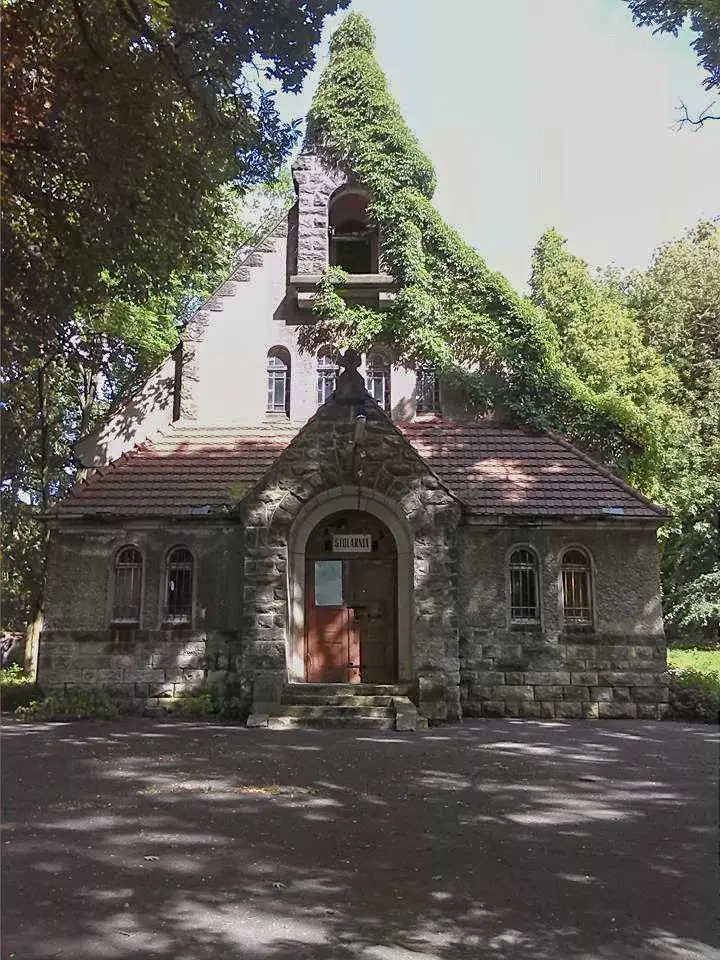
The first is a chapel, a small religious building that served patients, their families and staff before the war. Services were held there. It is possible that deceased patients were also farewelled there before being buried near the hospital complex.
The Forgotten Cemetery
To this day, a forest known as the municipal forest stands near the hospital, behind it, along Piastów and Jagiellonów Streets. It begins at the junction of these two streets and ends only at the far end of Tysiąclecia Avenue. This forest is quite unusual.
Before the war, it was a well-maintained park. Later, from around 1860, deceased patients from the nearby asylum began to be buried there. The necropolis was beautifully situated among young trees and shrubs. Even today, one can come across grave plaques in the forest near Piastów Street bearing preserved grave numbers.
During World War I, a military hospital was established on the hospital grounds. Wounded soldiers were treated there, and those who did not survive were also buried in the nearby hospital cemetery.
The period of World War II is the most mysterious. We know for certain that in most hospitals, including psychiatric hospitals, throughout the Third Reich and in the occupied Polish territories, the T4 programme was carried out, meaning that seriously ill and mentally ill patients were eliminated. Such actions were carried out, among other places, in:
- Międzyrzecz
- Akloven near Linz
- Owińska near Poznań and Fort VII in Poznań
- Warta
- Vilnius
- Rybnik.
Did mass euthanasia also take place at the Bolesławiec Provincial Silesian Hospital for the Mentally Ill? We will never know. There are no documents. We can only surmise that if the T4 programme was carried out throughout Germany, the Bolesławiec hospital was not exempt from such inhumane activity.
The fact that a shooting range was located next to the hospital cemetery, used by the police barracks located in today’s School Complex of Construction, gives considerable food for thought. It is possible that mass euthanasia was carried out there during World War II. In such a barbaric and shameful manner.
As for the cemetery, it is where hospital residents and wounded soldiers from World War I are buried. The number of graves is estimated at several thousand, which is considerable, especially since after its expansion at the end of the 19th century, the hospital could accommodate not 400 patients, as it had initially, but 1,150.
Let us note that a psychiatric hospital does not have a high mortality rate; it is not a typical hospital where ordinary procedures and operations are performed. So where did such a large number of graves in the hospital cemetery come from?
Jenny Tower
What role did the hospital shooting range play? Was it only used for training? We do not know, and it will remain a mystery. It is certain that officers who guarded concentration camps were trained in the former police barracks.
In the clearing by the forest, where Bolesławiec residents now enjoy camping, there were barracks after 1939 housing Polish female labourers. They worked in nearby warehouses, sorting clothing, underwear and uniforms belonging to wounded or deceased soldiers. Items suitable for further use were washed and used again.
This system may seem astonishing, but the German economy was already declining, and shortages of uniforms had to be made up somehow, preferably at the lowest possible cost.
The final noteworthy feature of our former park is the observation tower. It was built in 1873 at the request of Etienne Doussin in honour of his wife, Jenny. It was therefore named the Jenny Tower. It is often claimed that it was built to honour the founder’s daughter, also named Jenna. She was a well-known sculptor, but this information is false. Jenny Tower was built to honour Doussin’s wife. In the past, it was surrounded by a beautiful park—the same park where deceased patients from the nearby hospital and soldiers were also buried.
The entire complex of the Hospital for the Nervously Ill and people with neurological problems, formerly an asylum, is an extraordinary mystery. From the outset, the hospital was excellently organised; it was later expanded, a chapel was added, and a hospital cemetery was established nearby. A police shooting range was built a short distance away. The observation tower was also a magnificent structure, and people surely often visited it to admire the panorama of the city.
The forgotten former cemetery is only one part of the city’s history, particularly the history of all those who ended their lives on Bolesławiec soil. Perhaps it is worth thinking about those who rest in the forest thicket. They too deserve remembrance and respect.
Paweł Skiersinis

The author is a blogger and history enthusiast, particularly interested in the history of Lower Silesia and Poland. Why Lower Silesia? As he puts it: “Why not? The most interesting history is the history around us, concerning us and our ancestors.”
He adds: “I try to present history from a different perspective, in an engaging way—not like a typical book, full of dry dates and facts. My articles concern facts that cannot be found in textbooks or well-known publications. The history of Lower Silesia is undoubtedly interesting and fascinating, so it is worth devoting at least a brief moment to it from time to time.”