
Vandals tore off the swan’s brass neck, along with its head. Perhaps frightened away by someone, they left the detached fragment at the scene. In the morning, LPWiK employees secured it. The Municipal Office referred the matter to the police.
“They should cut off the hands of such thugs,” says the Legnica resident outraged by the vandalism, Kazimierz Kujawski. “They thoughtlessly destroy what is beautiful. I lack the words to express what I feel.”
A similar “feat” had already taken place earlier. In July 2006, vandals twisted off and stole the swan’s head. Its faithful recreation took the specialists a considerable amount of time. It was also costly. In this case too, conservators will restore the historic sculpture to its former glory.
Repairing damage caused by vandals in various parts of the city costs us all as much as approximately one hundred thousand a year. Recreational facilities in the park, rubbish bins, streetlights, building facades, playgrounds, bus stops and festive illuminations are vandalized. There is nothing sacred to these aggressive hooligans.


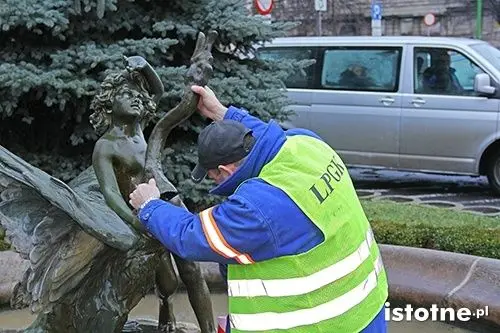
The original model of the sculpture “Boy with a Swan” was created in 1834, and it was made in Gliwice by Teodor Kalide, the most outstanding Silesian sculptor of the nineteenth century. This fountain sculpture, along with “The Vigilant Lion” and “The Sleeping Lion,” is among his best-known works. The depiction of “Boy with a Swan” became very popular in this part of Europe. During the interwar period, one of the replicas adorned Stryiskyi Park in Lviv, while another can still be admired in the garden of the palace in Wilanów. The sculpture arrived in Legnica at the end of the nineteenth century, initially at City Park and later beneath the Town Hall.
In 2010, this fountain sculpture from Legnica served as a model for the Wrocław artist Grzegorz Łagowski, who copied it for the reconstructed former garden of the Merchants’ Society, that is, today’s Kopernik Park in the vicinity of Teatralna and Podwala Streets.
Legnica City Hall/ii