
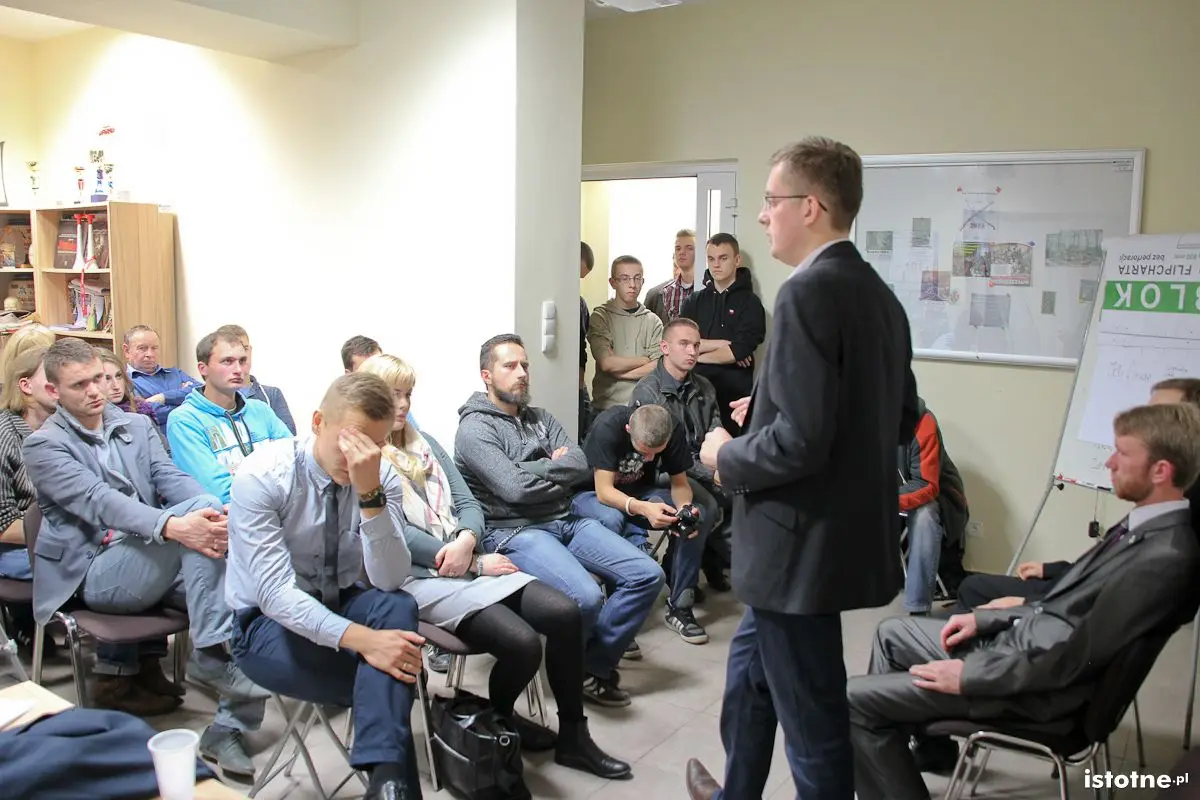
An unexpected exchange took place at a meeting of Młodzież Wszechpolska in Bolesławiec. The guest of the residents of Bolesławiec was the organization’s honorary president, Robert Winnicki.
The meeting began with the president’s more-than-hour-long presentation on the history of the national movement and the current political situation. Winnicki discussed many topics. He did not spare criticism of people with different views. He used epithets such as “leftists” and “Palikot supporters.” He spoke at length about what the country should look like, how patriotic Poles should behave and how the economy should function. At the same time, he admitted that, being almost thirty years old, his financial situation was still that of a student and that he sometimes was six months behind on rent owed to a friend.
After the presentation, unexpectedly Marcin Kołodziej, former head of the Lower Silesian branch of Młodzież Wszechpolska, asked Winnicki why he had removed Karol Kazimierczak from the decision-making council of Ruch Narodowy. Why had he suspended Piotr Rutkowski and Mikołaj Kamiński, head of Młodzież Wszechpolska in Lower Silesia? Kołodziej also asked how it had happened that the board of Młodzież Wszechpolska had “ceased to exist.” He also pressed for details about what had happened at the convention in Tenerife and what the drinking and disputes during the convention had been about. Finally, he asked what connected Winnicki with the two businessmen, Tenerowicz and Borodacz.
Robert Winnicki kept his cool. “I think it is an outrageous disgrace that, in the interests of your buddies, you put on a little show,” Winnicki replied to Kołodziej. “Rutkowski, Kazimierczak and Kamiński were members of the Lower Silesian regional leadership of the national movement. Their actions, manipulations and intrigues led the remaining members of the leadership to conclude that further cooperation was impossible,” Winnicki said. “It is obviously untrue that the Wrocław branch, under Kamiński’s leadership, was the best in Poland. There are many larger and better-managed branches, with less drinking and less of a tendency to glorify National Socialism or other distortions. They made a mess in Lower Silesia. At the request of the majority of the regional leadership, they were expelled,” Winnicki added sharply.
“As for USOPAŁ and the reports about drinking… A month after Tenerife, after the convention to which Jan Kobylański invited us, he gave me a beautiful album thanking me for exemplary participation. Three months later, an unpleasant incident occurred in Ruch Narodowy. Private correspondence from ONR leader Przemysław Holocher was leaked, showing that he had acted improperly. After leaving his position, Holocher, as an acquaintance of Kobylański, began writing all sorts of letters. And Kobylański—well, he has advanced dementia—began sending such emails about events. It is an unpleasant and embarrassing matter. I have nothing more to add on the subject. No ambulance came for me. My only offense was that I took a swim in the ocean and got sea urchine spines stuck in my feet. I had to pick them out and was late for Mass because of it. That was my entire offense,” Winnicki explained.
“As for my ties to the businessmen Artur Borodacz and Krzysztof Tenerowicz, I visited Borodacz’s home once in my life and stayed overnight after a lecture in Legnica. I have somewhat more of a connection with Tenerowicz; he is active in various national organizations. I contact him regularly in his capacity as the movement’s regional representative. Neither Borodacz nor Tenerowicz provides me with financial support,” Winnicki assured.
The president felt that Kołodziej had “soured” the atmosphere of the meeting. Marcin Kołodziej, in turn, believed that such matters should be explained publicly.
Around 40 people attended the meeting in Bolesławiec with the honorary president of Młodzież Wszechpolska.
Gallery (4)


Show remaining photos (1)
