
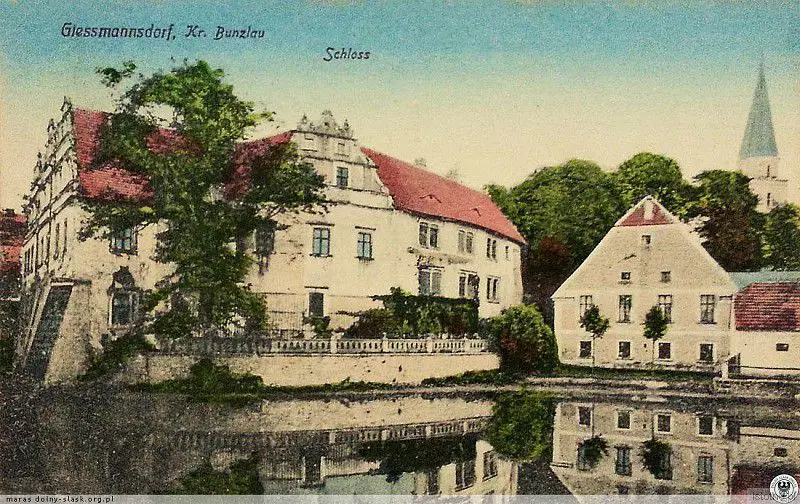
Before World War II, Gościszów was known by the German name Giessmannsdorf. It is a settlement located in Bolesławiec County, in the Nowogrodziec commune. One of the region’s architectural treasures was the beautiful and imposing palace situated in the village. It was considered one of the most beautiful Renaissance buildings.
The first stone defensive stronghold on this site was built in the 14th century. The oldest elements of the palace, remaining from the first stronghold, were the defensive wall and a residential tower incorporated into the newly built Renaissance palace.
Construction of the palace proceeded in stages and was completed by Caspar von Warnsdorf and his wife Helena in 1603. They gave the building its late Renaissance appearance. Caspar von Wansdorf was an outstanding scholar and patron of the arts. He was a frequent guest at the Prague court of Emperors Rudolf II and Matthias.
The palace was enhanced with a representative wing, a main portal and a tower topped with a cupola. It was surrounded by a moat and a park. In the 19th century, Baroque sculptures were brought to the park. At that time, the building became famous for its exclusive furnishings, including furniture and decorative elements brought from Venice, as well as its extensive collection of books. In the 1930s, renovations were planned for the palace, with completion scheduled for the 1950s.
The twists and turns of history led to the palace being burned down in 1945, along with the Protestant church dating from 1754. The church housed books and numerous old printed works evacuated from the Prussian Library in Berlin, numbering approximately 280,000 volumes. Unfortunately, the preservation work carried out in the 20th century did not protect the building from the looting of architectural details and stone used as construction material, which led to its further destruction.




Sebastian Zielonka – historian and graduate of the University of Wrocław. Specialization: archival science and conservation documentation. He is interested in the history of the region and the social life of Europeans in the 20th century. In his free time, he travels.
(information: Sebastian Zielonka)