
A presentation of a publication containing the memories of residents of the Eastern Borderlands, created as part of the “Saving from Oblivion” project carried out by the Bolesławiec Museum of Ceramics and Gimnazjum Samorządowe No. 2 named after Poles Deported to Siberia, took place on June 22 at the “Orzeł” Cultural Integration Center. The ceremony was attended, among others, by the president of the Main Board of the Society of Friends of Lviv and the South-Eastern Borderlands Andrzej Kamiński, Bolesławiec mayor Piotr Roman, deputy mayor Kornel Filipowicz, city secretary Jerzy Zieliński, Bolesławiec Commune head Andrzej Dutkowski, deputy county head Stanisław Chwojnicki, representatives of the Bolesławiec branch of the Society, and students participating in the project.
Gallery (30)


Show remaining photos (27)


Stanisława ZięcikA member of the Society, explained how it all began: “On September 17, 1945, after a four-week journey, a long freight train arrived at the Bolesławiec railway station. It carried Poles from Drohobych, who settled on Kubika Street, today’s Kutuzowa and Gdańska streets. In 1946–50, people arrived in Bolesławiec from all over the world. Re-emigrants returned from Yugoslavia; those who had survived the war in France arrived here, as did those who had survived concentration camps, those returning from Siberia and Kazakhstan, compatriots from Lithuania, Latvia and Belarus, as well as people from central Poland who were looking for a home, housing and work here. Bolesławiec is a melting pot of very different human fates called Poles.”
The activities of the Bolesławiec branch of the Society, which is celebrating its 25th anniversary this year, were discussed by the organization’s longtime president Stanisława Balawander and Mieczysław Sulikowski.
Piotr Roman spoke: “I extend my great thanks to you for what you pass on to the next generations—and what you pass on to them is true history, which in some homes is not fully presented as it should be, while in schools it varies. What you are doing is a great help in fulfilling our civic duty, the duty to cultivate what is most important to us Poles.”
Andrzej Dutkowski: “Through your activities, you have recalled the memory of the lands that lay within the borders of the Second Polish Republic. You did not allow people living in the Borderlands to be forgotten. And it is precisely the people, the Kresowians, who are the greatest value of your association.”
This is not the first publication to result from cooperation between the Museum of Ceramics and GS No. 2. Last year, the book “We Had No Childhood. Memories of Bolesławiec Siberian Deportees” was published. “Unlike the Siberian deportees, you had a wonderful childhood,” said Maria Subik, the school’s headmistress. She emphasized that Sunday’s ceremony was an extraordinary history lesson and that teachers and students, who did the lion’s share of the work, played the main role in the “Saving from Oblivion” project.
As Anna Bober-Tubaj, director of the Museum of Ceramics, noted, last year’s book had 128 pages, while this year’s has 208. “This one required considerably more work and commitment,” she added.
The ceremony also provided an opportunity to honor those who support the activities of the Society of Friends of Lviv and the South-Eastern Borderlands. The 25th-anniversary medals were awarded to Ewa Lijewska-Małachowska, director of BOK-MCC, and Anna Bober-Tubaj. The Society’s gold badge was received, among others, by Barbara Smoleńska, coordinator of the “Save the Grave of Your Great-Grandfather from Oblivion” campaign on behalf of the General and Vocational Schools Complex named after Maj. Henryk Sucharski in Bolesławiec.
The project organizers also thanked the students and teachers who actively participated in the undertaking. One of the final items on the program was an address by the head of the Bolesławiec Society Michał Wojdyła, but... emotion left him speechless.
The ceremony, hosted by Joanna Kupisz, was enhanced by performances from female students of GS No. 2.
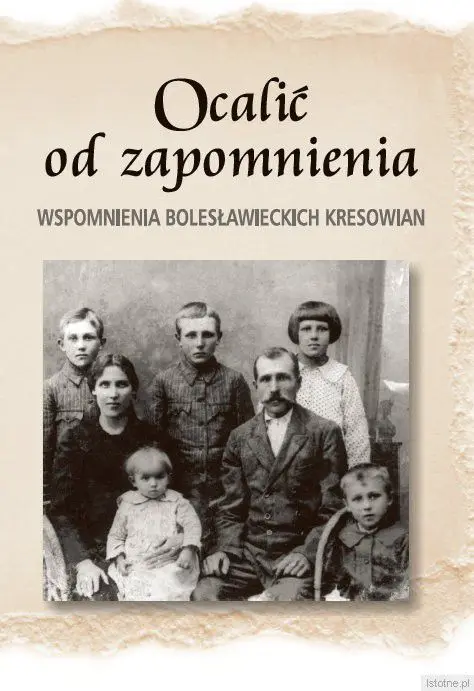
“Saving from Oblivion. Memories of Bolesławiec Kresowians” presents more than 60 biographies of people who spent their childhood in the Borderlands, along with interesting photographic material. Nineteen teachers and 99 students from primary, middle and secondary schools were involved in creating the publication; they collected materials and photographs and conducted interviews. The project received honorary patronage from mayor Piotr Roman and the Polish Army Museum in Warsaw. The book can be purchased at the Museum of Ceramics and in Bolesławiec bookstores.
(information: ii)